
Kyiv’s two worlds: Between celebration and war
Parties and cultural events have become a form of resistance to the bombardments, turning Ukraine’s capital into a place where life and death coexist side by side
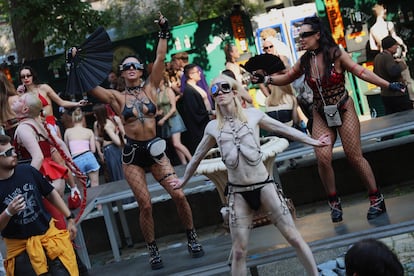

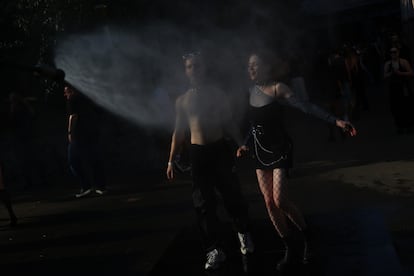
Dasha, 18, sways to the music from head to toe alongside a group of friends as Belgian DJ Matthias Geerts performs. It is Saturday and, along with several hundred other young people, they are celebrating life amid war at a summer festival that serves as a kind of therapy.
They are doing so in one of the places targeted during Russia’s latest major attack on Kyiv on June 15: the grounds of the historic Oleksandr Dovzhenko Film Studios, founded in 1927.
Dasha is a bundle of joy and fun. But, sitting for a few minutes beside the reporter, she admits that her dancing conceals the tragedy of the war: “My father died three years ago after stepping on a mine in the village of Vodyane, in the Donetsk region.”
Despite everything, life in Ukraine’s capital bubbles along with apparent normality. With the harsh winter — marked by power outages caused by the Russian offensive — now over, the resilience of Kyiv’s residents remains the chief survival tool for those who do not wear a uniform, like Dasha. Yet the city continues to embody a painful contradiction.
“After the drones and the missiles, we get up, go to work and then meet friends,” sums up Karina Romanchenko, 24. She works in one of the departments of the vast historical, cultural and religious complex that includes the Kyiv Pechersk Lavra (Monastery of the Caves), a holy site of Orthodox Christianity dating back to the 11th century and a UNESCO World Heritage Site. The complex was also struck by Russian Shahed drones in the early hours of June 15.
On the one hand, the city is full of children enjoying their summer holidays, groups of young people attending concerts, spending time in restaurants and cafés, visiting exhibitions and theaters, and gathering with their families along the banks of the Dnipro River. On the other hand, as Romanchenko notes, there are still nights and early mornings of bombardment, constant worry about relatives and friends at the front, and the impossibility of returning to a normal life.
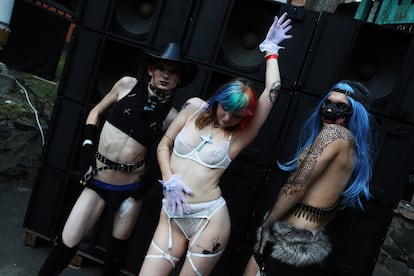
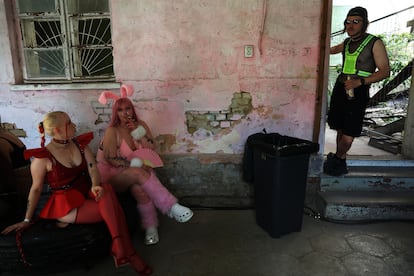
Just a hundred meters from where Dasha and her friends celebrate their youth and freedom, the remains of a completely destroyed building were still smouldering nearly two weeks after the attack. It housed Ukraine’s largest collection of film costumes — around 100,000 in total. In an indirect nod to that irretrievable loss of props and costumes, the Veselka Festival — veselka means “rainbow” in Ukrainian and is also the name of the famous New York restaurant — embraces a simple idea, as Dasha points out while admiring the eccentric outfits of many attendees: “Here everyone can be who they really are.”
The night before the June 15 attack, the studio grounds had hosted the Dirty Dog festival. The event ended at 10 p.m. because of the curfew, which remains in force between midnight and 5 a.m. Just four or five hours later, the missiles began to fall. The extensive damage — not only to the costume department — has not prevented the Veselka Festival from going ahead.
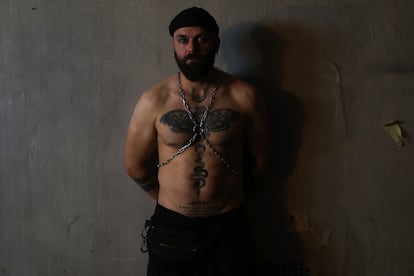
Serguei, 36, strolls through the festival shirtless, displaying his tattoos beneath a chain worn like a cross. “We are at war, but we need this as a refuge,” explains this police officer, whose duties include registering the deaths of fellow officers killed in combat.
He says he once hoped to become an actor and singer — he even hums a song by Spanish artist Alex Ubago, though he knows little about him beyond his nationality. But the 2013 Revolution of Dignity, or Maidan, pushed him to do more for his country, eventually leading him into uniform.
“We live under two worlds,” he concludes, referring to the dichotomy that envelops Kyiv.
Rapid repair
The Kyiv Pechersk Lavra — the oldest monastery in Ukraine — managed to return almost immediately to normal operations after the June 15 bombardment. The city has endured similar attacks since Moscow launched its full-scale invasion in 2022.
Shortly after firefighters extinguished the blaze, workers covered the damaged Dormition Cathedral — the building most affected — with a temporary roof made of wooden beams and plastic sheeting. Within two days, the site had reopened to visitors, although the interior of the cathedral remained closed.
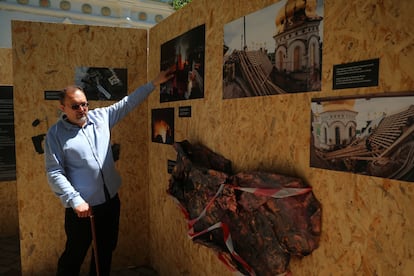
“It was a direct attack,” says historian Kostiantyn Krainii, deputy director of the complex, as he shows the damage.
Alongside the cathedral walls, a makeshift exhibition has been set up using chipboard panels to commemorate the strike. Twisted fragments of the roof lie on display, along with what are identified as parts of the Russian kamikaze drones used in the attack.
Krainii says the rapid response by firefighters prevented the cathedral’s main sections from being damaged. The gilded wooden decorations and large icons inside remain intact while workers continue repairs. Several powerful fans run constantly to reduce the high levels of humidity caused by the large amounts of water used to extinguish the fire.
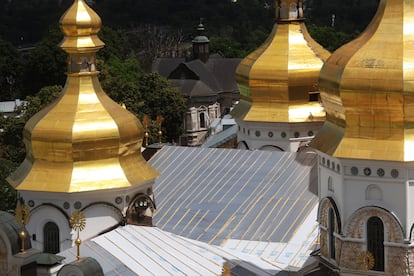
“The damage has been minimal,” the historian, who has worked at the complex for 37 years, says gratefully. “If the fire had reached inside here, this would have burned within seconds, and it would have been a true disaster,” he adds, recalling the dozens of neighbors and emergency workers who saved relics and everything they could in the first minutes after the impact.
In the gardens, a group of children wearing colored identification bibs tour the facilities on a field trip. One of the few tourists is Marion, a 39-year-old Frenchwoman who has traveled to the Ukrainian capital for the first time to spend several days with a friend. She says she is not afraid because she works for a humanitarian agency in a conflict zone, though she prefers not to give more details. She does note, however, that “despite the cost of the war, life goes on” in Kyiv.
Next to the walls of the Kyiv Pechersk Lavra stands the much smaller Monastery of St Theodosius, where Father Makarios, 64, once again welcomes the EL PAÍS correspondent 51 months after their previous meeting. Back then, he spoke of attending courses to prepare for the Russian invasion.
Only a few metres from the entrance arch of St Theodosius, a large building still bears the marks of a second drone strike targeting the monastery.
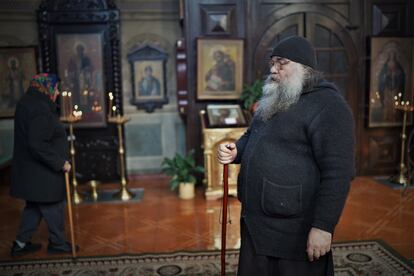
Despite everything, the clergyman, wearing a black cassock and a thick beard, downplays the attack and shows the same conviction and faith as in March 2022. “They bomb loudly and often, and sometimes we can’t sleep for days. But God loves us, protects us and will not allow anything to happen to us. Ukraine will win!” he says firmly, leaning as always on a walking stick.
Occupied areas
Karina Romanchenko gazes at the repaired roof of the Dormition Cathedral from the neighboring bell tower, the highest structure in the complex and one of the best vantage points in the city.
She comes from the outskirts of Melitopol, in the southern region of Zaporizhzhia, which has been under Russian occupation since 2022. Ukrainian forces have recently intensified attacks in the area, seeking to disrupt Russian supply lines to neighboring Crimea.
Romanchenko, who has lived in Kyiv since 2019, tries to speak with her mother every day, although that is not always possible. She says Melitopol suffers frequent power outages. But she is convinced that “crying in the corners all day won’t solve anything.” Although “it isn’t easy, we’ve gotten used to it,” the young woman concludes.
Sign up for our weekly newsletter to get more English-language news coverage from EL PAÍS USA Edition









































