
Specter of social upheaval threatens final stretch of Colombia’s presidential race: ‘Everything will start the day that man is installed’
Warnings of protests and violence are on the rise ahead of the possible victory of far right candidate Abelardo de la Espriella
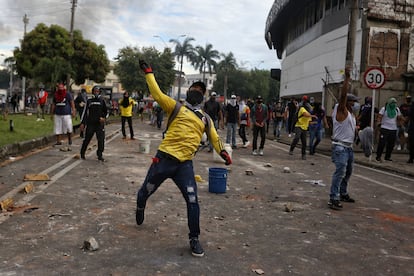

The countdown has been underway for a few weeks. On June 21, depending on who wins the election, people are preparing a response in the streets. From a Bogotá prison, one of those jailed for the social uprising of 2021 reaffirmed to EL PAÍS a message that has been circulating for days: “If the right wins power, the people will take to the streets.” He says it is not speculation. “We spent more than 50 years under a fascist, genocidal right. People will not put up with that.”
The warning comes from Sergio Pastor, alias “19,” one of the young people who in 2021 formed the Primera Línea, the protesters who organized to lead the marches and confront police repression to protect those behind them. The government of Iván Duque treated them as criminals. Pastor is serving a sentence of 12 years and 9 months for torture and conspiracy to commit a crime, charges he denies.
From prison, he says those social movements are already preparing. If Abelardo de la Espriella — the candidate who calls them “terrorists” — wins on Sunday, they will return to the streets from the day the result is announced. “A possible social uprising is not a distant reality. It is the picture being painted across Latin America today. Let’s talk about what is happening in Argentina, Chile, Bolivia, Ecuador…” The reaction, he says, will be immediate: “Everything will start the day that man is installed.”
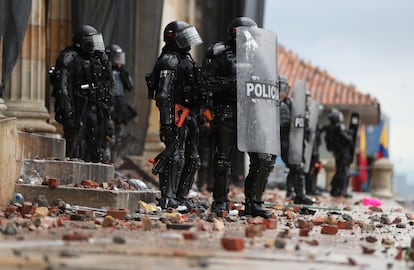
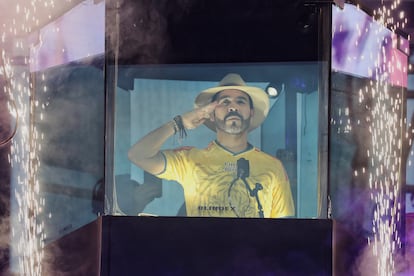
On May 31, Colombia split in two. De la Espriella, the far-right lawyer who turned the campaign into a spectacle and presented himself as the outsider who would break with everything, unexpectedly won the first round with 43.7% of the vote. Iván Cepeda, the left-wing senator who represents the continuity of Gustavo Petro’s project, trailed by less than three percentage points, with 40.9%. That same night, before the count was finished, Petro questioned the results without evidence and De la Espriella called on the army to activate constitutional mechanisms if the president “intended to disregard the will of the people.” Democracy would be enforced, he threatened, “by reason or by force.” Colombia headed into the runoff with tensions spiking.
Intelligence services have begun mobilizing. So have private security teams from various companies, which this week held protocol meetings to protect their workers who will be on the streets on June 21. “Alerts are activated for possible mobilizations, especially in the southwest: Cali, Popayán, Cauca,” was heard at one of those meetings.
But not all scenarios are the same. For Control Risks, the consultancy that monitors political stability in the region, two moments should be distinguished. The first would be immediate: a street reaction on June 21 itself, in the event of a De la Espriella victory, with some level of vandalism but “nothing on a large scale.” According to Oliver Wack, the firm’s general manager for the Andean region, that initial response would be partly spontaneous but “largely coordinated from the campaign and from the government,” and likely accompanied by statements from President Petro or Cepeda himself questioning the results.
The second scenario is slower. If De la Espriella takes power and implements cuts to public spending, facilitates oil exploitation by speeding up prior consultation processes, or rolls back social rights, Wack believes a “much more organic” discontent could emerge, comparable to those of 2019 and 2021. “We could see it in the medium term,” he warns. The difference, in his reading, is crucial: one thing is the political, violent protest the following day, and quite another is an uprising that begins to build from the grassroots.
Defense Minister Pedro Sánchez also warned this week about social tension that could put the streets at risk. “Regarding possible violent disturbances, we have intelligence information that it could occur, and it is one of the most important threats we face. After disinformation comes the violent action by some people,” he said. These alerts are focused on 38 municipalities, although the main attention is concentrated in the country’s four largest cities: Bogotá, Medellín, Cali, and Barranquilla. “We are deploying all capabilities,” he added.
In a campaign that has been escalating for weeks, public figures have raised the temperature. The most recent was Gustavo Bolívar, a former senator campaigning for Cepeda. “Business owners are put on notice, the owners of this country, the economic powers, are put on notice, that if the violent, far-right alternative prevails, this country will burn,” he said on Tuesday. “People will not let them gut it with their arms crossed,” he added, referring to De la Espriella’s threat to “gut” the left.
Carlos Carrillo, the former director of the National Unit for Disaster Risk Management who resigned to join Cepeda’s campaign, spoke along the same lines. This week, on the program Desnúdate con Eva, Carrillo issued a warning the right interpreted as an ultimatum: if De la Espriella wins, Colombia will burn. “Undoubtedly, the country will catch fire,” he said. When Spanish journalist Eva Rey asked whether calm should be urged in case of defeat, Carrillo was blunt: “That doesn’t work like that.” He added: “If fascism wins, violence will intensify. They will gouge out protesters’ eyes again. We will return to a past where protest is criminalized and popular youth are pursued.”
From prison, Pastor insists it will not take long to feel the result in the streets. On the side of his face, between temple and eyebrow, he has a tattoo. He got it at a Primera Línea camp while the police were attacking them. In Gothic letters it reads: resistencia.
Sign up for our weekly newsletter to get more English-language news coverage from EL PAÍS USA Edition









































