
Noboa’s emblematic jail hit with wave of torture and death allegations
Created using Bukele’s maximum-security model, the new Ecuadorian prison has been criticized for negligence, outbreaks of fatal diseases, and government secrecy that has left families in legal limbo
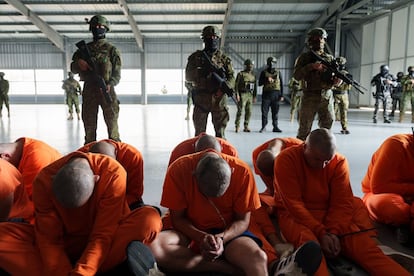
The last time Verónica saw her son was December 16, 2025. She had been working at the small food stand with which she supports her family — an improvised oven and some plastic tables and chairs alongside the highway that connects Quinindé with Esmeraldas on the northern coast of Ecuador. Starting early in the day, she had watched for the military convoy transferring her son to the maximum-security prison Encuentro, which was built in the middle of a forest, some 280 miles from her home. “It was as if God wanted us to see each other, because the vehicle stopped for a moment,” she remembers.
For a few seconds, Verónica managed to make out her 38-year-old son’s face, pressed against the glass of the window. “He looked at me and motioned for me to bless him. He couldn’t raise his hands because they were chained. I blessed him and then my daughter and I started to cry.” In her memory, that scene has become the worst day of her life. Ever since, she’s had no news of him.
For family members of prisoners, the name of Encuentro has become associated with fear. Inaugurated by the Daniel Noboa administration as an emblem of its war against organized crime, the prison was created following the maximum-security model that President Nayib Bukele turned into a symbol of his punitive policy in El Salvador. Part of the team that built Bukele’s Terrorism Confinement Center (CECOT) even advised on the construction of Encuentro.
The Ecuadorian penitentiary facility has been the subject of allegations of starvation, abuse and complaints connected to an outbreak of tuberculosis and a lack of medical attention. Fear as to prisoners’ safety has only increased due to the hermeticism with which authorities manage information about those behind its walls. Families go weeks or months without news of their relatives and on occasion, are only informed when they are transferred to another prison, or of their death.
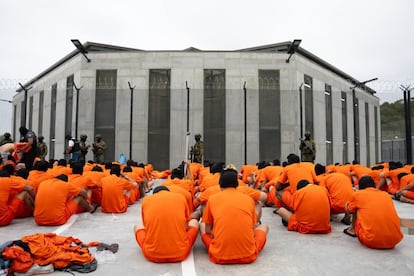
Three inmates died in May at the prison. Two of their deaths were attributed to tuberculosis, the other to pancreatitis. “No one dies from pancreatitis from one day to the next,” says Ana Morales, spokesperson for the Committee of Families for a Dignified Life In and Out of Prisons (COFAVID). “If someone dies from that cause, what happened was a lack of timely medical attention.”
A lack of information about those who are sent to Encuentro has also led to questions. The last person who died in the prison was a trans woman who had no criminal sentence in Ecuador, according to a complaint lodged by the Silueta X Association. “The United Nations’ Bangkok Rules are binding in Ecuador. A trans woman incarcerated in a maximum-security prison, with no clear sentence and with no documented gender-based protocol was not invisible, she was the responsibility of the state,” says Zackary Elías, deputy director of the organization, who is demanding an investigation under inter-American standards.
Most of what is known about the conditions inside Encuentro has come from the testimonies of prisoners who have been transferred to other facilities, and from information leaked by penitentiary officials. One of those leaks were photographs of the transfer of 11 out of 35 inmates diagnosed with tuberculosis to the Guayaquil regional prison, according to documentation provided by COFAVID.
The photos were taken during a nighttime transfer. Under spotlights, a line of prisoners moves slowly forward in the darkness. They are extremely thin, just skin and bones. Some can barely stand on their feet, and look for help from the equally fragile bodies walking next to them. One needs to be supported underneath both arms to stay upright. Another seems unable to lift his head.
There has been no comment on the images from the government. After a few days, Minister Nataly Morillo, in an interview with the media outlet Visionarias, confirmed that the transfer had taken place. “Every person deprived of their liberty in the Encuentro prison is in their space, their environment, they have the areas they need, there is no epidemic in the penitentiary system,” she said.
State negligence and torture
The allegations concerning Encuentro have arisen amid a silent transformation of the Ecuadorian prison crisis. An investigation by Tierra de Nadie and Connectas led by journalist Karol Noroña found that in 2025 there were a record 1,220 inmate deaths, or more than three a day, one every seven hours.
In contrast to the years of gang massacres, many of these deaths were documented by the state as “natural” or stemming from “indeterminate” causes. The finding points to a shift in the prison crisis: inmates are no longer dying from organized crime violence alone. Now, they also die from illness, negligence and a lack of medical attention.
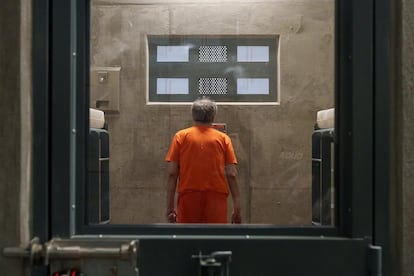
Accusations also point to alleged systematic abuse. Morales says that former inmates have spoken of daily punishments and degrading conditions. “Torture is continuous. There is a select group who is tortured on a daily basis,” she says. Among these alleged practices are inmates being woken up at dawn and submitted to physical and psychological aggressions. “They wake you up at three in the morning, throw water on you and put a gas mask on you. This has caused heart attacks,” she says. Morales says that inmates have even left the prison with permanent injuries. “We have one person who came out disabled after being struck on the spine with a club,” she adds.
Several testimonies describe extreme physical deterioration that fits with the photographs that were made public. “There is dengue, malaria, tuberculosis, malnutrition, dehydration,” Morales says. According to her, a lack of water is one of the primary problems in the penitentiary facility. “There’s no water there. They give you a tiny amount of water and that water is very contaminated. It comes out completely black, like chocolate, and that is the water they drink,” she says.
The availability of basic services was on the list of criticisms and warnings received when it was announced that the prison would be built in the middle of a protected forest that belongs to an ancestral Indigenous community. Towns nearby the prison have always suffered from a lack of potable water. Residents rely on tanker trucks and the river for their water supply, and the latter has now been polluted by the prison’s runoff.
Isolation and military control
Isolation is one of the characteristics that distinguishes Encuentro from other Ecuadorian prisons. Members of the military monitor and restrict travel down the road that connects nearby towns. Only inhabitants who have proven they are from the area are permitted to pass a military checkpoint. Families are not allowed to approach the facility’s perimeter nor request information on inmates. In this prison, inmates have no right to visits.
One of the few exceptions to this rule is the mayor of Guayaquil, Aquiles Álvarez, who has been incarcerated in Encuentro since February, despite never having been convicted of a crime. After outcry was raised by his family and defense team, authorities authorized a weekly video call under the supervision of penitentiary officials. After nearly four months of imprisonment, those close to him say he has lost more than 50 pounds.
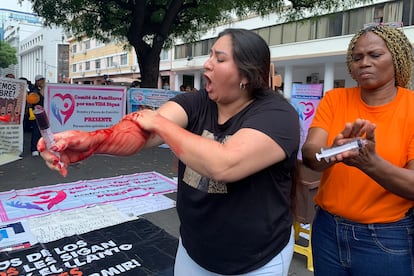
The government, which denies the existence of any prison crisis or tuberculosis outbreak, justified the mayor’s drastic physical deterioration by saying that he was “watching what he eats,” according to Minister of the Interior John Reimberg. Later, those statements were qualified: officials said the mayor was carrying out a legal strategy. “Since Aquiles’ defense has not managed to get him out of jail, what do they tell him? Don’t eat. And he doesn’t want to eat,” said Reimberg.
Former vice president Jorge Glas, who was sentenced on charges of corruption and was one of the first prisoners to be transferred to the facility that authorities have dedicated to the fight against terrorism, has made similar allegations. Glas says he has not received adequate food and is suffering systematic torture.
Vivian Idrovo, coordinator of the Alliance for Human Rights Ecuador, says that prisoners have been a population that the state is willing to sacrifice. “They commit serious human rights violations to justify these cruel measures,” she says. In her eyes, the militarization of the penitentiary system has not managed to contain the advance of organized crime. “They focus on this population to cover up the inaction of the state in the fight against criminal economies, like for example, money laundering,” she says. “It is a dehumanization. The cruelty is exhibited, as if cruelty were an antidote to organized crime.”
Sign up for our weekly newsletter to get more English-language news coverage from EL PAÍS USA Edition









































