
Maradona’s massive heart is central to the trial over his death
Five and a half years have passed since the soccer icon’s demise and still there’s no court ruling on whether it was inevitable

The Argentine justice system makes no exceptions for popular heroes regarding the pace at which it moves. Five and a half years after Diego Armando Maradona’s death, Argentines know that his heart was monstrously large when it stopped beating, weighing 503 grams, almost twice that of an ordinary human. They know that the footballer died of lung edema resulting from acute heart failure. They know that three weeks earlier he had been operated on for a chronic subdural hematoma. They know that he was later transferred to a house to continue his recovery and never left. But there is still one question to be answered: whether his death on November 25, 2020, could have been avoided.
Eight members of the medical team that treated Maradona have been in the dock since April for a second time. They are charged with alleged “homicide with eventual intent”; in other words, the Prosecutor’s Office maintains that they acted deficiently and recklessly, despite knowing Maradona’s health was hanging by a thread. The defense seeks to convince the court otherwise, that the patient had serious pre-existing health problems and that his heart, affected by dilated cardiomyopathy — a disease that weakens the heart muscle and enlarges the chambers — deteriorated suddenly. The ruling, which was scheduled for July, is now postponed until August at the earliest.
The fragility of Maradona’s health was an open secret. Etched on the collective memory was the fact that, at the end of October, when he had just turned 60, he appeared fleetingly in the stadium as the coach of Gimnasia y Esgrima de La Plata almost unable to walk. He dragged his legs and gasped for breath while the crowd chanted, “Diego, Diego, olé, olé, olé, Diego, Diego, Diego.”
The profane, boastful and deceitful idol that was Maradona was a figure mired in scandals that persisted beyond the grave. But few could trump the annulment of the first trial, in May of last year, which caused great embarrassment to the judiciary. Two months of hearings had already been held with accounts from 44 witnesses when it was discovered that one of the judges, Julieta Makintach, was involved in the filming of a secret documentary about the trial.
Images of the trailer for her documentary, Justicia Divina (Divine Justice), went viral. A tsunami of popular indignation was directed against Makintach. The judge was booed in the streets and slammed on social media. Dismissed from her job, she now faces a million-dollar lawsuit filed by Maradona’s eldest daughters, Dalma and Gianinna.
Counterattack
A new trial was ordered to begin on April 14. Since then, the Oral Criminal Court No. 7 of San Isidro, on the northern outskirts of Buenos Aires, has held hearings twice a week. None of what was heard in the first trial can be taken into account, but the feeling is that the stage is set. The prosecution and defense are both familiar with the central arguments made by many witnesses, because they have heard them before, and they have reworked their strategy accordingly. The most visible change is the main defendant, neurosurgeon Leopoldo Luque, who was in charge of supervising the team. The silence he maintained in the first trial contrasts with his current desire to testify: he has been on the stand six times in 10 hearings.
“We play dumb, what else can we do?” says a source linked to the prosecution. It is an unprecedented situation and everyone is being cautious. Nobody wants to do anything that might lead to another annulment.
The defense’s strategy is practically the only novelty. The last row of the courtroom is filled with the press and TV channels wait at the entrance of the courts in the hope of a twist in the script or eliciting some explosive statement regarding Argentina’s most famous showman.
Still, there’s the participation of the most media-friendly lawyers in Argentina and a family that everyone knows to be a source of scandal. The last occurred on May 14, when the intensive care specialist Mario Schiter had finished testifying and Luque took the stand. The neurosurgeon showed the video of the autopsy to the court without taking into account that Gianinna Maradona was present in the courtroom. Horrified, she ran out. The hearing was suspended amid fiery criticism and a request for a doctor to attend to Gianinna.
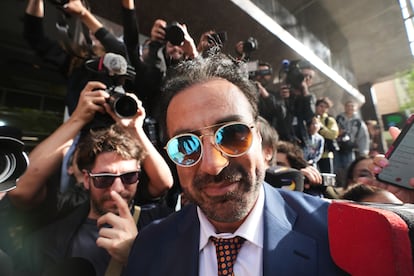
Meanwhile, a parallel trial is being held beyond the courtroom. Without waiting for the court to give its verdict, Argentines have already made up their minds. There are those who yearn to see the doctors behind bars, considering them to be murderers; others want them acquitted, believing it is impossible to know if there was medical malpractice or if Maradona simply died from a heart punished by a life of excess and addiction. Then there are those who think it’s all about money and question the motives of both the doctors and the family that has put them on trial.
Maradona’s fortune has triggered another lawsuit. His children — Dalma, Gianinna, Jana, Diego Fernando and Diego Junior — have filed a case against the last lawyer and representative of the soccer player, Matías Morla, and his sisters Rita Mabel and Claudia Norma Maradona, as well as two assistants. Morla and his associates will be put on trial for allegedly defrauding Maradona’s legitimate heirs. According to the lawsuit, the alleged fraud was carried out by a company that managed a total of 246 trademarks linked to the footballer, with multimillion-dollar revenues. The trial will begin in a few months and promises to be a further source of salacious gossip linked to the soccer legend.
Sign up for our weekly newsletter to get more English-language news coverage from EL PAÍS USA Edition









































