
The new trial over Diego Maradona’s death: Homicide, negligence, or an inevitable outcome?
After the scandalous annulment of the process initiated last year, seven health professionals are being tried in Buenos Aires for the death of the former Argentine soccer player
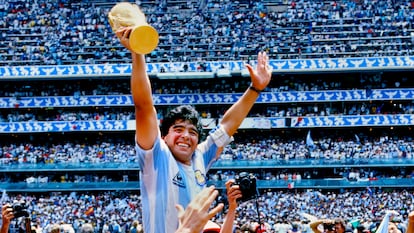

The resemblance is reminiscent of televised replays of Diego Maradona’s feats, when viewers tried to make sense of the feat they had just witnessed, now free from the dizziness and excitement that cloud the moment, the fleeting present. A public trial, which began last Tuesday, is attempting to determine whether Maradona, the Argentine football idol, died as a result of the neglect and abandonment he suffered at the hands of the healthcare professionals who were supposed to be caring for him on November 25, 2020. The new trial seems like a carbon copy of the proceedings that began a year earlier, also in the courts of San Isidro, on the outskirts of Buenos Aires. The accused and the accusers, the victim and the crime, are the same. But that’s where the similarities end. The narrative of those involved is different.
When the first trial was suspended after it was discovered that one of the judges was secretly filming the proceedings for a movie, more than 20 hearings had already taken place and over 40 witnesses had testified. Although all of that was annulled and the trial is starting anew, the defense attorneys are already familiar with the prosecution’s case and the plaintiffs’ arguments to support a charge of simple homicide with eventual intent. And they are trying to use them to their advantage. Or against the other defendants.
“All the defendants abandoned Diego Armando Maradona [1960-2020] to his fate, condemning him to death,” stated prosecutor Patricio Ferrari at the first hearing last Tuesday. According to the prosecutor, the four doctors, two nurses, and one psychologist — who face possible sentences of between eight and 25 years in prison — acted like “a band of amateurs” and, with “criminal indifference,” “did nothing to prevent Maradona’s death.” Lawyer Fernando Burlando, representing Dalma and Gianinna, two of the former Argentina national team coach’s daughters, concurred: “Diego Maradona was murdered,” he said.
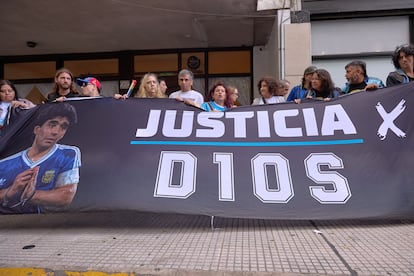
Five and a half years ago, in the midst of the Covid-19 pandemic, the former captain of the Argentina national team that won the 1986 World Cup in Mexico was in critical condition. He had undergone cranial surgery for a subdural hematoma, and it was decided that his rehabilitation would take place at home. He was transferred to a house in a gated community in Tigre, Buenos Aires province, where he died. His death was triggered by cardiac arrest and pulmonary edema, in a clinical picture that included chronic kidney disease, cirrhosis, respiratory and heart failure, neurological deterioration, and addictions, among other ailments. According to the prosecution — a view shared by the plaintiffs representing Maradona’s daughters and his last partner — the home care provided was “devoid of everything” necessary to care for the patient.
Prosecutors have named neurosurgeon Leopoldo Luque — whom they consider Maradona’s primary physician — psychiatrist Agustina Cosachov, and psychologist Carlos Díaz as the main individuals responsible for his death. They also accuse nurse Ricardo Almirón, who was in charge of monitoring Maradona’s vital signs, along with another nurse, Gisella Madrid, who will be tried separately. The other three defendants are doctors Pedro Di Spagna and Nancy Forlini, and nurse Mariano Perroni, all appointed by the healthcare companies Swiss Medical and Medidom to oversee and coordinate Maradona’s care.
According to the medical panel that reviewed the case, “Maradona began to die at least 12 hours before” the time of his death. “He presented unequivocal signs of a prolonged agonizing period,” details the report included in the file, “therefore we conclude that the patient was not properly monitored.” Based on this, prosecutor Ferrari pointed the finger at the seven healthcare professionals: “Any one of them who had thought to transfer him to a clinic,” he said, “would have saved his life.”
Trial changes
The most notable change between the protagonists of the first and second trials is in the courtroom. Judge Julieta Makintach is no longer on the bench, having been removed for attempting to film a documentary about the proceedings without the consent of the parties involved, and featuring herself as the star. The judges now presiding over the case are Alberto Gaig, Alberto Ortolani, and Pablo Rolón.
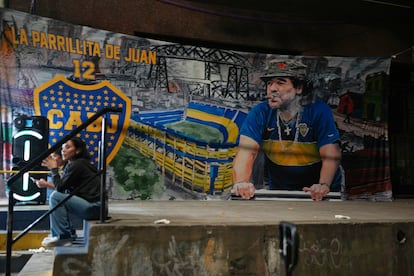
Another notable difference lies in Luque’s defense: the neurosurgeon has appointed Francisco Oneto — President Javier Milei’s lawyer and a well-known supporter of the far-right government — as his legal representative. At least in the two hearings held so far, this addition has also brought about a change in the defense strategy. Last Thursday, Luque surprisingly announced his intention to testify before the court for the first time, disrupting the planned testimonies.
“I am innocent, I deeply regret his death,” the doctor said, casting doubt on the official cause of Maradona’s death. “I am completely certain that there was no agony,” he asserted, suggesting that the death occurred unexpectedly, due to a heart attack. He then attempted to distance himself from his patient’s transfer and home care. “I was not in charge of the hospitalization,” he insisted. Luque’s case is complicated by the fact that he, along with psychiatrist Cosachov, signed Maradona’s discharge from the clinic where he had undergone surgery. There are text message exchanges included in the file where he appears to advocate for home confinement, but not at the home of Maradona’s daughters, seemingly in an effort to preserve his job and those of other associates.
The year that has passed since the charges were filed has allowed all the defense teams to refine their objections to the prosecution’s case, question the homicide charge as excessive, and maintain that the accused were simply fulfilling their duties and could not have done more. Cosachov’s lawyer, Vadim Mischanchuk, argued, for example, that if the nurses are accused of not examining Maradona and of not accurately recording the patient’s condition in their reports, as the indictment describes, then the doctors cannot be accused of acting improperly, given that they would have had erroneous information. In turn, the nurses’ representatives argued that they were only following instructions from the doctors in charge.
Attorney Diego Olmedo, Díaz’s lawyer, said that the psychologist “cannot be held responsible for Diego Maradona’s death” simply because he treated him for his addictions during the last 30 days of his life. The lawyers for Forlini, Di Spagna, and Perroni argued that the three professionals did not have direct contact with the patient.
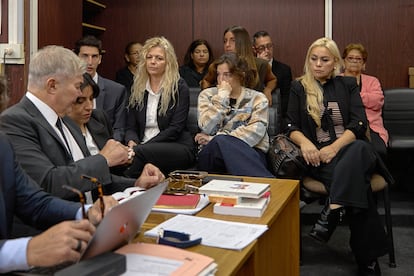
The new trial has just begun and will continue on Tuesdays and Thursdays for at least three months. More than 120 people are expected to be called as witnesses.
Sign up for our weekly newsletter to get more English-language news coverage from EL PAÍS USA Edition









































