
Colombia boosts cocaine seizures despite technological advances in maritime drug trafficking
Authorities confiscated 445 tons of the narcotic in 2025, according to a new report that details how traffickers are adapting their methods to evade growing pressure from Washington
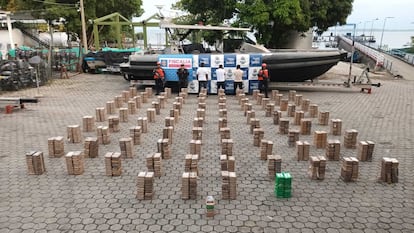

Colombia, the world’s largest producer of cocaine, is striving to show that its fight against drugs is succeeding. It is a decisive factor in its global image, but also in its economic and political relationship with the United States, its main trading partner. Rather than focusing on crop eradication and aerial fumigation, the government of Gustavo Petro has placed its biggest bet on cocaine seizures — and it has reached record levels.
A new report by the think tank and specialized outlet Insight Crime notes that in 2025, authorities seized 445.9 tons of cocaine, a significant 59.4% increase over the 279 tons confiscated in 2024. The milestone comes amid major technological advances in the drug‑trafficking industry.
Drug seizures reached their peak last year, driven by major operations. The most memorable was in November 2025 in Buenaventura, Colombia’s main Pacific port, where authorities seized 14 tons of cocaine — the National Police’s largest haul in a decade. The shipment, packed in 50‑kilo sacks and mixed with gypsum for camouflage, was bound for the Netherlands.
Two months earlier, Colombia’s international reputation in the drug fight took a hit when it was removed from the United States’ list of partner countries in this area. Colombian President Gustavo Petro called the decision by Donald Trump unfair, noting that internal records showed seizures at historic highs. But production was also rising, and eradication efforts were stagnating. U.N. estimates — which Petro has questioned — put potential cocaine production at 3,001 tons in 2024. That is why the president has tried in every way to highlight his record on seizures, stressing that there have been “no deaths.”
Jeremy McDermott, co-director of Insight Crime, believes there are two main reasons for the rise in seizures. “One is the increase in cocaine production. That increases the volume of drugs exported,” he says. On the other hand, the expert argues that Petro “prioritized” interdiction over eradication.
But the effectiveness of the president’s anti-drug strategy has been questioned. Just a few days ago, Petro again defended his view that forced eradication — the method favored by Washington — is “a total failure.” That is why his government has focused on voluntary crop elimination through agreements with rural and Indigenous communities. The administration has tried to project a tougher stance, but without success. In December, it announced that fumigation with glyphosate would resume, this time using drones. The plan was set to begin in February, but it was suspended after community protests.
The report also suggests that drug trafficking is undergoing a major shift driven by new technologies. McDermott notes that “transporting drugs in containers has become riskier.” “Major ports routinely inspect containers, and relevant updates have been implemented as a result,” he explains.
One change concerns transit: to avoid ports, traffickers are now using other types of maritime vessels, such as semi‑submersibles or vacation boats. In some cases, ships are “contaminated” once they are already at sea, and the drugs are off‑loaded before reaching land. “The other shift involves better camouflage — mixing cocaine with other organic materials, turning it into liquid form, or hiding it in metal; anything that can fool the scanners,” McDermott explains.
Colombian authorities are already reporting these new methods. In July 2025, the national Navy intercepted a remote‑controlled submarine in the Caribbean Sea with the capacity to carry more than 1.5 tons of cocaine and a maximum range of about 800 miles. It was the first discovery of a vessel of that kind in Colombian waters. In the first half of last year, at least 10 similar craft were detected in different parts of the Americas. All were outfitted with technology that gives them partial autonomy and makes them harder to detect by radar.
Everything suggests that this modernization of maritime trafficking has only accelerated following the offensive launched by Washington in September in the Caribbean and the Pacific against alleged drug‑running boats attempting to reach the United States. Although the strikes initially appeared to target vessels linked to Venezuela, it soon became clear that many had ties to Colombia. According to updated reporting by The New York Times, U.S. forces have struck 54 vessels and killed 185 people. One of those strikes targeted a narco‑submarine.
According to Insight Crime, this U.S. strategy appears to have “temporarily reduced and diverted” cocaine flows in Venezuela, particularly in traditional departure points such as Margarita Island, Falcón, and Sucre. But it has also significantly harmed lawful economic sectors, including fishing. Venezuela also recorded the largest cocaine seizure in the Americas in 2025: 15.4 tons were confiscated in April in Zulia state, on the border with Colombia. The area has long been a key corridor for cocaine trafficking and was once controlled by the Sinaloa Cartel. Local groups have since gained increasing power.
How does the fall of Venezuela’s Nicolás Maduro change the drug trafficking landscape? McDermott believes very little. “The Cartel of the Suns, that is, the state-run drug trafficking network integrated into the Chavista regime, remains intact; it has simply become more discreet in its operations,” he explains. Insight Crime reports that there is less trafficking from the Venezuelan Caribbean coast because it has shifted south and east, toward Guyana and Suriname.
In Ecuador — one of the most important transit points for cocaine headed to criminal markets — seizures fell to 75.9 tons in 2025, down from 160 tons in 2024. Insight Crime notes that the most successful operations carried out by Ecuadorian authorities took place in international waters, where they seized up to 124 tons last year. Military and intelligence cooperation with the United States has grown increasingly close, and this has driven up the cost of transporting drugs toward Central America.
Seizures also increased in most destination countries. In 2025, Belgium — the main entry point for drugs into Europe — confiscated 55 tons, a 25% rise from the previous year. Major operations were also conducted in Spain, Portugal and France. Among the European countries analyzed in the report, the only one that saw a drop in seizures was the Netherlands — not because less cocaine is arriving, but because trafficking organizations are increasingly diverting their routes to smaller ports and smaller countries to evade authorities.
Sign up for our weekly newsletter to get more English-language news coverage from EL PAÍS USA Edition









































