
Lula: ‘Trump has no right to wake up in the morning and threaten a country’
In an exclusive interview with EL PAÍS in Brasília, the Brazilian president discusses global turmoil, elections against another Bolsonaro, his career, and his visit to Spain to meet with Pedro Sánchez and other international leaders
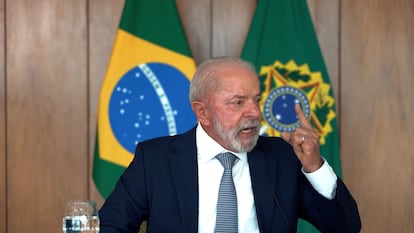
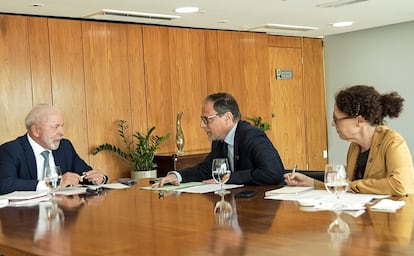
Brasília awoke to a gray morning. A subdued atmosphere hangs over the Three Powers Square, the heart of Brazil’s executive, legislative, and judicial branches. But it quickly dissipates upon entering the bustling Planalto Palace, where President Luiz Inácio Lula da Silva receives EL PAÍS on the third floor.
The seat of the head of state, designed in 1956 by Oscar Niemeyer, is steeped in symbolism. It was one of the buildings stormed on January 8, 2023, by mobs loyal to former president Jair Bolsonaro. The coup attempt brought Brazilian democracy to the brink of collapse, and even today — though the far-right leader has been sentenced to 27 years in prison — its impact is still felt in national politics: Lula, who is preparing to run for a fourth term in October, will face one of Bolsonaro’s sons as his main opponent.
“We cannot allow this country to be destroyed again as it was for four years,” Lula states.
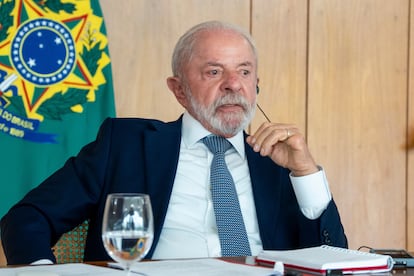
As soon as he entered the room, the president — wearing a blue suit, white shirt, and matching tie — greeted the journalists warmly and recounted details of the assault. He did so in a tone that, as the conversation progressed, grew more passionate. Passion for politics, passion for people, and even for soccer (he admits to being a fan of Atlético Madrid). An almost youthful fervor lights up the face of this metalworker, founder of the Workers’ Party and three-time president, leading him to raise his arms and pound the table with his fists when he wants to emphasize a point. His tone softens when he brings up a story from his life. Then, as he speaks of Fidel Castro, François Hollande, or Donald Trump, he leans back in his chair and gives a knowing glance. The calm lasts just long enough to draw the listener in and pull them back into his verbal whirlwind.
Lula is 80 years old and faces the world with the energy of someone much younger. “And I’m going to live to be 120,” he says half-jokingly, on the eve of his trip to Barcelona on April 17 for a Spain-Brazil summit with Prime Minister Pedro Sánchez, and to participate in the In Defence of Democracy forum on Saturday.
Question. You’ve been president three times, spent time in prison, managed to have the case dismissed, and survived a coup. You’ve even beaten cancer. Do you still have the strength at this stage of your political career?
Answer. In life, I do everything with great passion. I dedicate myself 100% to everything I believe is possible, both within and outside the government. That’s how it was in my childhood, at the factory, in the union, when I founded my party, and while governing. I don’t accept the word “impossible.” Everything is possible when you’re willing to do it. And the cost of not doing it, in the medium and long term, is infinitely greater.
Q. Brazil has just gone through one of its worst crises with the United States, involving clear interference, exorbitant tariffs, and sanctions against the judges presiding over the case against Bolsonaro. What did you learn from that clash?
A. It struck me that Trump’s arguments for imposing tariffs on Brazil were not true. That insistence on military force, ships, fighter jets… I decided to be very patient and told him, verbatim, that two countries governed by two 80-year-old men should converse with maturity. We don’t have to agree ideologically. A head of state sits down at the table with his country’s interests in mind. Furthermore, I told Trump that it was important to define what kind of leader one wants to be. I prefer to be a respected leader, not a feared one. No one has the right to instill fear.
Q. And how would you describe Trump?
A. He’s playing a very dangerous game. He operates on the premise that American economic, military, and technological power dictates the rules of the game. But that can’t be the case, because, ultimately, it ends up creating problems for the United States. When he decided to attack Iran, I don’t know if he realized that fuel prices would rise and that the people would be the ones to pay the price. When one is head of state, one must respect the sovereignty of other countries. It upsets me greatly that the U.N. Security Council, created to maintain peace, wages war. It is as if the world were a ship adrift, with no institution to guide the civilized behavior of nations. We are facing a very, very delicate situation: never since World War II have there been so many simultaneous conflicts. Last year alone, $2.7 trillion was spent on wars. With half of that, we could end illiteracy, solve the global energy crisis, and end hunger for 630 million people. When are we going to come to our senses...?
Q. Could it be that the institutions we put in place to prevent conflicts are obsolete?
A. The time has come to redefine the United Nations to restore its credibility; otherwise, Trump is right. International institutions are not fulfilling the role for which they were created. And why? Because the five countries on the Security Council, which should set an exemplary standard, do not. Neither the invasion of Iraq, nor that of France and the United Kingdom in Libya, nor Putin’s invasion of Ukraine, nor Israel’s massacre in Gaza went through the Security Council. The lords of peace have become lords of war. In Africa, there are countries with over 120 million inhabitants, and none are on the Security Council. Neither are Brazil, Germany, or India… And we must do away with the veto power. The geopolitics of 1945 don’t apply to 2026.
Q. Some believe that this won’t be resolved in the short or medium term and that it’s advisable to rearm to prevent abuse by the superpowers.
A. That is the problem. Everyone feels compelled to rearm. In Brazil, we believed in disarmament and enacted a Constitution in 1988 that prohibits the manufacture of nuclear weapons. What happened? The United States did not disarm, nor did Russia. China built them. And India. And Pakistan. And North Korea. And here we are, almost defenseless, with a land border of 16,800 kilometers [10,440 miles] and another 8,500 kilometers [5,280 miles] of coastline. But I don’t want to invest in weapons; I want to invest in books, in food, in jobs. The problem is that the European Union has just proposed 800 billion euros for defense, the United Kingdom is rearming, Japan is too… Someone has to take the initiative. I’ve already called Chinese President Xi Jinping, Indian Prime Minister Modi, Putin, Macron — everyone — asking them to meet with us, to discuss this. Because Trump has no right to wake up in the morning and threaten a country. He wasn’t elected for that, and his Constitution doesn’t allow it. It’s essential that the powerful take on more responsibility for maintaining peace.
Q. In this context of war, following what happened in Venezuela and the new U.S. security doctrine, aren’t you afraid of further interventions in Latin America? Does Brazil feel safe?
A. I feel safe. This country, for the first time in history, has a former president in prison and four four-star generals behind bars. Democracy works here; it’s an example for the United States. My war is one of arguments. And I want to fight it at the negotiating table. I want more free trade. The EU and Mercosur taught the world a lesson with the agreement that takes effect on May 1. Nearly 750 million people, a GDP of $22 trillion — it’s a very successful start. Our beloved U.N. has absolutely no power. For God’s sake, a Third World War would be a tragedy 10 times worse than the Second!
Q. Do you think that’s possible?
A. It could happen if they keep believing they can wake up in the morning and shoot anyone. The only way to prevent it is to strengthen multilateralism and democracy.
Q. But do you really believe Russia is willing to cooperate within that international order? And, given what happened in Ukraine, shouldn’t you have been more critical of Vladimir Putin?
A. Brazil was very critical. At no point did it recognize Russia’s right to invade Ukrainian territory. What Brazil maintained was that the solution lay at the negotiating table. Many people were wrong; Biden thought he was going to destroy Russia in no time. And Russia thought it was going to destroy Ukraine in no time. They were wrong. The war has been going on for four years now. How many lives, how many dollars, how much destruction has it caused? And does anyone really think it’s going to stop there? It’s not going to stop.
Q. And you really aren’t afraid there might be more interventions in Latin America?
A. Honestly, I don’t think so. It would be so absurd... I want to work with everyone. I’m not at an age where I’m interested in a new Cold War between China and the United States. I want more negotiation, more democracy, more multilateralism. What happened in Venezuela began with the election of Hugo Chávez in 2000... The United States has been involved in Venezuela ever since.
Q. And right now, shouldn’t the Venezuelan government be calling for elections?
A. That’s Venezuela’s problem, not Brazil’s. But if I were Venezuelan and vice president, and if what happened had happened, I would take office and call for general elections. That’s what I would do. There should be an electoral process agreed upon with the opposition for the result to be accepted and for Venezuela to have some peace. What cannot happen is for the United States to believe it can run Venezuela. That is not normal; it has no place in democracy.
Q. What is your prediction regarding Cuba? Will the regime fall?
A. Seventy years of blockade is inexplicable. If those who do not sympathize with the Cuban regime were concerned about the Cuban people, why aren’t they concerned about Haiti, which does not have a communist regime? Cuba needs a chance. How can a country survive without receiving food or energy?
Q. Argentina granted political refugee status to a man convicted over the January 8 coup. Isn’t that a hostile gesture toward Brazil?
A. I have no relationship with President Javier Milei, nor do I have any interest in having one. His decisions don’t bother me. He has to solve his issues with the Argentine people. We’ll see what happens when his term ends and what the outcome is of what he has sown in Argentina.
Q. There are presidential elections in Brazil in October, and polls point to a tie with Bolsonarism. How do you explain that it retains so much strength after an attempted coup and encouraging U.S. interference?
A. Bolsonarism will not govern this country again because the people prefer democracy. I am convinced of that. And the fact that Brazilian society is more divided is nothing new either. I’ve never won an election in the first round. And the world has become even more polarized; the far right is gaining ground with a discourse of lies and denial, using digital networks like never before, and now with the help of artificial intelligence.
Q. What do you fear most in this election: disinformation campaigns on the internet or possible interference from the United States?
A. I have no fear. My responsibility is to ensure that the Brazilian people receive the correct information, so that on the day they have to decide, they do not do so based on fake news. That is my obligation. And foreign interference does not concern me at all.
Q. Are you confirming that you’ll run for a fourth term? Or, if the polls get tough, would you step down?
A. Look, I admire [Lionel] Messi, who might still be called up by Argentina... I’m in great health. I have a deal with God to live to be 120, because I really love life. And I’m preparing to run in the election; I’m preparing for a fourth term with the conviction that it’s entirely possible. We can’t let this country be destroyed again like it was for four years. I’m very, very, very committed…
Q. But the elections are shaping up to be a close race...
A. They haven’t even started yet. This is going to be like a Barcelona-Real Madrid clásico: in the week leading up to the game, everyone thinks they’re going to win. But when the teams take the field, the more competent one prevails.
Q. And where does the far right get so much strength? Couldn’t there be other causes, such as disillusionment with what modern democracies offer?
A. Democracy now owes the people an explanation, because democracy isn’t just about getting votes on election day; we have to show that people will work better, earn more, eat better, and have greater access to culture and education... If we don’t do that, why should people believe in democracy? We have a duty to show humanity that democracy is better than authoritarianism. Our problem is that we realized too late that we had failed in building the so-called welfare state, in education, in healthcare… That’s why I’m going to Barcelona to participate in the In Defence of Democracy forum alongside presidents and ministers from the Americas, Europe, Africa, and Asia.
Q. Are you seeking an alternative to Trump’s unilateralism?
A. It won’t be an anti-Trump meeting. We’re going to discuss democracy: see where it failed and what needs to be done to fix it. I’m going to tell you a story. When François Hollande was elected president of France, he asked to speak with me and said, “Lula, what do you think I need to do to make my government truly successful?” I told him: “Do you remember the speech you gave to win the election? Put it at the head of your bed, and every morning when you wake up, read what you said so you don’t forget what you promised.” That’s how democracy should be. I can’t run a progressive campaign and then govern conservatively.
Q. What do the racist attacks against Real Madrid player Vinícius in Spain mean for Brazil?
A. It is unthinkable that in the 21st century we still have racism in theoretically developed countries like Spain, the United Kingdom, or Italy. Any act of discrimination is abhorrent.
Q. When I interviewed you in March 2021, during the COVID-19 pandemic, you were in lockdown, and I remember you said, “Politics is in my DNA; I’ll only stop doing it when I die.” Do you still feel that way?
A. Politics only makes sense when you have a cause. Why do I joke that I’m going to live to be 120? I can’t stop the planet from spinning, so the years go by, and I’ll keep getting older. Today I’m 80. Next year I’ll be 81. You don’t grow old because of the number of years, but because of a lack of motivation. Every single day, I wake up ready to do more tomorrow than today. It’s the condition for survival. I prepare myself to be motivated 24 hours a day. I don’t know the word depression. Nothing, absolutely nothing, can upset me. I don’t make decisions with a 39ºC [102ºF] fever. I’m not a slave to my cell phone. After 8 p.m., I don’t let anyone call me. I’m not a slave to the digital world…
Q. And looking back, what was the worst moment of your career? Prison?
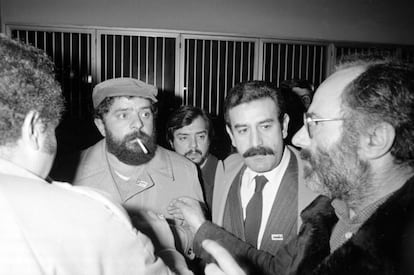
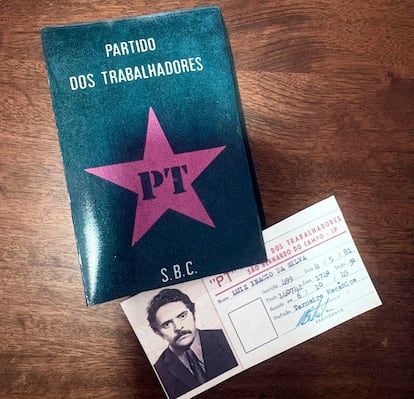
A. Nooooo... The worst was the first election I lost, in 1982, for governor of the state of São Paulo. My party was only two years old. It was the first time I’d run, and we gathered so many people in the streets that I started to believe I was going to win. I was a big novelty: a metalworker running for governor. I signed a lot of autographs, and I don’t think I got as many votes as the number of autographs I signed. I was very disappointed; I even thought about quitting politics. Then I had a conversation with Fidel Castro; I told him I was thinking of quitting, that I had only gotten 1.25 million votes. And Fidel replied: “Lula, do you know of any place in the world where a worker has gotten 1.25 million votes? It doesn’t exist.” And that motivated me to keep going.
Q. And after such a long political career, after so many struggles, do you feel the balance is positive?
A. It’s up to others to judge. I know we’ve done a lot, and I also know there’s always much more to do. My concern is never to be satisfied with what I’ve already done, because I might get complacent. I have to keep pushing myself, always, always. That’s how I survive.
Q. By the way, did you follow the mission to the Moon?
A. Nooo, my feet are on Earth — I have plenty of problems here. I don’t have a single vote on the Moon.
Sign up for our weekly newsletter to get more English-language news coverage from EL PAÍS USA Edition









































