
Iranians respond to US threats to send them ‘back to the Stone Age’: ‘We owe Trump nothing’
Reactions among the Iranian population and diaspora to the White House’s warnings range from caution to indignation and skepticism
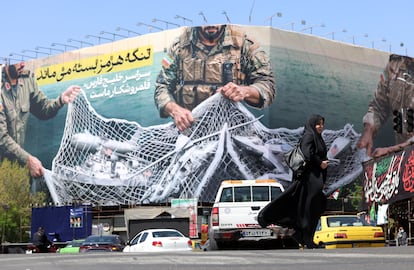

Donald Trump’s bellicose rhetoric against Iran has sparked reactions ranging from concern to outrage among Iranians, both inside and outside the country, especially his threat to wipe out the Islamic Republic in airstrikes.
“We are going to hit them extremely hard over the next two to three weeks," Trump warned in a speech last Wednesday. “We’re going to bring them back to the Stone Age, where they belong.”
On Sunday, just hours before the Monday deadline he set for reopening the Strait of Hormuz and reaching an agreement, Trump repeated that he would unleash “all hell” on Iranian territory.
“Iran is a land that, when many nations were still in the Stone Age, was building cities, writing laws, and shaping civilization,“ Yashar Soltani, a journalist based in Iran, posted on X in response to Trump’s threats. ”A nation with such a history cannot be driven backward by threats."
The U.S. president’s statements also reignited criticism against the Iranians who support the offensive by Trump and Israeli Prime Minister Benjamin Netanyahu. “Some Iranians filming explosions say ‘Thank you, Trump,’” said Shirin, a retired teacher living in Tehran, in a message exchange. Like the other people interviewed for this report, she asked that her real name not be revealed for fear of reprisals. Shirin admits that “many times” she has prayed for “the killers of the protesters to face justice,” but added: “Iranians owe Trump nothing.” “Do those who supported him still thank him now that he wants to unleash hell on us?” she asked.
Some believe that Trump’s threats are just rhetoric and are confident they won’t be carried out. “I wouldn’t be surprised if Trump extends the deadline again on Monday or even says he’s reached an agreement with the Islamic Republic,” said Laden, from Shiraz, the capital of Fars province in southern Iran. “It’s very likely Trump is bluffing and knows that bombing Iran’s infrastructure would only make the situation worse.”
“They want to return Iran to the Stone Age. Is democracy even possible in the Stone Age?” asked Mohsen Milani, a professor of International Relations at the University of Florida, in a post on X. The academic criticized the war’s supporters: “The traitors will say there is no cause for concern, because Trump is only referring to the Islamic Republic.”
Others criticize the U.S. president for targeting the civilian population. Setayesh, a primary school teacher in Tehran, argues that “the U.S. and Israel shouldn’t attack electrical or oil infrastructure. These attacks harm civilians, not the regime.” Reluctant to embrace Trump’s promise to “Make Iran Great Again,” she added: “The school in Minab was bombed, and innocent girls were killed. Now they’re attacking infrastructure and, on top of that, saying they want to open the gates of hell for us.”
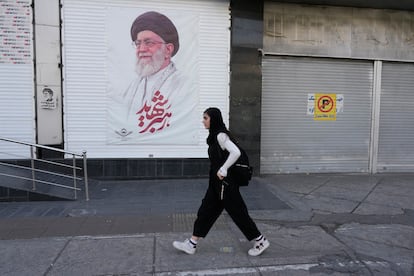
However, not all Iranians agree. Shahram, a mechanical engineering student in Tehran, says that “most of the attacks have targeted military objectives or those related to missile and nuclear projects,” adding that “it is the Islamic Republic that, with its obstinacy in destroying Israel, is irresponsibly leading the country toward disaster.”
“Hell in the 21st century is living without the internet,” said Shayan, a computer engineer. He works for a foreign company and has been forced to live temporarily in Turkey. “Many have lost their jobs because of the internet outage, and that’s on top of this runaway inflation and widespread unemployment,” he said. Iran is already experiencing one of the world’s longest internet blackouts, after the Islamic Republic cut off access to the network for almost 40 days and also banned the use of Starlink terminals.
The opposition in Iran has also spoken out. Saeed Ghasseminejad, adviser to Reza Pahlavi, son of the last Shah of Iran, wrote on X: “The criminal clergy comes from the Stone Age and, along with their revolutionary guards, will return to it. Iran, without the clergy, will quickly reach the place it deserves: the gates of a great civilization.”
But from outside Iran, Yassamin Ansari, a Democratic congressman of Iranian descent, called Trump’s statements “horrible and diabolical.” In a social media post, Ansari reminded Trump that he was speaking about a country of 90 million people and described his words as “vile, terrifying, and perverse.”
Alireza Faghani, an international football referee based in Australia, responded to Trump’s threats in an Instagram story, evoking the hardships faced by the population before the conflict: “Stone Age means air polluted by carcinogenic mazut [a heavy, low-quality fuel], deliberate droughts, and inflation rising every hour.”
Faghani, whose assets were recently confiscated by the Islamic Republic, added: “The Stone Age means buying meat and chicken on credit, murdering protesters, raping prisoners and nurses, carrying out executions in hospitals, internet blackouts, and a poverty line below 80 million tomans a month [about $400].” According to recent labor market data, the official minimum wage in Iran is around 166 million rials (about $100), following recent adjustments to address inflation.
Public intimidation
Many Iranians have shared on social media a message that has become a symbol of popular outrage: “If your underage sister were also imprisoned and facing death, would you be so concerned about the infrastructure?” The question reflects the frustration felt across broad sectors of society in the face of repression, mass arrests, and the perception that the authorities prioritize their own survival over the safety and basic rights of the population.
“It’s clear that when the aim is to bomb an entire population back into the Stone Age, the execution of a few political prisoners or the detention of thousands of protesters ceases to be a genuine concern,” Shadi Sadr, a lawyer and human rights activist, noted on social media. “This is what war does to human rights: human life loses value, and those responsible for death act with greater impunity.”
Sadr was referring to the recent succession of executions of political prisoners, carried out through opaque judicial processes, without free access to lawyers and at an accelerated pace — developments that have reinforced suspicions that the Islamic Republic is using the death penalty as a tool of public intimidation.
Nasrin Sotoudeh, a prominent lawyer and human rights activist, before her arrest in Iran on Wednesday night, expressed her concern about the situation in the prisons in an interview with Iran Wire: “There are few officers in the prisons. Most have left, and only a few remain to provide water and food to the inmates. The authorities, in violation of the law, refuse to release prisoners in times of war. They are only concerned with saving their own lives.”
Sign up for our weekly newsletter to get more English-language news coverage from EL PAÍS USA Edition









































