
The ‘Narco-Architect’ who designed tunnels to bring hashish from Morocco into Spain
Police talk about a ‘complex underground infrastructure’ similar to a mine, complete with pulleys, cranes, rails and carts to transport the drug on behalf of ‘a very, very powerful’ organization
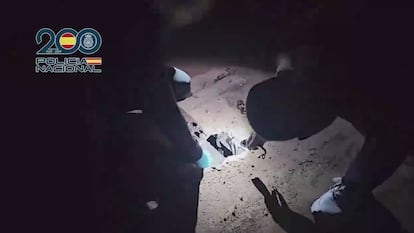
Two clandestine tunnels linking Morocco and the Spanish autonomous city of Ceuta that were being used to transport drugs were designed by a trafficker dubbed by the police as the “Narco-Architect” or the “Tunnel Boss.” This trafficker is a Moroccan national with a criminal record who was arrested on March 26 in Ceuta during Operation Ares, a police raid that dismantled “the network of hashish networks” that the suspect controlled, according to a statement released by the Spanish Ministry of the Interior on Tuesday. Another 26 individuals were arrested during the operation.
Images released by the Spanish ministry show a “complex underground infrastructure” that officers compared to a “mine-like labyrinth,” through which up to two tons of hashish could be smuggled each week into the Spanish exclave city, located on the northern coast of Africa and bordered by Morocco. “It is a very sophisticated, well-equipped drug tunnel, specifically designed for trafficking hashish,” emphasized Commissioner Antonio Martínez Duarte, head of the Drugs and Organized Crime Unit (Udyco), at a news conference on Tuesday.
From there, the drugs were shipped to other European countries, primarily the Netherlands, where the “architect” had family ties to members of the Mocro Maffia, the powerful criminal organization based in that country.
The entrance to the tunnel was located inside a warehouse in the El Tarajal industrial park, just a few dozen meters from the border fence with Morocco. To find it, agents had to move a large refrigerator, behind which was a door leading to a second, soundproofed warehouse. There, Udyco agents discovered clear signs that a section of the floor had been “tampered with,” meaning that construction work had recently been carried out there.
After removing a layer of cement—which, according to sources close to the investigation, had been laid “somewhat sloppily”—the agents found a trapdoor leading to a passageway divided into three distinct levels. The first level was the entrance to the access tunnel, 19 meters (62 feet) deep. The second, or intermediate, level was what the agents have dubbed the “storage room,” where “bales of hashish were stacked on pallets before being transported outside.” The third and final level was the passageway leading to Morocco, which was 80 centimeters (31 inches) wide and 120 centimeters (3′9 feet) high. Its total length and exit point have not yet been determined, as it remains flooded with three meters of water and could not be explored even with the help of an underwater drone.
The “Narco-Architect” had equipped the tunnel with features worthy of “an engineering feat.” He had installed a system of pulleys, cranes, rails, and two carts that allowed the pallets of hashish to be moved without those operating at either end of the passageway ever having to see each other, which increased security in the event of a police raid. Furthermore, to keep the structure operational in an area with underground water deposits, he had installed “two powerful bilge pumps” that ran continuously, and he had also soundproofed the warehouse so that the noise would not attract the attention of outsiders passing by the warehouse.
Investigators note that this drug tunnel has a more complex structure than the one located in February of this year by the Spanish Civil Guard, and which was operated by the same drug trafficker. That other tunnel had its entrance in a defunct marble workshop in the same El Tarajal industrial park. Although it also had its own lighting system, its structure was more flimsy. The walls, dug to a shallower depth, were covered with wooden planks—the new one has sections of masonry—and the carriers had to crawl on all fours, as the tunnel was somewhat narrower and lower. There were neither rails nor carts.
Investigators believe that both drug tunnels were operational at the same time, and that the organization—described by Commissioner Martínez Duarte as “very, very powerful”—continued to operate the one that has now been discovered even after the Civil Guard uncovered the first one. However, the investigation suggests that fear of the second tunnel also being discovered led them to stop using it in September and to seal its entrance into Spain with cement. The agents underscore that it was precisely this lack of use that led to the water extraction pumps being shut down, triggering the flooding. “It will take us quite a few days to pump out all the accumulated water,” admits an official in charge of the operation.
Investigations have revealed that the “Tunnel Boss” boasted in his conversations that he had bribed law enforcement officers to allow the vehicles to pass through land port checkpoints. However, the seizure last June in southern Spain of a heavy-duty truck from Nador (Morocco) loaded with 15 tons of hashish hidden among pallets of watermelons and sweet potatoes—which were themselves stuffed with drugs—led the organization to seek other smuggling routes. To this end, it contacted an organization in La Línea de la Concepción, in Spain’s southern province of Cádiz, to begin using high-speed vessels to unload along the Andalusian coast and via the Guadalquivir River, as well as fishing boats to transport the shipments to Galicia, where it had reached an agreement with another criminal network.
Sign up for our weekly newsletter to get more English-language news coverage from EL PAÍS USA Edition









































