
Italian woman dies after self-administering a lethal drug with an eye-controlled device
The high-profile case of the quadriplegic patient, known as Libera, has once again put pressure on parliament to pass a law on euthanasia
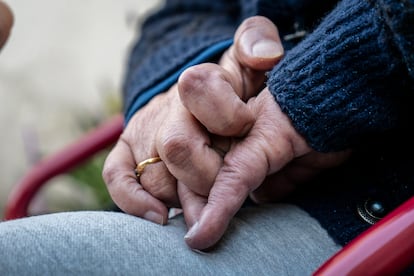

After a long legal battle that lasted more than two years, Libera – a fictitious name –, a 55-year-old Italian woman who suffered from multiple sclerosis and had become quadriplegic, died on Wednesday by assisted suicide carried out with the support of a special eye-controlled device that administered a lethal drug. This woman’s story has reopened the debate on euthanasia in Italy, where it is not legal. However, assisted suicide is permitted in certain cases. This practice involves a doctor preparing the lethal medication, which the patients then take themselves; in other words, a professional assists but does not directly cause death.
In Spain, a 25-year-old woman named Noelia Castillo received euthanasia on Thursday after another drawn-out legal battle, in this case with her family, which opposed her decision.
Libera’s case was complex because she couldn’t administer or take the drug herself. Therefore, a machine activated by eye movements, which the National Research Council (CNR) built and tested specifically for her, was ultimately used. Last week, the Florence court granted authorization for the procedure after a two-year legal battle.
The machine was necessary because otherwise Libera would not have been able to self-administer the drug. The device allowed her to activate the lethal injection using an eye pointer connected to an infusion pump. The Luca Coscioni Association, which advocates for euthanasia and supports and advises people who have decided to die, explained that Libera self-injected the drug using only eye movements.
The legal battle began in March 2024, when Libera asked the health authorities of her region, Tuscany, to verify whether she met the conditions required to access medically assisted suicide. These conditions are to suffer from an irreversible illness, great physical or psychological suffering, reliance on treatments to stay alive, and full decision-making capacity.
At first, since she was unable to administer the drug herself, the authorities rejected her request for this procedure. She then decided to take legal action. The Florence Court referred her case to the Constitutional Court, requesting that it legalize euthanasia. The Constitutional Court reiterated the prohibition of euthanasia and noted that in this case, sufficient checks had not been carried out regarding the existence of means by which she could administer the drug herself, that is, by resorting to medically assisted suicide.
After months of unsuccessful efforts to locate companies capable of supplying the necessary equipment, the CNR, the most important public body dedicated to research, was tapped to develop a machine with which Libera could self-administer the lethal drug. The judges specified that the regional health authority should cover all the costs for the construction of such a machine.
A few months ago, the CNR completed the construction of the device – the first of its kind in Italy – and delivered it to the Tuscan health authorities. The next step was to conduct a test directly in the patient’s home to ensure it functioned correctly, using a harmless saline solution. After correcting some issues and making the final necessary adjustments, the machine was declared ready a few days ago, and on Wednesday, Libera was able to use it. Before her death, in a message sent to the Luca Coscioni Association, she declared: “This is not just my story. It is a plea for dignity that I hope one day will not have to be won, but simply respected.”
The anesthesiologist who has followed her case in recent years, Paolo Malacarne, emphasized Libera’s determination in an interview with the newspaper La Repubblica: “She saw death as the only way to stop suffering. When she was able to fulfill that wish, there wasn’t a moment of pain, tears, or doubt, but rather liberation. It’s dramatic to say, but that’s how it was.” He also criticized the decision to require the construction of a special machine so she could self-administer the drug: “I don’t see anything wrong with euthanasia, but rather something good. And if the injection pump had jammed, what would I have been supposed to do? If at the last moment she had become nervous and told me, ‘I can’t, I’m afraid,’ what would I have been supposed to do, tell her, ‘You figure it out yourself’?”
Legal limbo
Unlike other European countries, Italy exists in a kind of legal limbo regarding this issue. Although assisted suicide is theoretically permitted—only in very specific cases—there is no national legislation regulating it; instead, there is only case law and judicial decisions, primarily from the Constitutional Court. Each case is usually resolved with express judicial authorization.
One of the most relevant cases was that of Fabiano Antoniani, known as DJ Fabo, whose struggle led to a landmark ruling in 2019 that established that assisting suicide is not punishable if certain extreme conditions are met.
Since then, the Constitutional Court itself has repeatedly urged parliament to legislate on the matter. Following the Libera case, La Repubblica published statements by Giovanni Amoroso, judge and president of the Constitutional Court, in which he reiterates that jurisprudence has established clear criteria for applying assisted suicide, while also emphasizing that it is up to parliament to legislate and provide a definitive legal framework. “The request to introduce national legislation regulating physician-assisted suicide has not yet been heeded,” the judge stated.
The issue of assisted dying remains the subject of intense social and political debate in Italy. Currently, a bill on medically assisted voluntary death has stalled in the Senate for four years, amid amendments and political disagreements.
Sign up for our weekly newsletter to get more English-language news coverage from EL PAÍS USA Edition









































