
‘No to war’: 23 years later, Spain’s PM revives the left’s historic slogan against the Iraq invasion
In the middle of a standoff with Trump, the Spanish leader is seeking a similar momentum to the one that created a common cause in 2003 and gave the left an unexpected victory at the polls
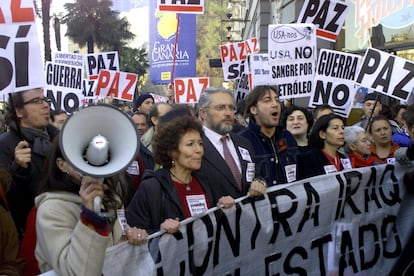

It happened 23 years ago, in February 2003, before the phenomenon known as “polarization” had taken hold and practically relegated the concept of broad consensus to the history books. The CIS, Spain’s statistical bureau, asked almost 2,500 citizens their opinion about the military intervention in Iraq being prepared by the George W. Bush administration and supported by Spain’s government, then led by José María Aznar of the Popular Party (PP). The result was one of those cross-party agreements that are so rare today. More than nine out of ten respondents rejected the war. And the rejection spilled onto the streets, with massive demonstrations that mobilized more than three million people under the slogan “No to War.”
It is the very same slogan that Prime Minister Pedro Sánchez of the Socialist Party (PSOE) repeated, quite deliberately, on Wednesday, in an appearance to explain his decision to reject the United States’ use of the joint military bases in Rota and Morón for the attack on Iran. “The government’s position can be summed up in four words: ‘No a la guerra (No to war),’” he said. The refusal has led U.S. President Donald Trump to threaten Spain with a trade embargo.
Sánchez’s position brings to the forefront a historic demand of high symbolic value, especially for the political left, which 23 years ago—as now—almost everyone considered doomed in the upcoming elections, but which united behind a common cause and ended up achieving an unexpected victory at the polls the following year.
“The parallels are so clear they practically draw themselves. The prime minister only has to say those four words for almost everyone to remember both the feeling of unity that the movement triggered, and what the Iraq war meant: an invasion without UN approval, a decade of Europe suffering from terrorism, rising energy prices…,” adds a source at La Moncloa, the seat of government.
“The ‘no to war’ movement has characteristics that could mobilize the left and at least unsettle the right. Among these characteristics is its reliance on a widespread anti-Americanism, which makes it unpopular to appear subservient to the U.S. Furthermore, it benefits from Donald Trump’s unpopularity. But no one should expect immediate effects. It’s an idea that will take time to gain traction and won’t halt some voting trends that favor the right and the far right,” says a source familiar with Sánchez’s efforts to connect 2003 with 2026.
Carmen Lumbierres, a professor of Political Science at the distance university UNED, sees “clear” intentions in the revival of the “no to war” slogan. “To channel the emotions of the voters, especially the progressive ones, into a moment of rebellion against the lies of the PP and against an unjustified war, by drawing a parallel,” she says. However, this expert believes too much time has passed for it to be truly effective. “Neither the country’s makeup nor its concerns are the same. What is pushing the vote to the right, especially among young people, and what sets social media ablaze, is not the rejection of submission to the U.S. or an illegal invasion, but rather the defense of Western identity against Islam, presented as a threat.”
NATO, Bush, Trump
Gaspar Llamazares, a former leader of the United Left (IU) political group, notes that the main difference is that today there is a “global disorder” caused by the “global far right” that did not exist then. And a key figure of this “global far right” is Trump, who has low approval ratings in Spain: 76.5% of those surveyed by the CIS for its February barometer expressed negative opinions about him. Almost 80% see him as a danger to world peace. Perceptions about Trump taint those about his country. Between April 2024, with Joe Biden in power, and June 2025, with Trump already in office, the percentage of those who see the U.S. as a threat to Spain almost quadrupled, rising from 5% to 19%, according to the Elcano Royal Institute’s barometers.
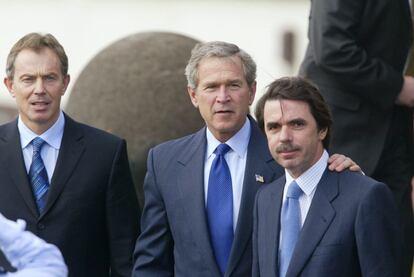
Abdón Mateos, a professor of Contemporary History at the UNED, believes that Trump’s unpopularity is one of the factors that could contribute to the effectiveness of the “no to war” movement in Spain. In his opinion, the appeal goes even deeper. “In Spain, there has always been a pacifist subculture that is opposed to military interventions,” notes one of the leading experts on the history of the Socialist Party in particular and the Spanish left in general. He says that this “pacifist” undercurrent has clearly emerged on two occasions: first, the demonstrations in 1986 against Spain’s NATO membership; the second was the protests against the Iraq War in 2003.
His colleague Juan Sisinio Pérez Garzón, emeritus professor of History at the University of Castilla-La Mancha, believes that the 2003 demonstrations were an expression of a deeply rooted trait in Spanish political culture: the rejection of American imperialism. “I wouldn’t speak so much of pacifism as of anti-imperialism. Because, if you look, there hasn’t been a strong reaction to the change in position on the Sahara, which should mobilize a truly pacifist society. Nor would I speak of a rejection of all imperialism, because Russian imperialism barely gets people out on the streets. The one that causes rejection is American imperialism. And the opposition is greater if Spain appears subservient. If the ‘no to war’ movement of 2003 garnered such unanimity, it’s because it appealed to a diffuse rejection of U.S. imperialism with origins in the Cuba [Spanish-American] War, which gives the U.S. a bad reputation even in sectors of the right. That’s what Sánchez wants to recover when he now says ‘no to war’.”
Sign up for our weekly newsletter to get more English-language news coverage from EL PAÍS USA Edition









































