
The new cartel kingpins handed over to Trump
The latest batch of prisoners includes organized crime heavyweights and a handful of names that transcend the six organizations included on the State Department’s blacklist
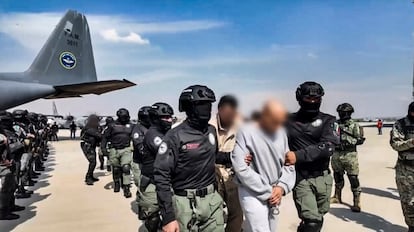

The latest transfer of Mexican drug lords to the United States represents a further escalation in the bilateral security relationship. Less than a year ago, Donald Trump, through a presidential decree, added six cartels to the State Department’s list of international terrorist organizations. Since then, 92 inmates have been sent across the border, including some historical kingpins with decades-long outstanding debts to U.S. justice, as well as heavyweights from today’s most powerful cartels. But Tuesday’s transfer carries even greater significance because it symbolizes the consolidation of the new playing field imposed by Trump. Among the 27 prisoners transferred is the first person indicted by U.S. prosecutors for the crime of narcoterrorism, in addition to a handful of names that extend beyond the six criminal organizations included on the blacklist.
The case of Pedro Inzunza Noriega, alias “Sagittarius,” is paradigmatic not only because he is the first drug lord to be extradited on charges of narcoterrorism, but also because of the speed with which his capture and transfer to a U.S. prison unfolded. The 62-year-old, alleged leader of the Sinaloa splinter group of the Beltrán Leyva cartel, was arrested by the National Guard in Culiacán, the capital of Sinaloa, on New Year’s Eve. It was a clean operation, without a single shot fired. Less than a month later, and amid an increasingly intimidating international climate, culminating in the capture of Nicolás Maduro by U.S. military forces, Noriega is being flown in a wheelchair to a prison in the United States.
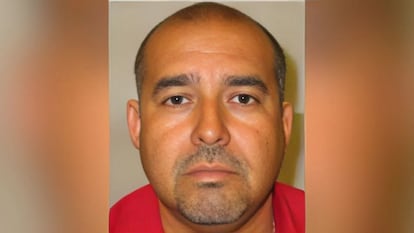
Along with Noriega, the U.S. Attorney’s Office indicted his son, Pedro Inzunza Coronel, known as “El Pichón,” on the same narcoterrorism charges last May. El Pichón was allegedly the organization’s second-in-command after his father. He was killed in December during a Mexican Navy operation in Guasave, in northern Sinaloa. Together, they ran “a powerful and violent faction of the Sinaloa Cartel that is believed to be the world’s largest known fentanyl production network,” the U.S. Justice Department stated in May. This indictment automatically made them high-priority targets on both sides of the border.
One of the central points of the case in U.S. courts is the December 2024 seizure of approximately 1,500 kilograms of fentanyl from various homes linked to the Inzunza family in Sinaloa. This was one of the largest seizures of this drug, considered Trump’s public enemy number one. This operation was also one of the first blows dealt by Omar García Harfuch in his role as Mexico’s new Secretary of Security, just before the Republican magnate’s return to the White House.
The United States considers the Inzunza family to be the leaders of what remains of the Beltrán Leyva organization, former partners and later enemies of Joaquín “El Chapo” Guzmán within the Sinaloa Cartel. Mexican authorities, however, place another name at the top of the faction, an ally of Los Mayos, the faction loyal to Ismael “El Mayo” Zambada in the internal war in Sinaloa: Fausto Isidro Meza Flores, alias “El Chapo” Isidro, who a few months ago was added to the FBI’s list of the 10 most-wanted fugitives.
Up to 11 names linked to the various factions of the Sinaloa Cartel, also known as the Pacific Cartel, appear on the list of the 37 prisoners who will be transferred. The next group with the most members on the list, with seven, is the Jalisco New Generation Cartel, currently the most powerful criminal group in Mexico, organized as a franchise with dozens of groups throughout the country that claim its acronym: CJNG.
The most prominent name among the seven is Armando Gómez Núñez, alias “Delta 1.” Also recently arrested, in mid-December, he is considered the third in command of the cartel’s internal structure in the Guadalajara metropolitan area. Gómez led a cell of hitmen dedicated to kidnapping, torturing, and murdering people, and was one of the closest collaborators of Juan Carlos Valencia González, alias “R3,” the stepson of the cartel’s founder and leader, Nemesio Oseguera Cervantes, “El Mencho.” Both are among the most-wanted criminals by the United States. Also noteworthy from the ranks of the CJNG is the only woman on the list, María del Rosario Navarro Sánchez, alias “La Señora,” who is also accused of narcoterrorism.
Another group with a significant presence on the list is the Northeast Cartel (CDN), one of the six organizations included on the State Department blacklist. It represents the main splinter group of Los Zetas in western Tamaulipas, primarily in Nuevo Laredo. Although there are more far-reaching offshoots of the notorious Zetas — such as the Old School Zetas — the Department of Justice considers the CDN to be the successor organization to the cartel that established a reign of terror with episodes of extreme violence just over a decade ago. The most prominent leader of this faction on the list is Ricardo González Sauceda, alias “El Ricky,” “regional head in Nuevo León, Tamaulipas, and Coahuila for the Northeast Cartel,” according to his arrest record from February of last year. Mexican authorities indicated that El Ricky was “the second most important man” within the criminal organization, below Juan Cisneros Treviño, alias “Juanito Treviño.”

The first round of extraditions, in February of last year, included notorious drug lords such as the former leaders of Los Zetas, Miguel Ángel and Omar Treviño Morales, known as Z-40 and Z-42. Also included was the septuagenarian Rafael Caro Quintero, leader of the Guadalajara Cartel, accused of the 1985 murder of DEA agent Enrique “Kiki” Camarena, which made him the most wanted target of U.S. authorities for decades. The second round of extraditions, in August, included Abigael González Valencia, “El Cuini,” El Mencho’s right-hand man and brother-in-law, as well as Servando Gómez, “La Tuta,” who was the leader of the once-powerful Knights Templar cartel, and Juan Carlos Félix Gastélum, “El Chavo Félix,” son-in-law of El Mayo Zambada, the founder of the Sinaloa Cartel who is also in Washington’s hands.
This third shipment expands and deepens the net with up to 15 prisoners who do not belong to any of the organizations targeted on the State Department’s list. These names are somewhat less well-known, but according to an internal document about the transfer, they are linked to investigations by various U.S. law enforcement agencies, from the ubiquitous CIA and DEA to the Bureau of Alcohol, Tobacco, Firearms and Explosives (ATF), the U.S. Marshals Service (USMS), and Homeland Security Investigations (HSI).
Sign up for our weekly newsletter to get more English-language news coverage from EL PAÍS USA Edition









































