
Violence rages in Culiacán: ‘It’s the mopping up of what’s left’
Nearly 50 murders have been recorded in Sinaloa in the last week, mainly in the capital, the main front of a war between cartel factions that has lasted more than a year
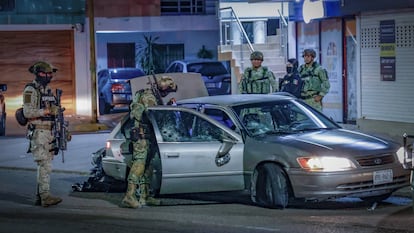

Blood marks the days in Sinaloa, a useful description for almost any of the last 60 weeks in which the state, and particularly its capital, Culiacán, have lived at war. The battle between factions of the Sinaloa Cartel rages in waves, like last week’s, which resulted in almost 50 murders, a situation that is difficult to interpret. Sometimes, shootouts and attacks occur in the upper part of Culiacán, and sometimes in the southern areas. On other occasions, they occur in municipalities further south or north, such as Navolato, and still others, rarely, in Guasave or Los Mochis, on the road to Sonora. “It’s the mopping up of what’s left,” says an agent from the security forces deployed in the capital, with years of experience in the area.
When he says “what’s left,” the agent is referring to one of the warring factions known as Los Chapitos, which bands together the still-at-large sons of the former Sinaloa Cartel drug lord, Joaquín “El Chapo” Guzmán, and their followers, and which has been seriously decimated in recent months. Last week, the federal Security Cabinet, headed by Secretary Omar García Harfuch, announced the arrest of six members of Los Chapitos following a confrontation in Culiacán. Some of them were captured in recent months but later released. Authorities also reported the death of one of the main operators of this faction, Ezequiel Rubio, alias “Morral,” who was allegedly killed in the clash.
Morral and some of those arrested were allegedly part of the Los Chimales criminal network led by José Ángel Canobbio, alias “Güerito,” one of the main scions of Los Chapitos and the protagonist of countless corridos and alleged criminal exploits. Wanted by the United States, Mexican authorities arrested him in February, in one of the most severe blows the faction has suffered in recent months. Shortly afterward, Claudia Sheinbaum’s administration extradited him to the U.S. for trial, as part of a group of 29 alleged drug traffickers transferred to American prisons. Among other things, the Mexican authorities noted that Güerito had staged clashes against the security forces in 2019 and 2023 to thwart their attempts to arrest one of El Chapo’s sons, Ovidio Guzmán.
Those days of war, popularly known in the Sinaloa capital as “culiacanazos,” now seem like a distant past, removed from a reality that has imposed death and violence on the streets almost every day. There have been better days and worse days, like last Wednesday, October 22, which ended with 12 deaths, most of them in the capital. That day began with the discovery of a bagged corpse in Santa Rocío, in the city; the seizure of half a ton of methamphetamine; the confiscation of 43 explosives in Concordia, in the south; and a trail of murders, both single and double, in various parts of Culiacán and southern Mazatlán. The new wave of violence has left at least 41 people dead in six days. García Harfuch said this Monday in the Chamber of Deputies that Sinaloa is a priority, and that it can be pacified.

So much “slaughter,” a common expression in the region, occurs amid the weariness of a desperate population. This Saturday, hundreds of people demonstrated in Mazatlán, the state’s tourist jewel, in protest of the number of missing persons recorded in the state: 1,391 since the cartel war began in September of last year, according to the Ministry of the Interior, of whom 157 were found dead. The local Prosecutor’s Office raises the number of missing persons by several hundred, a difference that is difficult to explain. The forced recruitment carried out by the warring factions — Los Chapitos, on the one hand, and the sons of another of the region’s longtime bosses, Ismael “El Mayo” Zambada, on the other — partially sheds light on this statistic. The concealment of the bodies of the enemy, victims of the war, completes the picture.
The disappearance in early October of a young man from Durango, from a bar in the port of Mazatlán, owned by State Secretary of Economy Ricardo Velarde, catalyzed the weekend protest. The story is the same as so many others. On October 5, Carlos Emilio Galván, 21, was at a tourist establishment in the port with his cousins. It was already dawn. The young man, a qualified chef, got up to go to the bathroom and never returned. The scandal grew, even more so when it became known who owned the establishment. The business said it has provided videos and other information to the Prosecutor’s Office, but for now, the young man remains missing. Velarde resigned from his position, and the violent events that took place subsequently threaten to bury the case.
Little is known about the future of the criminal battle in the state, beyond speculation on social media, information often rooted in propaganda. Pioneers of online disinformation in criminal contexts, Los Chapitos and La Mayiza have created channels and accounts on various virtual highways to report on their alleged advances, alliances, and victories, information they sometimes pepper with videos of murders, explosives being thrown, or simple patrols to the beat of popular corridos. The question is why some weeks are less violent than others; why sometimes it seems that some parts of the state have calmed down, only to flare up again.
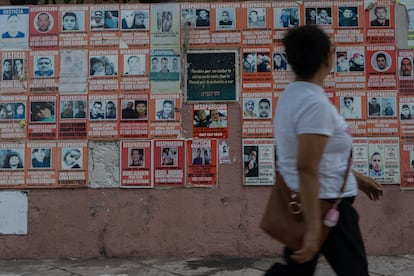
“What happens is they do it in stages,” explains the agent cited above. “They kill a few, many then hide and flee, and the others take three or four weeks to locate them again. It’s a hunt between the hat men and the others,” he asserts. “The Hat Men” is a way of referring to La Mayiza, the faction allegedly led by Ismael Zambada Sicairos, alias “Mayito Flaco,” one of El Mayo Zambada’s sons. According to the agent, Sicairos has gained the support of important local crime bosses, although none as powerful as Fausto Isidro Meza Flores, alias “Chapo Isidro,” who has his fiefdom in Guasave and has reportedly taken advantage of these months of war to expand into the mountains and southward, toward Culiacán.
Sign up for our weekly newsletter to get more English-language news coverage from EL PAÍS USA Edition









































