
Trump claims peace in Ukraine is near, but Moscow suggests otherwise
Volodymyr Zelenskiy is hoping the US president will run out of patience with Vladimir Putin as his military prepares for a prolonged war
In 1990s Russia, Prime Minister Viktor Chernomyrdin’s aphorisms, born of gaffes and misunderstandings, became a genre unto themselves: the chernomyrdinka. “We wanted the best, but it turned out like always,” is one of the most famous. It’s a phrase that could be applied to the current peace negotiations over the war in Ukraine.
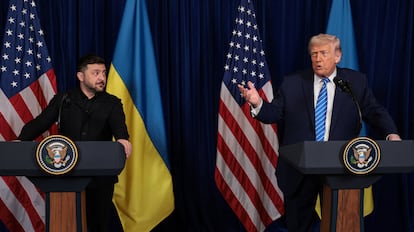
U.S. President Donald Trump’s efforts to pacify the Russian-occupied country are approaching their one-year mark, despite his promise to conclude a peace agreement within 24 hours of returning to office. In his latest attempt, held this Sunday in Florida with his Ukrainian counterpart, Volodymyr Zelenskiy, and with Russian leader Vladimir Putin on the other end of the phone, Trump claimed that this time they are “a lot closer, maybe very close.” A day later, Moscow announced it was reconsidering the negotiations after accusing Kyiv of carrying out an alleged drone attack against a secondary residence of Putin immediately after the Zelenskiy-Trump meeting. The Ukrainian president denied the incident and stated that it was a pretext used by the Kremlin to sabotage the talks.
The reality, however, seems different: nothing suggests that the Kremlin intends to halt its invasion until Kyiv capitulates. According to various analysts, even the hypothetical surrender of the eastern Donbas region would not satisfy the Russian president.
These are strange negotiations. Normally, experts from both sides discuss the technical aspects first, and then the presidents pose for a photo. In this conflict, it is Trump who is improvising his conversations with two leaders vying to win over the powerful American leader or, at least, avoid angering him.
Zelenskiy has learned how to deal with Trump. His poker face proved it when the U.S. president, standing beside him Sunday, asserted that Putin wants peace. Zelenskiy hasn’t risen to any bait since the meeting that descended into a row at the White House last February. For the Ukrainian president, securing the United States as an ally takes precedence over his pride. He himself admitted last week that U.S. military aid, especially intelligence, remains “critical” and difficult to replace with that of European NATO partners.
From Florida, the Ukrainian president echoed Trump’s words that “great results” were being achieved in the negotiations with the United States. But his words had a double meaning, because Zelenskiy was trying to praise Trump and curry favor. He is convinced that Russia will not accept his peace plan and that the war will continue. Sooner or later, Zelenskiy hopes, Trump will tire of waiting for Putin.
“Russian representatives hold long talks [with the United States], but in reality, it is the missiles and drones that speak for them. Putin and his team do not want to end the war,” Zelenskiy wrote on December 27 after another major Russian bombing raid on Kyiv.
Two different plans
The result is two different peace plans on Trump’s table. One, a 27-point plan promised to Moscow, is part of what the U.S. president discussed with his Russian counterpart at their summit in Alaska last August. The other, a 20-point plan being negotiated with Zelenskiy, has been partially agreed upon by Kyiv and Washington.
The Kremlin — known for frequently lying about its intentions, as it did in 2021 when it denied the imminent invasion of Ukraine — is being very clear this time. Both Putin and his inner circle have emphasized that they do not want ceasefires and will only accept a peace that satisfies their demands regarding what they call “the root causes of the conflict.”
“This [20-point] plan is radically different from the 27 points we have been working on with the United States,” Deputy Foreign Minister Sergei Ryabkov warned on Sunday. Two weeks earlier, Putin’s foreign policy advisor, Yuri Ushakov, said the proposals agreed upon in the Washington-Kyiv draft were “completely unacceptable.”
Ukraine, supported by a European Union sidelined from the talks, is proposing an unconditional ceasefire that would freeze the front lines in their current positions. Moscow rejects the idea. “We haven’t discussed this even once. We’ve discussed various options for a long-term solution, but replicating the Korean problem [the division of the Korean Peninsula in 1958 without a formal peace agreement] has never been discussed. If these changes are introduced, we will strongly oppose them; our position was clear to the Americans,” Ushakov warned. According to Kremlin representatives this weekend, Trump has shifted from supporting a ceasefire to considering it unnecessary.
A hypothetical Ukrainian withdrawal from Donetsk and Luhansk (the two provinces that make up the Donbas region) would not bring an end to the war. Despite not controlling them, Putin annexed these provinces, along with Zaporizhzhia and Kherson, in his Constitution of September 2022. “These four territories are an integral part of the Russian Federation,” Ryabkov stated definitively a few weeks ago.
No sign of the Kremlin
The head of Ukrainian military intelligence, General Kyrylo Budanov, explained on Sunday on state broadcaster Suspilne that he perceives no signs — either from the war front or from the Russian army structure — that indicate the Kremlin is preparing to suspend the invasion in the medium term.
Budanov assumes that Moscow will meet its goal of recruiting more than 400,000 new soldiers by 2026. The war will continue next year despite negotiations, Budanov added, because Russia is demonstrating its commitment to its strategic objectives: “Its military planning is clearly defined. It aims to gain full control of the Donetsk region, make maximum progress in the Dnipropetrovsk region, and continue operations in the Zaporizhzhia and Kherson regions.” The head of Ukrainian intelligence emphasizes that the invader’s priority for 2026, regardless of negotiations, is to seize control of all of Donbas and advance as far as possible in Zaporizhzhia. Russia has occupied all of Donbas except for 25% of the Donetsk region.
Putin is attempting to show Trump that he holds a position of strength in the negotiations. The Russian leader adopts a military persona and convenes his General Staff every time the Republican meets with Zelenskiy to discuss the war. This weekend marked the sixth time he did so, inside a building that could be either a command center near the front lines or offices in Moscow. The message is always the same: the Russian army is advancing relentlessly.
“Our interest in the withdrawal of Ukrainian forces from the territories they occupy has been reduced to zero,” Putin said defiantly hours before the conversation with Trump. Ryabkov also reiterated that another non-negotiable demand is international recognition of Russia’s illegal annexation of Crimea in 2014.
One of the Kremlin’s objectives in these negotiations is to destabilize Ukrainian domestic politics. While Moscow demands presidential elections from Kyiv amid ongoing bombing campaigns, Ushakov on Sunday refused to grant a temporary truce to allow Ukrainians to vote in a referendum on a hypothetical peace agreement.
Kyiv wants real security guarantees from the West to sign a peace agreement. Ukraine fears a repeat of what happened with the 1994 Budapest Memorandum, when it surrendered Soviet nuclear weapons in exchange for promises that Moscow broke with the annexation of Crimea and its 2022 invasion.
The Kremlin is not rejecting guarantees for Ukraine that include its signature. But in its negotiations with the United States, it has not only vetoed the presence of foreign troops on Ukrainian territory, but has also demanded that NATO withdraw its defenses to the German border.
One of Europe’s flagship peace proposals is the deployment of peacekeeping forces in Ukraine, the so-called “coalition of volunteers.” “The ambitions [of European politicians] blind them: they not only don’t care about the Ukrainians, but they don’t care about their own population either […] We have already declared a hundred times that [these contingents] will become a legitimate target for our Armed Forces,” remarked Russian Foreign Minister Sergey Lavrov this weekend.
Zelenskiy revealed last October, just days before discussions began on the U.S. peace plan, that Ukraine was preparing for two or three more years of war with sufficient European support. This support materialized in December when the EU agreed to a new financial assistance package worth €90 billion ($106 billion), extending until 2027.
Sign up for our weekly newsletter to get more English-language news coverage from EL PAÍS USA Edition









































