Kaja Kallas: ‘We should stop pretending that Russia is negotiating peace and force it to do so’
The EU’s foreign policy chief discusses peace plans for Ukraine, her relationship with Donald Trump and the changing world order
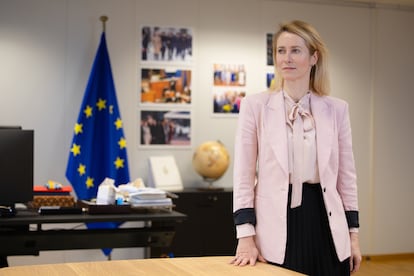

Kaja Kallas, 48, views with deep skepticism the peace plans for Ukraine currently being negotiated. In an interview in her office at the European Commission, the EU’s High Representative for Foreign and Security Policy says not only that they are disadvantageous for Kyiv, but also that they fail to establish the conditions needed to deter the invader, Russia, from repeating its aggression. The successor to Spain’s Josep Borrell is about to complete one year in the role at an extremely delicate moment for Europe: Ukraine is trying to withstand Kremlin attacks in the fourth year of the war and defend its sovereignty not only against Russia, but also against Donald Trump’s United States. Washington, Europe’s historic ally, is no longer quite so reliable. And that has completely changed the rules of the game for the Old Continent.
In this global conext — where the European Union needs unanimity to move forward and where the European Commission is highly centralized under the conservative Ursula von der Leyen — the European External Action Service is seeking room for maneuver that it has lacked on key issues. Such as Gaza, where the Estonian diplomat — who initially faced criticism for focusing too much on Russia and overlooking other areas like the Middle East — believes it is “serious” that the 27 member states have not always been able to find a common position.
Kallas’s personal history (she was Estonia’s prime minister from 2021 to 2024) with Russian imperialism — her grandmother and mother were deported to Siberia by the Soviet Union in 1949 — shapes her priorities and her vision as the head of European diplomacy.
Question. Do the peace plans for Ukraine currently being negotiated represent a real opportunity?
Answer. There are rarely cases as clear-cut as this war, where there is an aggressor, Russia, and a victim, Ukraine. To have peace, we need concessions and obligations from Russia. By my calculations, in the last 100 years, Russia has attacked more than 19 countries, some as many as three or four times; and I’m not counting the African countries where the Wagner Group [of military contractors] is operating. And none of these countries has ever attacked Russia. We need a plan to prevent Russia from invading again, instead of making things easier for them. The plans regarding Ukraine that have been made public don’t include a single obligation for Russia. And focusing on what Ukraine must sacrifice will not lead us to lasting peace.
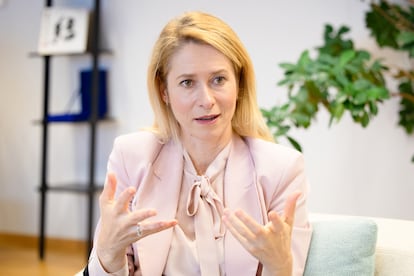
Q. You don’t appear to have too much hope.
A. Everyone welcomes the peace efforts. And I believe President Trump genuinely wants peace. And the Ukrainians yearn for it too. They agreed to an unconditional ceasefire back in February; now we need that ceasefire so we can sit down at the negotiating table. And we mustn’t put the two sides on equal footing.
Q. How can Russia be pressured?
A. We can put pressure on Russia with sanctions. The sanctions on oil are really biting. In November alone, their oil revenues fell by 35%. The Russian economy is in an extremely hard place; its national reserves are almost depleted, and its gas and oil revenues have plummeted. Twenty-five percent of Russian companies are bankrupt or at risk of bankruptcy, inflation is over 10%, and the national bank’s interest rate is close to 20%. So now they’re going to raise taxes, which is an unpopular measure. They’re also experiencing major gasoline shortages. The public is starting to feel it. Will that bring about a change? Not yet, but if they run out of money, the situation could turn dramatically.
Q. Ukraine depends on financial and military support from the West, but it is becoming increasingly difficult to mobilize funds, as with Russian sovereign assets. Does the fact that it is taking so long to make a decision about that money send a signal to Russia?
A. The Russians analyze every step we take, but even before that, I don’t think they have any genuine wish to negotiate peace. We should move from pretending to negotiate to a point where they are actually forced to negotiate. And the reparations loan is very important. Our taxpayers shouldn’t have to pay for what we didn’t destroy. Russia is causing the damage, and that means it should pay for it.
Q. The funds are in Belgium, and that country doesn’t want them released. They cite risks of Russian reprisals, including against the euro, and maintain that it would harm the peace negotiations. Will you be able to convince the Belgian government?
A. Belgium has legitimate concerns. The first step is to mitigate the risks and then to share the burden of those risks, with everyone’s agreement. This can be done if there is political will.
Q. After Trump’s heated exchange with Ukrainian President Volodymr Zelenskiy in the Oval Office, you said on social media: “the free world needs a new leader. It’s up to us, Europeans, to take this challenge.” However, it seems that the EU is not at its best moment as a global geopolitical actor and is heavily dependent on what Trump does and says…
A. To be a geopolitical actor, we need unity. And of course, both our allies and our adversaries know that they want to divide us and deal with each of us separately. I try to coordinate a foreign, security, and defense policy with common lines, but it’s not easy; we are 27 countries. The U.S. has been our greatest ally and continues to be.
Q. But you mentioned the need for a new world leader. Is the EU better suited for this role than the U.S.? Is it in a position to assume that leadership?
A. Let’s think about the EU’s core values: respect for human rights, for the rule of law, for international law. When I travel the world, countries increasingly look to Europe because we are a reliable partner who still believes in international law and the rules-based multilateral system. And countries around the world, especially small ones, understand that international law is the only thing that protects them. If we discard the U.N. Charter, which prohibits changing borders by force, we are all in danger. The world order is changing. And it is up to us, the EU, to steer this in the right direction.
Q. What is your relationship with the United States?
A. When I travel the world, many countries tell me that it used to be easy because the EU and the U.S. agreed on everything. That’s no longer the case, and that makes things more difficult, but we are supporters of international law and multilateral forums, just like most countries in the world. That’s why they look to us when we talk about trade.
Q. There is a feeling that Europe has applied a double standard by declaring Russia an aggressor while not doing the same with Israel for its attacks on Gaza, even though the U.N. has described them as genocide.
A. It is serious that in Gaza [the 27] we have not always been able to reach a unified position. But we have reached many agreements on the need for humanitarian aid to arrive and have full access. We all support the two-state solution and we are the biggest donor of humanitarian aid to Palestine and the biggest supporter of the Palestinian Authority. When we are accused of double standards, I always use numbers: the European Union is contributing more than €600 million [$696 million] in humanitarian aid, in addition to €1.3 billion [$1.51 billion], from 2025 to 2027, to fully support the Palestinian Authority. We are doing what we are saying to support the Palestinians and at the same time maintain good relations with Israel.
Q. You talk about aid in Palestine and Ukraine. Does Europe only play a role when it’s time to pay?
A. I have tried to guide the foreign policy and common strategies of the 27 countries. But the portfolios where the money is managed are not in my hands. We cannot rush to hand over our funds before receiving something in return because it is taken for granted that we will. And if our interests are not taken into account, then we shouldn’t contribute so much because there are countries that are heading in the wrong direction. To have geopolitical power, you need the economic power we have, but you also need to use it wisely to achieve our foreign policy interests.
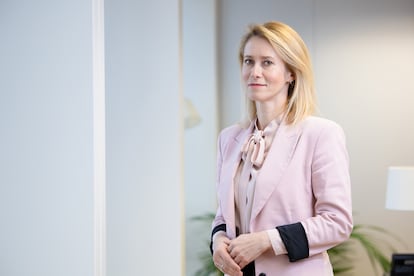
Q. Is the EU shifting its diplomacy towards a more transactional approach, like the United States?
A. We must recognize that the world has changed, that there is more transactionalism. Of course, we must stick to our values and principles, which is not to trade for anything. But at the same time, when addressing financing, we must also consider whether the countries with which we reach agreements or which we support are aligned with our foreign policy interests.
Q. Intelligence reports indicate that Russia has intensified its hybrid warfare against Europe. Is this because Europe is now weaker?
A. It’s due to two things. One is that they want to test how far they can go, and that depends on our reaction. The other is that they want to sow fear in our societies so that we refrain from helping Ukraine. We must have a balanced approach, be very firm, and think about how to prevent these attacks. That’s why we have the drone initiative, which was initially intended only for the eastern flank and has now been extended to all of Europe: drones can also take off from the sea and reach countries like Spain and Portugal.
Q. The Russian opposition has criticized the European measure to tighten visa requirements.
A. Russia is not a democracy; what matters to the dictator is keeping his cronies happy. So the elites keep the power structures, like the police and the army, happy and eliminate all alternatives. The elites live in Moscow and St. Petersburg, and they are the ones who travel because most Russian citizens don’t have the means. Wealthy people, for now, feel no effect of the war because it is being fought on Ukrainian soil. It is Ukrainian civilians who are dying: 93% of Russian targets have been civilians: hospitals, schools, apartment buildings, energy infrastructure. Russians still feel that the war is very far away. The majority of the Russian people support the war, and they do so primarily for the glory, because for them, conquering other territories means glory, because they don’t feel the suffering of the Ukrainians. So, if they can’t travel, perhaps they also feel that they are paying the price of the war. And that could have a small effect of putting pressure on the Russian leadership, which might change things.
Q. It’s been 30 years since the Barcelona Process, the Euro-Mediterranean cooperation project. It seems that Europe is once again focusing its attention on the Mediterranean area and its surroundings. Has the EU neglected its neighbors, and is it only now paying attention to the region again as other actors, such as China and Russia, try to occupy this space?
A. Now we have a Commissioner for the Mediterranean in the new commission. This demonstrates the importance we attach to it. Yes. If we look at Africa, we see that China, or even Latin America, are approaching countries and operating differently. But we come with a positive offer. If the Chinese come to extract crucial raw materials, they don’t care about the local people, while the Europeans offer that it’s in our best interest for jobs to be wherever they are and for people not to have to migrate from their homes if they have work and prosperity; so that’s also in our best interest.
Q. European political leaders have insisted that the United States should not declare war on Venezuela. You have been in the region recently. How serious is the danger?
A. The countries of the region, both in the Caribbean and Latin America, are extremely concerned and eagerly await our support and defense of international law. We held very intensive discussions on all of this during the EU-CELAC summit. Drug trafficking and organized crime are a global problem and therefore require global solutions. We are ready to support our Latin American partners.
Q. Is the European Union also concerned?
A. I always hate when the European Union is “concerned,” as a concept. The question is: what are we doing about it? The cities and security alliance we forged with the CELAC countries is more tangible; we also address the issue of cryptocurrencies because, often, it’s about tracing the money and then getting to those behind it. But with cryptocurrencies, the situation is becoming increasingly difficult. I believe in this alliance for cooperation on citizen security with Europol, the exchange of maritime data, and all these practical measures to combat this fear and make Latin America stronger.
Sign up for our weekly newsletter to get more English-language news coverage from EL PAÍS USA Edition