
Trump to assess next steps in Venezuela after meeting with advisers
The president has confirmed he spoke to Nicolás Maduro by phone on November 21. According to Reuters, during that call the Chavista leader received a deadline to step down by last Friday. The Venezuelan leader is allegedly seeking a second phone conversation
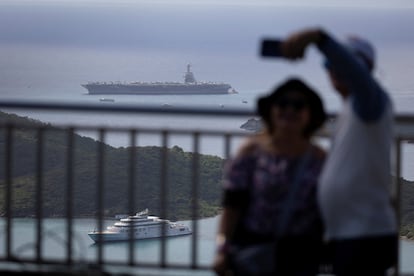

U.S. President Donald Trump met with his national security team on Monday to discuss the next steps regarding Venezuela, according to the White House, which did not provide details on what was discussed. Tensions have been running high for days over the possibility that the president may order attacks on land targets in the South American country.
The White House has also confirmed that on September 2, when U.S. forces sank the first alleged drug-running boat in Caribbean waters as part of their anti-drug campaign, they carried out a follow-up attack that killed the two survivors detected after the first strike. Spokeswoman Karoline Leavitt attributed the order to Admiral Frank Bradley, head of the Special Forces command.
The meeting took place 24 hours after Trump confirmed that he had spoken to Venezuelan president Nicolás Maduro by phone. According to an exclusive story by Reuters, during that call on November 21, the U.S. president gave the Chavista leader a deadline to step down by Friday, November 28, in exchange for guaranteeing his safe passage to a third country. According to sources cited by Reuters, that offer is no longer on the table.
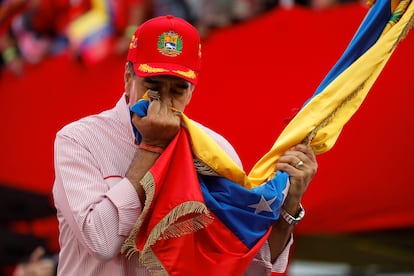
The expiration of the deadline without Maduro stepping down precipitated Trump’s announcement on Saturday that the airspace above and surrounding Venezuela should be considered “closed in its entirety,” according to Reuters.
Among his conditions, Maduro demanded full legal amnesty for himself and his family, an end to international sanctions against him and a hundred other senior Venezuelan officials, and the withdrawal of the charges he faces before the International Criminal Court. He also proposed the formation of an interim government headed by Vice President Delcy Rodríguez until elections could be held.
If the news agency’s information is confirmed, Maduro’s options have become considerably more complicated. The Chavista government is seeking a second telephone conversation, according to Reuters.
Monday meeting
Defense Secretary Pete Hegseth was one of the participants at Monday’s meeting of top Trump advisers. Also present were Secretary of State Marco Rubio, Chief of Staff General Dan Caine, Trump’s Chief of Staff Susie Wiles, and Wiles’s number two aide and the president’s chief domestic policy advisor Stephen Miller, among others. The meeting took place in the Oval Office—not the Situation Room, as would be the case for any ongoing operation— and White House spokeswoman Karoline Leavitt indicated that, in addition to Venezuela, a number of other issues would be addressed.
Although he has admitted to speaking with Maduro, Trump has given no indication as to whether that call bore any fruit. “I wouldn’t say it went well or badly, it was a phone call,” he told reporters accompanying him aboard Air Force One on his return to Washington on Sunday night, after spending Thanksgiving at his private residence in Florida, Mar-a-Lago.
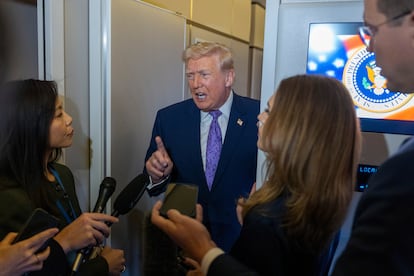
The day before, the president had set off alarm bells by announcing to international airlines that they should consider Venezuelan airspace “closed in its entirety,” in what appeared to be a warning that some kind of U.S. action was imminent. But in his remarks to the press on Sunday, he cautioned against “making a big deal out of it” or “reading too much between the lines.”
Direct contact between the two presidents had raised hopes for a diplomatic solution to the conflict between their governments. Washington accuses Maduro of “narco-terrorism” and of leading the Cartel of the Suns, a term used to refer to corrupt groups and individuals within the Venezuelan government and the armed forces with ties to drug trafficking. Last week, the State Department added the Cartel of the Suns to its list of foreign terrorist organizations. The United States also considers the Chavista leader an illegitimate president due to irregularities in the electoral processes, particularly those of 2023.
The fight against drug trafficking is the argument Washington uses to justify the massive military deployment it has maintained in the Caribbean since August. Since September 2, U.S. forces have carried out at least 21 attacks against suspected drug-running boats in international waters in that sea and the eastern Pacific, killing at least 83 people in what has come to be known as “Operation Southern Spear.” The addition of the Cartel of the Suns to the list of terrorist organizations provides Washington, in the opinion of the administration, with new tools to launch a new phase of the operation that includes targets in Venezuelan territory.
State Secretary Rubio, one of the senior advisers at the Monday meeting, is a well-known hawk on Venezuela. He is one of the key architects of the hardline policy toward Caracas, including the U.S. military deployment.
Defense Secretary Hegseth, meanwhile, is embroiled in a major controversy after The Washington Post published information that, if confirmed, could make the Pentagon chief guilty of war crimes, according to several lawmakers. According to the Post, on September 2, in the first attack against a suspected drug-running boat carrying 11 people, two individuals survived and were seen clinging to the wreckage. A follow-up strike killed the survivors.
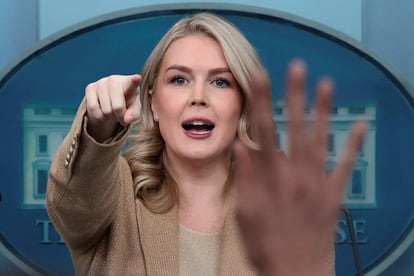
At her weekly news conference on Monday, Leavitt confirmed that the second attack did indeed take place. According to her explanation, the decision was made by the head of Special Operations Command, Admiral Frank Bradley, on grounds of “self-defense,” in “international waters,” and said the admiral “worked well within his authority and the law directing the engagement to ensure the boat was destroyed and the threat to the United States of America was eliminated.”
Leavitt did not provide any arguments to justify that the second attack complied with the laws of armed conflict. The Pentagon’s 2023 Law of War manual specifically cites an order to attack shipwrecked sailors after an action at sea as an example of a case in which an order from a superior should be rejected.
The Pentagon and Hegseth have denied the information reported by The Washington Post. On Sunday night, the Secretary of Defense posted a supposedly humorous image about the attacks on his social media account. It is a parody of a children’s book, featuring the title “Franklin Targets Narco Terrorists” and showing Franklin shooting a rocket-propelled grenade from a helicopter.
Trump has also rejected the accusations against his Pentagon chief, albeit more ambiguously. “I don’t know anything about this,” he declared aboard Air Force One. The president also stated that he “wouldn’t have wanted that, not a second strike.”
Sign up for our weekly newsletter to get more English-language news coverage from EL PAÍS USA Edition









































