
Argentina creates a National Migration Agency with more police power inspired by US Border Patrol
Border immigration controls are being transferred from the Ministry of the Interior to the Ministry of Security, and will no longer be in the hands of civilians
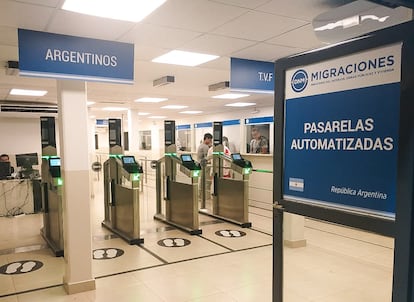

Immigration controls at Argentine border crossings will no longer be in the hands of civilians. The government of Javier Milei announced on Tuesday the creation of a National Migration Agency that will report to the Ministry of Security, not the Ministry of the Interior, as is currently the case.
The new department will coordinate the work of all security forces, such as the Federal Police, the Airport Police, and the Gendarmerie, in combating transnational crime. The ultimate goal is the creation of an immigration police force modeled after the U.S. Border Patrol, which is now a key component of the border control model promoted by President Donald Trump.
The official launch of the new agency was Patricia Bullrich’s last official act before leaving her post as Minister of Security to take a seat in the Senate. Bullrich, a proponent of a hardline approach to crime, will be replaced by her deputy, Alejandra Monteoliva, thus ensuring the continuity of her policies.
Milei likes to talk about the “Bullrich doctrine,” which he attributes to the end of street and highway blockades as a form of social protest. In a second phase, the Casa Rosada promoted replicating U.S. security agencies in Argentina, a country that, through Trump, has become the economic backbone and ideological mirror that Milei’s libertarian government looks into.
Milei’s fascination with Trump and everything associated with the U.S. has even led him to propose the creation of an Argentine FBI. During a speech last June, he promised a reform of the Federal Police that would allow this agency to make arrests or conduct espionage without judicial authorization. The reform announced this Tuesday is also inspired by U.S. security models, although with economic resources that are light years behind and very different realities.
The new agency, the government said in a statement, “will optimize border coordination, policing, and migration intelligence to confront transnational threats. Given the region’s critical violence and criminal displacement, border protection has become a national security objective, not merely an administrative one.” According to Minister Bullrich, Argentina “has managed to keep the major [transnational] gangs very much under control here.”
“Today we need to transform this National Directorate [of Migration] into a National Agency, one that comprehensively addresses all the migration issues we have in our country,” she added.
In any case, this represents a paradigm shift, because immigration was historically under the Ministry of the Interior. Bullrich secured the transfer to the Ministry of Security thanks to an agreement with Karina Milei, Milei’s sister and Secretary General of the Presidency, currently the most powerful person in the government.
The same paradigm shift was applied by the government when, over the weekend, it appointed a military officer to head the Ministry of Defense, a portfolio that had been in civilian hands since Argentina’s return to democracy in 1983. The government clarified that its intention was “to put an end to the demonization of our officers, non-commissioned officers and soldiers” which, according to the renewed reading of history promoted by the far right, is suffered by the heirs of those convicted of crimes against humanity committed during the last dictatorship.
Sign up for our weekly newsletter to get more English-language news coverage from EL PAÍS USA Edition









































