
Two girls killed in the mountains of Sinaloa, 119 shots fired, and 13 soldiers involved: The daylight attack no one wants to talk about
EL PAÍS has obtained details of the investigation into an apparent mix-up by uniformed officers, an investigation that is progressing through the courts beset by numerous contradictions
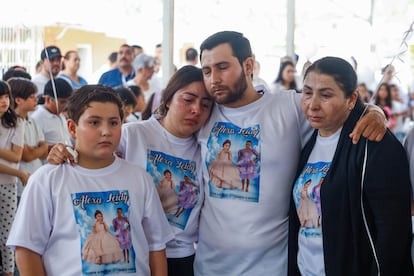

119 bullets, 13 soldiers implicated, and two young girls dead. This is the toll of the attack by a group of uniformed soldiers in May against a family’s SUV in Badiraguato, in the mountains of Sinaloa, in northwestern Mexico. Details of the investigation, to which EL PAÍS has had access, shed light on this event — an apparent case of mistaken identity — which the government of Claudia Sheinbaum has barely addressed in recent months. The attack, which left two other minors and two adults wounded, revives concerns about trigger-happy soldiers, given the military deployment in the country in recent years as part of the strategy of successive governments in the fight against organized crime.
Just this week, Secretary of National Defense Ricardo Trevilla touched on the matter briefly, when questioned at the president’s morning press conference. “Investigations were opened by the Attorney General’s Office (FGR) and the Military Attorney General’s Office. In the military case, the judge ordered the imprisonment of six officers. As for the civilian case, the FGR is handling the homicide investigation. That is the situation,” said the army chief. Although military justice initially imprisoned 12 of the 13 individuals involved — according to this newspaper’s sources, on charges of disobedience — six were released months later, judging by Trevilla’s statements. The 13th individual involved was never arrested. The reason is unknown.
EL PAÍS contacted the spokesperson for the Ministry of Defense to inquire about the latest developments and to understand why half of the 12 soldiers remain imprisoned while the others were released, but received no response. Similarly, this newspaper contacted the spokesperson for the Attorney General’s Office to inquire about the status of the civilian investigation, but also received no response. The soldiers involved were part of the 42nd Infantry Battalion, based in Guamúchil, just north of Badiraguato. The incident occurred after 2:30 p.m. on May 6, on a highway outside the municipal capital. Badiraguato is one of the largest municipalities in the state, encompassing dozens of communities and ranches. The attack took place amid the ongoing battle between factions of the Sinaloa Cartel, a conflict that began in September 2024 and continues to this day.
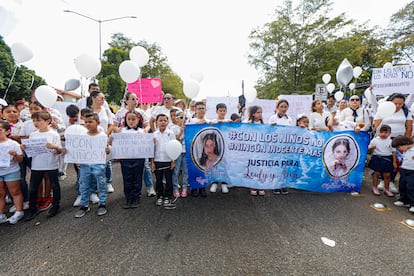
The case made headlines as the horrific result of a clash between soldiers and armed civilians, a version promoted by the authorities. According to this account, the family’s pickup truck was caught in the crossfire, and bullets struck two of the girls, Leidy, 11, and Alexa, 7, who were riding in the truck bed. As the hours passed, relatives of the girls and the other victims rejected this version, stating that the soldiers had fired without any provocation. Witness statements given later to the military or civilian prosecutor’s office indicated that they heard gunfire from the hill or a rise on the left side of the road. Only one person reported hearing gunfire from the direction in which the truck had passed.
At least 13 of the 24 soldiers in the three-vehicle convoy admitted to firing their weapons. Of those 13, two were in the first vehicle, seven in the second, and four in the third. The lieutenant in command of the convoy stated that he heard no shots fired before his men responded and that he ordered them to cease fire. A count of the ammunition carried by the soldiers, both before and after leaving their base, indicates that 119 rounds were fired. Of those, the family pickup truck, a black GMC Sierra with an open bed, was hit by 38 bullets, mostly in the vehicle’s body and windows.
This case is not unique under Sheinbaum’s administration. In October, soldiers shot and killed six people in Tamaulipas, apparently farmworkers in the region’s agricultural fields. A year earlier, in Chiapas, soldiers also killed six migrants, allegedly in a case of mistaken identity. In both cases, as well as in Badiraguato, the government’s reaction has been similar. Sheinbaum has expressed regret over the events, promised an investigation, and reiterated that the army does not operate as it did in the past, referring to the eras of Felipe Calderón (2006-2012) and Enrique Peña Nieto (2012-2018), when such incidents were more common.
But situations like the one in Badiraguato reveal certain discrepancies between the president’s words and the military’s actions. First, there’s the narrative. In the hours after the event, authorities tried to promote the idea in the media that the family had been caught in a crossfire, shifting responsibility away from the military. Only the statements of the victim’s relatives shed some light on what happened, allowing them to challenge the official version. And then there are the military protocols. The soldiers in Badiraguato fired over 100 rounds at a pickup truck in which four children were riding in the open bed, in broad daylight.
Sign up for our weekly newsletter to get more English-language news coverage from EL PAÍS USA Edition









































