
Disappointment among families of exiled Palestinian prisoners: ‘I thought maybe the list was wrong’
A last-minute Israeli change to the list delivered a dozen prisoners who were to be released in the West Bank to Egypt instead
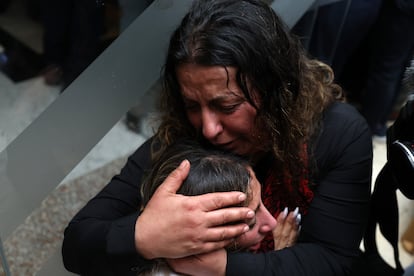

Ibtisam and Raed Imram are devastated. Nothing stems their tears. Not even hugs, or well-intentioned words of comfort. Three days ago, their brother Muhammad appeared on the initial list of the 100 Palestinian prisoners — out of a total of 2,000 — scheduled for release on Monday in their native West Bank, as part of the exchange with Hamas for the last 20 surviving Israeli hostages. On the final list, published the same morning of the release, he was among the 154 expelled to Egypt, as a result of the opaque changes that the Israeli authorities introduced at the last minute, taking advantage of their position of strength and the fact that U.S. President Donald Trump was flying to Israel to showcase his success before parliament. “I was hoping to see Muhammad today. I thought maybe the list was wrong… but unfortunately, he didn’t come,” Ibtisam said at the Cultural Palace in the West Bank city of Ramallah, while other families tried to cheer her up by expressing things like “everything is in God’s hands” or “I hope he still shows up.” He never arrived. The last bus carrying prisoners left empty, and his two siblings returned, heads down, to the car in which they had traveled two days earlier from the Hebron area, certain that they would hug Muhammad again on Monday.
The feeling is bittersweet as they are also aware that, without the exchange, Muhammad would still be behind bars today. He is 43 years old and an Israeli military court sentenced him to 13 life terms for masterminding a notorious ambush in Hebron in 2002, in the midst of the Second Intifada. Three Islamic Jihad militants killed 12 soldiers, border police, and security guards in the Jewish settlement of Kiryat Arba, opening fire simultaneously from several directions. Muhammad was released after 23 years in prison on Monday, a sentence he served in part without family visitation rights.
Ibtisam’s account echoes that of other families of prisoners waiting in Ramallah Monday, and what the Palestinian prisoners’ association reported last week. She says an Israeli military commander told her by phone that her brother would be released in Ramallah this Monday. Then, several Israeli soldiers (the West Bank has been under military occupation for almost six decades) burst into her house in the early hours of the morning to warn that any celebration of Muhammad’s return, no matter how small, would end with the entire family in prison. “They raided the house, destroying everything inside, and informed us that he was going to be released and taken to Ramallah, and that any kind of celebration was prohibited. His name was on the list of those who would be released and taken to the West Bank. This morning, we were surprised to see that he was now among those deported. I can’t believe the lists aren’t clear and no one knows what’s going on,” she said through tears.
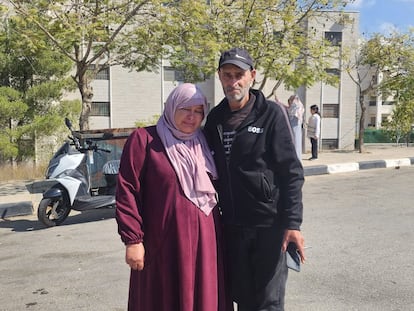
Between sobs, the woman questioned other prisoners, desperately searching for information that contradicted the reality her brain was processing as more and more inmates were released, and none of them were her brother. One of them hurriedly confirmed that Muhammad was with them in Ofer (the West Bank military prison where they gathered part of the 2,000 prisoners for the exchange), but that prison officials took him away the evening before with the group of deportees. In reality, she knows from the media that her brother is on his way to Egypt, but she hasn’t been able to speak with him yet — something other families also report — nor does she formally know anything more than what appears on the final list: his expulsion to an unidentified country.
For Palestinians in the West Bank, the exile of their families is more than a disappointment. It probably means never seeing them again, except by video call. Israel prevents Palestine from having an airport, controls any exit from the West Bank — including to Jordan — and often bars the extended family of those convicted of attacks against Israelis from crossing the border.
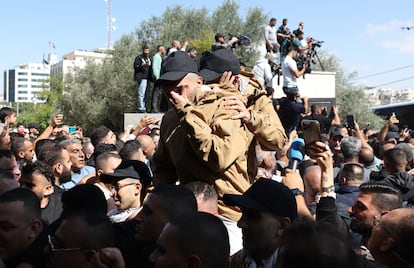
Ibtisam’s case was no exception on Monday in Ramallah. Some faces showed signs of painful anticipation, while the crowd chanted “Allah is the greatest” and lifted up the 88 who did arrive on their shoulders. A gray-haired man with a distraught expression burst in among the first batch of released prisoners, asking anxiously, “Was Abu Ahmed with you? Was he with you?” Someone replied that he had seen him, but that Israeli prison officials hadn’t allowed him to board the bus.
There was confusion due to last-minute changes to the list and because the Palestinian Authority representatives present at the scene could provide little insight to the families: their only role in the process was to receive the names.
Former minister in charge of prisoner affairs, Qadura Fares, was one of them, and he attacked Benjamin Netanyahu’s government for “manipulating” the list at the last minute. “Last night [Sunday], around 12 prisoners were supposed to be released to the West Bank, but Israel exiled them. It’s the same miserable tradition they follow with every agreement: not respecting it. They always look for loopholes to violate them,” he complained on the steps of the center.
Fares also admitted his “disappointment” at Israel’s veto of the five most prominent names: Marwan Barghouti, Ahmad Saadat, Abbas Al Sayyid, Ahmad Abu Al Hayja, and Abdullah Barghouti. They are serving sentences ranging from 30 years to life imprisonment for organizing attacks against Israelis. Hamas, from its position of weakness, failed to impose a single one on the Israeli government. The negotiation was further tainted from the moment Trump announced a deal, although the parties had not yet agreed on a list of prisoners.
Among the 12 last-minute changes reported by the former minister were those of Miqdam Yaber and Mohammed Al-Hammami, whose families waited with distraught faces before the prisoners’ release.
Abu Yawad, Yaber’s brother, was struggling with despair and denial over the “deeply frustrating and painful” news that had descended upon him overnight. “The list we received three days ago included his name among those to be released in the West Bank, and we still don’t understand what has happened, what is happening. We have spoken with other families of prisoners who are also here and discovered that many of us are facing the same shocking situation,” he said.
Yaber himself, he says, called them (an exception to the rule over the last two years of extremely strict prison conditions) from the Ofer prison and told them he would be released on Monday in Ramallah. Israeli forces then entered the family home to warn them that “any form of gathering, celebration, or expression of joy was strictly prohibited.” In the end, there wouldn’t even be a muted celebration. “We’ve been waiting for him every second, and every second seemed like a year,” Abu Yawad lamented. His brother appears on the Israeli Ministry of Justice’s list as having been sentenced to life imprisonment in 2009 by a military court for “attempted murder, hostile acts, and murder by hostile acts.”
Mohammed Al-Hammami’s case is similar. His sister, Um Rafaat, sobbed and chain-smoked cigarettes in the car where she kept the new clothes she had bought him for the occasion. The idea was for him to take off his prison clothes, shower, and eat a huge maqluba, a typical dish in the area and her brother’s “favorite,” so she prepared it for him as a welcome home and brought it from her home in the city of Nablus, in the northern West Bank.
Um Rafaat already knew that her brother had been transferred that very morning to the section for those to be deported overseas. But she still struggled to maintain the temperature of the maqluba, hoping that it was all “a tragic mistake” and that her brother was about to “return to his people.”
She recounts the same process as Abu Yawad: her brother (born in 1979 and sentenced by the military to three life sentences) called them two days before from prison and said that they would meet on Monday in Ramallah. This was what appeared on the initial list. Israeli forces confirmed this when they entered her house “at four in the morning” to make clear the prohibition on “receiving people or holding any kind of celebration” during the exchange.
“It’s all very strange. We hoped to see him today and hug him, but we still don’t know his fate. We contacted the Ministry of Prisoners’ Affairs to confirm, but they had no information. We thought that if he was deported, the occupation [Israel] would have informed us. Our faith in God keeps our hope alive.”
Hours later, with the last workers cleaning the area where the families had gathered and the released prisoners had arrived, Um Rafaat returned to Nablus with the new clothes and the maqluba for her brother intact.
Sign up for our weekly newsletter to get more English-language news coverage from EL PAÍS USA Edition









































