
Denmark shields European summit from Russian threat
NATO allies send anti-aircraft systems and reinforcements to Copenhagen after drone incursion
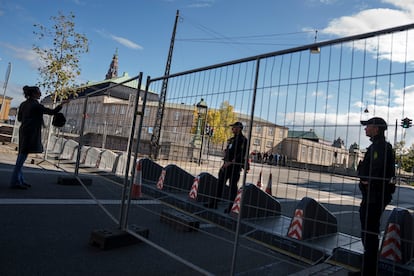

Russia is influencing the European agenda and also preparations for major EU summits. Denmark, in the midst of a security crisis following a drone incursion that forced the closure of six of its airports, is hosting two European summits on Wednesday and Thursday, which have now been reinforced in the face of the Kremlin’s threats. To try to prevent further incidents in Europe, several countries, including France, Germany, Sweden, and the Netherlands, have sent military reinforcements, unprecedented at previous such events.
The high-level meetings, which will focus on European defense and how to maintain support for Ukraine, come amid a surge in hybrid attacks from Moscow following the incursion of drones over Poland and Romania, and military fighter jets violating Estonian airspace. In an increasingly heated context following these recent events, EU leaders will discuss a series of flagship defense projects, including an anti-drone wall and an air defense shield.
Danish authorities are still investigating who is behind the incidents involving large drones that rendered, among others, the capital’s airport unusable. Investigators point to a “professional actor.” Mette Frederiksen has gone further and pointed directly to Russia, which she said is the main “country that poses a threat to European security.” “[Russian President Vladimir] Putin wants to divide us. I will do everything I can to ensure that he never succeeds,” the Danish Prime Minister, one of the most vocal European opponents of the Russian autocrat, said in a message on social media.
The EU and NATO have been on guard against the Kremlin’s hybrid aggression. France, Germany, Sweden, and the Netherlands, allies of the military organization like Denmark, have sent military reinforcements, radars, and anti-drone and anti-aircraft systems to Copenhagen. Meanwhile, the Atlantic Alliance has deployed the German frigate Hamburg. The aim is to shield the summits — which are expected to be attended by EU heads of state and government on Wednesday — and by other European countries such as Ukraine and Moldova at the semi-annual meeting of the European Political Community on Thursday.
The military support for Denmark — unprecedented for a European summit — will extend beyond the end of the meetings, at a particularly sensitive time for the allies who have provided the most backing for Ukraine. Denmark, for example, has promised fighter jets to Kyiv. The Nordic country, experiencing its greatest security crisis, has also banned the flight of all civilian drones for five days, including those used for surveying.
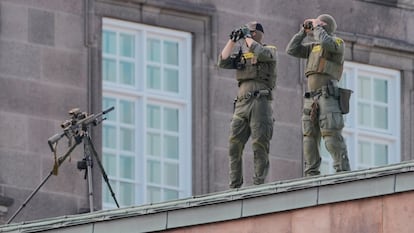
The EU-27 are meeting in Copenhagen at a crucial time for the continent’s security, as Russia has stepped up its hybrid warfare attacks, including drone and fighter jet incursions, sabotage, and propaganda and political interference operations.
The EU has set a goal for 2030 to strengthen its defense and security, boost European industry, and seek to move toward a common space with the creation of major European projects. The idea had been to focus on “pan-European” elements that would reinforce all flanks of the EU club and “protect Europe as a whole” against pressing threats. But the Kremlin’s assertiveness makes the urgency felt more keenly in the Eastern and Baltic countries, which are pushing for the so-called “drone wall” to be launched as soon as possible, with EU funding, to shield themselves from Russian aircraft, as well as a special surveillance project for the eastern flank.
“In light of the continued military aggression against Ukraine, and the recent increase of violations of airspace of member states, two flagship projects — the European drone wall and the eastern flank watch — require special urgency and should be moved forward expediently,” states a European Commission document sent to the 27 EU member states for discussion on Wednesday.
It’s also a pivotal moment for Ukraine, with the war approaching its fourth anniversary and with increasing signs that the U.S. is backing away from support for Kyiv and will leave Europe to pick up the tab and sustain Ukraine‘s defense. With this reality increasingly imminent, the EU is looking for ways to continue sending money to Kyiv, something that is becoming increasingly difficult in a context of tight budgets and with Hungary blocking new financial lifelines.
Thus, the European Commission has put forward a controversial proposal to hand over to Ukraine €140 billion ($165 billion) of Russian assets frozen in the EU due to sanctions. This fund would take the form of interest-free loans — dubbed “reparation loans” — that would only have to be returned if Moscow paid for the damages incurred by its war. With voices like that of German Chancellor Friedrich Merz calling for this fund to be used for Ukraine’s arms purchases, the Copenhagen meeting could give a boost to the idea, which will likely return to the leaders’ table at the EU summit in Brussels in late October.
Sign up for our weekly newsletter to get more English-language news coverage from EL PAÍS USA Edition









































