
A drone in the Wesolowski’s house
In the area of Poland bordering Ukraine and Belarus, with a long history of wars and destruction, the Russian threat is a reality
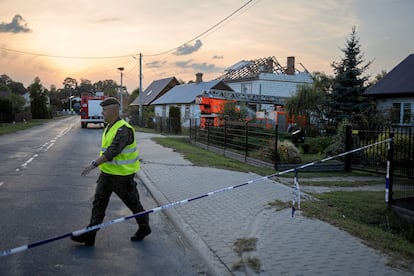

The war was always close to this village in an area of lakes, forests and fields, on the borders of Poland. These are the “bloodlands,” as historian Timothy Snyder called them, the slice of Europe where Hitler and Stalin murdered millions of people between the early 1930s and the end of World War II. We don’t really have to go back that far. The village of Wyryki is a few kilometers from the border with Belarus, and Ukraine is not far either. In this region, on the front lines of NATO and an EU that feel Russia’s breath on its neck, the sounds of Polish and allied fighter jets in the air have been familiar since Vladimir Putin ordered the invasion of Ukraine in February 2022.
But on Wednesday, the “claws” of the Russian bear, to quote Polish Prime Minister Donald Tusk, were felt in a way that Poland — so often punished by the eastern colossus — hadn’t felt so directly, so visibly, for decades. Alicja and Tomasz Wesolowski, retirees from Wyryki, are alive by a miracle. They were used to hearing planes, but the aircraft they heard flying over their three-story house next to the road that runs through the village that morning was strangely close. The noise was louder than usual. It was 6:30 a.m., and they had woken up a little earlier than usual and left their bedroom in the attic. Tomasz was watching the news downstairs on the television: the Polish Air Force had intercepted several Russian drones that evening. Alicja needed her blood pressure checked and also went downstairs.
Throughout the day, after law enforcement had blocked the road and the image of their house with its roof smashed and the remains of the building in the garden was seen around the world, both of them would tire of repeating to reporters what had happened.
“This plane is making a lot of noise,” Alicja told her husband. The noise grew louder. Then they heard an explosion. They didn’t know what it was. Tomasz, she would later say, saw parts of the roof fly into the air. She went out into the garden and looked up at the sky: she saw a plane circle above the house three times before moving away.
They later understood what had happened, and it had occurred in a similar way at various points in Polish skies. Starting at 11:00 p.m. the previous night, Polish and NATO air forces detected a multitude of drone incursions coming from neighboring Belarus, a country allied with Russia. There had been other similar incidents, such as the missile that landed in 2023, possibly by accident, near the border with Ukraine, further south. Or cases of lost drones. This time, the Polish authorities assume the incursion was intentional, and in any case, the response — Polish and NATO forces shooting down Russian drones over Polish territory — is unusual. The incursions lasted seven hours in total, forced the closure of several European airports, and have heightened tensions between Russia and the Western allies.
What exactly happened over the Wesolowskis’ home was that Allied aircraft detected a Russian drone flying overhead and shot it down. Unfortunately, the debris hit their house. They were unharmed, not a scratch. There were no deaths or injuries in the other incidents in the center and east of the country, where drones were intercepted. Clearly, the one that was shot down in Wyryki was unarmed, and the damage it caused was due to the impact. At dusk, in the darkness of this poorly lit village, the road remained closed, Alicija Wesolowska continued to tell her story to journalists and television crews, still reeling from the shock, and the mayor strolled around welcoming foreign journalists. Tusk had said hours earlier that, faced with Russia’s “claw,” Poland — and Europe — should respond with a vengeance.
In Wyryki, at that time, there was no panic or alarm. Here, war has long been a common occurrence.
Sign up for our weekly newsletter to get more English-language news coverage from EL PAÍS USA Edition









































