
Sex life after prostate surgery: ‘We need to rethink concepts like virility and change the rules of the game’
Suffering from prostate cancer or benign prostatic hyperplasia (BPH) is not the end of a relationship. Technology and sexologists offer solutions to maintain erections and orgasms, even if ejaculation is no longer possible


There are two moments in human life that are greatly feared. This is because, for centuries, they were seen as the official end of sexual life. In women, menopause not only signified the end of fertility, but also the end of a satisfying sex life, given the arrival of vaginal dryness, a lack of sexual desire, and the discomforts typical of this stage. And men weren’t exempt from this ordeal: in their case, it came in the form of prostate problems, with surgeries that could put an end to erections and/or ejaculation. Both topics were thorny issues that were best left unspoken.
Jaime, 63, experienced this firsthand when he began having prostate problems. The Madrid native was diagnosed with benign prostatic hyperplasia (BPH), a non-cancerous enlargement of the prostate gland, which is very common in men over the age of 50. “My first reaction was relief to learn that I didn’t have cancer,” he sighs. “The doctors told me it was a simple procedure… but they didn’t explain much more than that. I was worried about my health, but also about what my sex life would be like after the operation. The specialists weren’t very clear and said that it depended a lot on [the specific] patient. When I asked other men who had gone through the same thing, they all told me they were fine, that they performed as always in bed… but they didn’t seem to want to elaborate on the subject.”
Menopause — that existential tsunami that mature women must navigate — has become a trending topic in recent years. However, men still struggle to talk openly about their prostates. “It’s a taboo subject, because a man’s virility is still measured by his erections and ejaculations,” Raúl González Castellanos, a sexologist, educational psychologist and couples therapist practicing in Madrid, notes.
“The prostate has two pathologies: prostate cancer and benign prostatic hyperplasia,” Dr. Rodrigo García-Baquero explains. A urologist, andrologist, and member of the Spanish Association of Urology, he practices at the Puerta del Mar University Hospital in Cádiz. “[The] cancer is a malignant degeneration of prostate cells, which generates a tumor. And the second pathology is the enlargement of the prostate, which compresses the urine stream through the urethra. The latter is inherent to aging,” he explains.
“During a surgery for benign prostatic hyperplasia, only the adenoma — the enlarged part of the prostate that compresses the urethra — is treated. [The procedure is] usually performed endoscopically (through the urethra, without needing to make an incision) using laser [technology]. There are many surgical procedures, but the most well-known is laser enucleation,” García-Baquero continues. “This surgery doesn’t affect erections, but it very often affects ejaculation. The patient maintains his erections and orgasms, but he may not ejaculate. This is called a dry orgasm, or retrograde ejaculation. The orgasmic sensation changes slightly, because part of that pleasurable feeling comes from the sensation of decompression of the pressure chamber, which occurs during ejaculation. It’s a different kind of orgasm, neither better nor worse,” he adds.
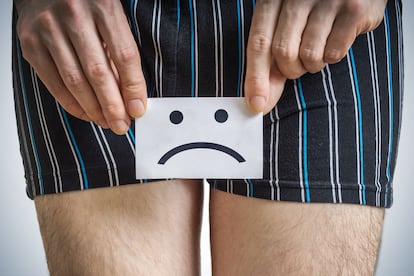
Benign prostatic hyperplasia comes with typical symptoms, which Jaime describes perfectly: “A weak urine stream, difficulty completing urination, a feeling of incomplete bladder-emptying, getting up to urinate four or five times a night, a lack of bladder control, such as [an urgent need to pee], or dribbling after urination.” These symptoms typically begin around ages 55 to 60.
“Not all patients with BPH require surgery,” García-Baquero clarifies. “Initially, if the symptoms are mild, medication is recommended. [But] if there’s no response, or if the symptoms worsen, then surgery is performed. And the sooner it’s done, the better, because the bladder suffers if it struggles for years with the obstruction caused by the prostate. If a long time passes and the patient urinates poorly, the bladder can suffer irreversible damage, [such as] loss of elasticity. It can become an atonic bladder (without tone) and, if the obstruction is severe, it can even affect kidney function. It’s a chain reaction of pressure; if it increases upwards, it can affect kidney function.”
A balance between complete tumor removal and preserving erections
The word “cancer” generates fear, anxiety, and uncertainty. In the best-case scenario when it comes to this type of cancer, the general perception is that sexuality is the price that has to be paid to stay alive. “In its initial phase, prostate cancer doesn’t cause symptoms,” Dr. Fernando Gómez Sancha emphasizes. He’s a urologist, prostate expert and medical director at the Institute of Advanced Urological Surgery (ICUA) in Madrid. “When blood appears in the urine — along with localized pelvic pain or bone pain — the disease is already more advanced. We usually see indications through a PSA test. Then, there are other markers, such as digital rectal exams, MRIs, as well as the definitive diagnosis that comes from a biopsy. Most cases are diagnosed in older people: 90% of patients are over 65, while the average age at diagnosis is 75. However, it can also occur in younger people. Therefore, if there’s a family history, [the patient] should be screened earlier. We recommend starting screening at age 45 if [a mutation in the] BRCA2 gene is present.”
“The symptom that all patients experience after a radical prostatectomy is the loss of ejaculation, because the prostate is the semen factory; 95% of semen is produced in the prostate and seminal vesicles, which are also removed during this operation,” Gómez Sancha explains. “Now, that doesn’t prevent orgasms: even without an erection, the patient can still have an orgasm when his penis is stimulated. The risk has to do with losing erectile function: [this] depends on the anatomical fact that the nerves that go to the penis and produce an erection are very close to the prostate. Depending on the case, if the cancer is diagnosed early and the tumor [removal] allows for it, we can perform a less invasive surgery and preserve those nerves. Then, the patient regains erectile function after surgery. There’s always a balance between removing the tumor completely and preserving erections.”
“One year after surgery, 75% of our patients worldwide are able to have erections, with or without medication. This depends on their previous [erectile capacity], since many patients have difficulties before surgery; they already come in with very limited erections,” this expert continues. “Another side effect of the operation is a shortening of the penis when flaccid. This is because, when the prostate is removed to suture the urethra to the bladder, it has to be pulled slightly inwards. This tension makes the penis shorter when flaccid, but it maintains the same length when erect.”
“Another important detail is that, sometimes, when we preserve the nerves during surgery, patients experience something called neurapraxia, a phenomenon in which a nerve that is touched or inflamed temporarily stops functioning. This can cause some patients to experience erectile dysfunction in the first few months after the operation, but they usually recover.”

Isabella, 65, experienced her husband’s prostate cancer diagnosis when he was 57. “At first, you only think about saving his life. But then, once the problem was resolved, he — having always been a very sexually active man — began to feel bad, because he had serious erectile problems. We tried many things, but what saved us was changing our understanding of sexuality with the help of a sex therapist. We’ve rediscovered our connection after a difficult period, when I was going through menopause and had discomfort during intercourse or a decreased desire. Now we’re more sensual and less sexual… and that’s not bad at all,” she says.
There are also solutions for cases where erections don’t come back. “Initially, we try [prescribing] medications, especially if they preserve the nerves,” Gómez Sancha notes. “The vacuum device is also recommended. It’s a cylinder into which the penis is inserted. And, when a vacuum [function] is created, an erection is experienced.”
“Alprostadil is a prostaglandin (a lipid compound) that dilates the arteries of the penis. [It’s] a powerful vasodilator (a medicine that helps open blood vessels) used primarily as a treatment for erectile dysfunction. It can be administered as a cream, or as injections into the penis. And then, there’s the penile prosthesis. The patient has a remote control and, [by pressing that], the prosthesis becomes erect. The erection lasts as long as desired, something that satisfies many couples.”
Still, Gómez Sancha warns, “even with assistance, a life in which you can never have sex again isn’t the same as one in which you can.”
Technology helps, but even more helpful is reflecting on the evolution of one’s own sexuality. “Making peace with your body, regardless of the situation you’re in, is always a good thing to do,” González Castellanos, the sexologist, points out. “Older men who undergo prostate surgery have already been losing some of their [sexual] abilities over time. The most difficult cases are young men, who, after a radical prostatectomy, see their sexuality change overnight. But we have to keep at it: [we must] review concepts like virility and change the rules of the game, so that the game can continue.”
Sign up for our weekly newsletter to get more English-language news coverage from EL PAÍS USA Edition









































