
Is psychedelia making a comeback? The limits of the medical use of hallucinogens
Donald Trump has signed an executive order to fund research into substances such as LSD and explore their possibilities in the treatment of mental health problems. Debates are being reopened on the legalization of drugs whose history has included experimentation, application within the military and now in medicine
U.S. President Donald Trump signed an executive order on April 18 that will expand and fund research into the use of psychedelic substances to treat mental health issues. For the first time in decades, the federal government is not just tolerating or indirectly funding research into psychedelic substances. This time Trump has decided to actually promote it at the federal level, focusing his efforts above all on ibogaine. But this is not the only substance that has received the green light. The clinical trials already underway with psilocybin and MDMA have been also been given a boost.
The arguments for and against are not only cultural and spiritual, but clinical and very much political. Influencing Trump’s decision is the cost of the treatment of post-traumatic stress for war veterans (an exorbitant $40 billion a year) and the opioid crisis, specifically the fentanyl epidemic. In 2023, the death toll from this drug reached 80,000.
But why now? To understand the scope of this turnaround, we must return to 1943. In the heart of a Europe at war, Dr. Albert Hofmann accidentally synthesized and sampled LSD. The scene that then unfolded has been mythologized ad nauseam: the hallucinatory bicycle ride, the visions, the revelation.
The pharmaceutical company Sandoz, however, would still take time to market it as Delysid; a drug widely distributed in Western democracies back then, which became the reference for current psychedelic drugs now waiting to be legalized by the Food and Drug Administration (FDA).
LSD is the first man-made psychedelic to enter modern scientific, medical and pharmaceutical circuits. It acts on serotonergic receptors, profoundly altering perception and the experience of the self to the point of dissolution. During its early years these qualities made it interesting to Cold War military projects. It was applied in programs such as MK-Ultra and Project Bluebird that relied on LSD to win psychological warfare: truth serum, manipulation of enemy ranks, mind control and so on. As a weapon it failed, but its clinical applications proved promising. It was thus used as a “psychomimetic” substance, not to cure, but to reproduce pathological states under controlled conditions.
Today, clinical trials point to the potential of psychedelics in the treatment of resistant depression, post-traumatic stress and addictions. Not by acting as a chemical corrector, but by intensifying the experience, making mental patterns more flexible and reopening biographical processes. It opens the door, but the result depends on context and predisposition. The jargon uses the words ‘set’ and ‘setting’ to describe the individual subjective conditions and the context in which psychedelics are consumed. Consumption of the same substance by a depressive patient in therapy will not have the same impact as that of an indigenous person in a religious ceremony or a hippie at a party.
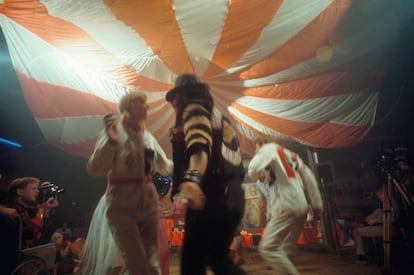
In the sixties, hippies started to use LSD. The drug left the laboratory, the military and the clinic and seeped into a more cultural environment. On the West Coast, the writer Ken Kesey and his Merry Pranksters collective turned the experience into a way of life; on the East Coast, the former psychologist Timothy Leary turned it into a spiritual revolution, and from New York, the writers Alan Ginsberg and William Burroughs integrated it into a radical exploration of consciousness. What was once an instrument of observation became a vector of vital experimentation.
The punitive reaction was not long in coming. In 1971, Nixon declared a war on drugs. But what was at stake was, strictly speaking, a much deeper and era-defining change: who has the right to alter the consciousness of an individual and under what conditions? Should this be controlled? By whom? Prohibition not only shut down the use of hallucingenics in countercultural spheres, it also restored the institutional monopoly on the legitimate use of the experience.
Since the 1990s, the “psychedelic renaissance” has been presented as the correction of the war on this particular drug. The banning of LSD is considered an anomaly because there is no scientific criterion that justifies psychedelics being relegated to the Schedule 1 category. They do not generate addiction or cause death by intoxication. Universities, start-ups and organizations such as MAPS and the Beckley Foundation have invested millions in clinical trials. But this is not a neutral or “scientific” recovery. It redefines the psychedelic experience, what it is used for, and who it should serve. It is a theme that in the contemporary social context could be explained as follows: “Psychedelics for the rich, antidepressants for the middle classes and fentanyl for the poor.”
Trump’s measure crystallizes this: from psychomimicry to psychopathologization, and, from there, to its therapeutic institutionalization through the repression of the hippie variant. Where before it was a matter of going through anomalous states to question the norm, now those same anomalies are redefined as symptoms to be treated. Those who describe this approach as the “denialist delirium” of Robert F. Kennedy, Secretary of Health, are mistaken: strictly speaking, the field is being opened to pharmaceutical companies to continue with research and patents.
The subjective plasticity induced by psychedelics is reoriented towards the production of functional subjects. Discomfort ceases to be political and becomes a clinical disorder. In this framework, microdosing leads to perfect integration: it does not seek to transform, but to optimize. It is marginal performance improvement, adaptation without question; this is the way in which the psychedelic substance is reinscribed in the global economy. Hence the unbridled enthusiasm and remarkable unconditional support of Silicon Valley, where many workers and entrepreneurs have experimented with these substances, also as support at work.
The problem with all this is not the therapeutic relief it might bring but the regime of truth that it consolidates. Only medically validated, protocolized, and commodified change is legitimate. What was once a hedonistic collective adventure now appears as a therapeutic service. The executive order does not legalize, but it does reconfigure the field: it legitimizes research and redefines priorities.
This process is therefore part of a broader transformation of drug policy. The shift has met with strong resistance in the Republican Party under the auspices of the DEA (the US Drug Enforcement Administration), the FDA and other government agencies. It will not be easy to dismantle the alliances forged to wage the war on drugs. The culture war persists. Images of the wild hippie trips of yesteryear are hard to forget. The selective approach reflects a paradigm shift: not all substances present the same risk, nor the same therapeutic utility; but absolute legalization is still not on the agenda.
Sign up for our weekly newsletter to get more English-language news coverage from EL PAÍS USA Edition









































