
Andrea Orcel: The banker in Europe who wants to do it all
UniCredit’s takeover bid for Commerzbank encapsulates the major dilemmas of the European project: from the quest for megabanks to the persistence of soverignty concerns
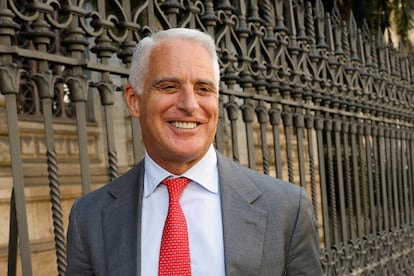
There’s a banker who’s taking the world by storm, dreaming of pan-European giants, throwing down the gauntlet to governments, and wanting to defy the unspoken rule that hostile takeovers are doomed from the start. His name is Andrea Orcel, he is the CEO of the Italian bank UniCredit, and on March 16 — with economic uncertainty running high due to the escalating Iran war — he launched an unsolicited €35 billion ($40 billion) takeover bid for Germany’s Commerzbank, a target he has had squarely in his sights for at least a year and a half.
That is, precisely, the same amount of time Berlin has been baring its teeth at the Italian executive, without managing to deter him: “Our message to Commerzbank today is it is now time to talk,” he told market analysts after announcing the takeover bid.
The UniCredit–Commerzbank episode encapsulates the European Union’s major dilemmas: the financial architecture needed to achieve political integration; the lingering national sovereignty concerns among member states, the mutualization of risks, and the debate over the creation of European megabanks that are too big to fail, recalling the trauma of the Great Recession. It is, inevitably, also a story of ambition.
“We have a European Union that must move towards political union,” explains Juan María Nin, an experienced banker, who was the former CEO of Spain’s CaixaBank and Sabadell and former director of Santander. “For that, economic union is necessary, and this is not possible without a banking union. We still don’t have a common Deposit Guarantee Fund, nor a single, financially endowed resolution mechanism to make it possible.”
In his view, and in line with the conclusions of the Draghi report, “if Europe wants to compete in the capital markets, it needs large banks like those in the United States.”
Europe suffers from over‑diagnosis and under‑treatment: theory calls for more integration and greater scale to compete in the global economy — a single market that truly applies to banking as well — but practice keeps colliding with reality.
It is one thing to launch a takeover, and quite another to be the target of one. UniCredit appeared unannounced on Commerzbank’s shareholder register in September 2024, acquiring a stake that eventually rose to 26% (28–29% including derivatives). The Italian bank has owned another German lender, HypoVereinsbank, since 2005 and saw the two as a perfect pairing. But the German government — itself a 12.5% shareholder in Commerzbank — pushed back hard.
At the time, then-chancellor Olaf Scholz dismissed the move as a “hostile attack.” Governments worry about foreign interest in their banks not only because they act as the circulatory system of the economy, but also because they are major holders of sovereign debt.
Around those same dates in Spain, BBVA’s takeover bid for Sabadell — equally unwelcome to the government and ultimately unsuccessful — was unfolding. And in Italy, UniCredit itself abandoned its bid for BPM after the Meloni government imposed heavy conditions. The tug‑of‑war between governments and banks over these operations also plays out at the national level.
Now UniCredit has launched an unsolicited takeover bid (in financial jargon, a hostile one, though the bank insists it does not want it to be) for the whole of Commerzbank. But it has done so at a modest price — only about 4% above the market value of the shares before the offer was announced — because, it says, the goal is not to seize control by force but simply to cross the 30% threshold. Reaching that level forces everyone to sit down at the negotiating table: shareholders, the government, and regulators. The aim is to agree on building a stronger institution. And German law gives UniCredit a masterstroke: once it holds 30% of the capital, the Italian bank would be free to buy more shares on the market without having to launch another takeover bid.
Orcel, now 62, is known for fighting his battles to the very end. Forged in the hard‑edged world of mergers and acquisitions, with a long investment‑banking career at Merrill Lynch and UBS, he was for years seen as something of a rock star in the industry. He is credited with engineering major deals, although the takeover of ABN Amro by Santander, RBS and Fortis at the height of the financial crisis ultimately brought down the latter two. He advised the Botín family at Santander for two decades, and the current chair announced his appointment as CEO in 2018 — but a last‑minute financial disagreement derailed the deal, and Orcel won a payout from the Spanish bank in court.
He arrived at UniCredit in 2021, and since then, the bank’s shares have risen more than sevenfold. Yet he continues to chase that elusive unicorn of European banking: “The dream of Europe having large, pan-European banks, [...] we would be the first one to do it,” Orcel told the Financial Times in November, speaking about his ambitions for UniCredit, which also owns Greece’s Alpha Bank. Because buying a bank does not, in itself, amount to a cross‑border merger.
These are difficult to achieve today. Joaquín Maudos, professor at the University of Valencia in Spain and a banking specialist, explains it this way: “If there is no consensus to approve this European deposit fund, it is because some countries of the supposed union are unwilling to mutualize risks, which is surprising, since they did so when the Single Resolution Mechanism was approved, which did have its own single European resolution fund.”
In his opinion, the obstacles are varied: a lack of homogeneity in tax regimes, differences in bankruptcy law, and differences in consumer protection. Cross‑border mergers, moreover, offer fewer synergies than domestic ones.
An executive at one of Spain’s major banks also rules out cross‑border mergers taking off in the short term for the same long list of reasons. But he adds that market fragmentation weighs on activity well beyond mergers. He also complains about the difficulties banks face when trying to roll out their products uniformly and efficiently across other EU member states.
For banks, this issue is crucial. Santander, for example, bases its efficiency and cost‑saving plans on a project called One Transformation, which involves not only creating five global divisions but also building a platform that allows the bank to standardize products across all the markets where it operates. It is no coincidence that the group’s two most recent acquisitions — Webster Bank in the United States and TSB in the United Kingdom — are in the more deregulated English-speaking market.
French President Emmanuel Macron encouraged cross‑border European integrations in 2024, but nothing has moved since. The ball in the UniCredit operation is now in Germany’s court: it can open negotiations, risk a gradual takeover by UniCredit, or look for a plan B. Chancellor Friedrich Merz has so far opposed any “hostile” attempt and has defended the bank’s independence. Italy’s UniCredit, as we know, is not giving up.
Sign up for our weekly newsletter to get more English-language news coverage from EL PAÍS USA Edition









































