
Journalism takes center stage in Venice with George Clooney, Rupert Murdoch and Gerda Taro
The film festival opens with ‘Ink,’ a drama about the rise of ‘The Sun,’ and a biopic of the pioneering photojournalist killed during the Spanish Civil War
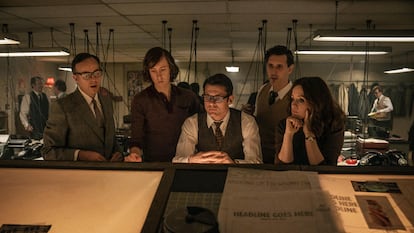

George Clooney experienced his finest moment at the Venice Film Festival in 2005. It came thanks to his second film as a director, Good Night, and Good Luck, a restrained tribute to Edward R. Murrow, the journalist who exposed Senator Joseph McCarthy’s paranoid anti-communist witch hunt. Clooney made the film with his father, journalist Nick Clooney, and all the reporters he had admired since childhood in mind.
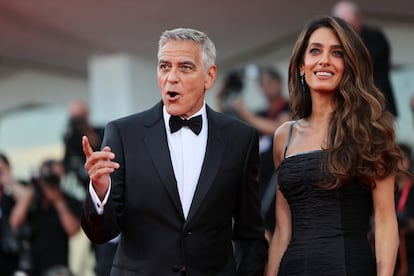
That year, the actor missed out on the Golden Lion because he was up against Heath Ledger and Jake Gyllenhaal’s sweeping romance in Ang Lee’s Brokeback Mountain. But on Wednesday, the Venice festival reaffirmed its loyalty to him by awarding him a Golden Lion for Lifetime Achievement. At a press conference beforehand, displaying his customary good sense and charm, Clooney spoke about the press, democracy and the threat artificial intelligence poses to the very idea of truth.
“I would like to avoid being in a tampon commercial 20 years after I’m dead,” he said, adding that he was concerned about how AI could affect how people perceive the truth. “Worse than that, because you poison the well of saying ‘maybe this is true’, ‘maybe this isn’t’, then when you see real things that are really true, people are able to say, ‘Well, that’s fake’,” he said.
George Clooney repeatedly spoke about his wife, Amal Clooney, saying that he had married her in Venice and that the city meant far more to them than simply a romantic destination, describing it as a place that inspires hope. He also defended free speech when asked about his colleague Mark Ruffalo. “I support Mark Ruffalo’s ability to speak freely,” he said. “I like him, he’s a good man.”
Clooney also highlighted his work on behalf of imprisoned journalists through the Clooney Foundation for Justice. “The richest people in the world right now are owning the Washington Post and Twitter and most of the places we get our information, and that is a concern,” he said. “The state of journalism is always in flux, always challenged. But I do believe that information will find its way out.”
Clooney said that, as the son of a journalist, and with a wife who also comes from a journalistic family, he has always admired the profession. He added that this is why their foundation supports journalists and others living under authoritarian regimes.
Despite maintaining an optimistic outlook, which he also applied to the political situation in the United States, Clooney did not hide his frustration. “Where’s the sense of decency in all of this? I’m ashamed of all of that. But we will get through it, and we will come out better on the other side,” he said.
The actor also suggested that he now sees himself in a different phase of his career and that he prefers spending time with his nine-year-old children. Reflecting on growing older, he struck a wistful note: “Everything is melancholy. You brush your teeth, you’re like, ‘Oh, my teeth used to be so much nicer.’”
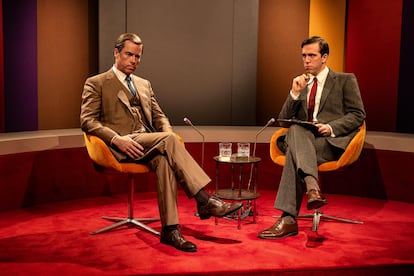
Journalism was the star of the festival’s opening day, and not just because of what Clooney had to say. The opening film, Ink, by British director Danny Boyle and based on James Graham’s stage play, tells the story of how The Sun was transformed in the 1970s by Australian businessman Rupert Murdoch and British editor Larry Lamb into the United Kingdom’s most widely read tabloid.
Drawing on the frenetic, irreverent style that has defined his work since Trainspotting, Boyle charts the populist evolution of a newspaper that embraced television news, sport, crime stories and sex in a bid to attract and retain ever more readers.
The result is packed with memorable lines about what journalism is and what it is not, all of which could be distilled into the idea that a tabloid seeks to be a mirror in which readers see themselves rather than a window through which they can understand the world. Boyle depicts that slide toward a more unscrupulous brand of journalism with energy and wit, but he never quite moves beyond the surface in his portrayal of the central characters. In the clash between editor and proprietor, with Guy Pearce as Murdoch and an excellent Jack O’Connell as Lamb, it is Lamb, who died in 2000, who ultimately emerges as the darker figure.
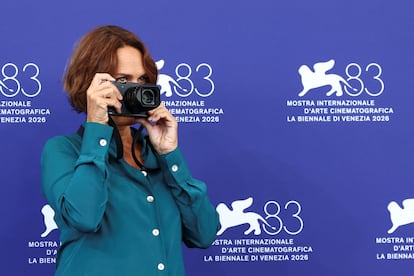
A third film to put journalism front and center was Alina Marazzi’s biopic of the legendary German Jewish photojournalist Gerda Taro, which opened the Orizzonti section.
Titled The Girl with the Leica, the film weaves together a briskly edited collage of archival material, ranging from photographs by Taro and her partner, Robert Capa, to newsreels featuring Spanish dictator Francisco Franco, footage from the Spanish Civil War and Nazi Germany, and records of the international anti-fascist movements of those turbulent years.
Marazzi adopts a feminist, first-person perspective, using Taro’s voice and occasional anachronisms to guide viewers from Germany to France and Spain alongside a pioneering photographer whose legacy was long overshadowed by Capa’s fame. Capa was the author of one of the most famous and fiercely debated photographs in history, The Falling Soldier.
Taro and Capa took many photographs together, but many of those images were credited solely to him. Her death, after being crushed by a Republican tank while retreating from advancing Nationalist forces, complicated efforts to fully define her legacy.
Referring to the debate over the scarcity of women directors in competition, Marazzi said it was fitting that the film was screening in Orizzonti, Venice’s second-most prestigious competition section. She described Taro as a woman whose achievements had long been overlooked, adding that researchers’ efforts had gradually brought her story back into view.
Her film, presented at a Venice Film Festival where journalism and the work of documenting reality dominated the opening day, contributes to that effort as well.
Sign up for our weekly newsletter to get more English-language news coverage from EL PAÍS USA Edition









































