
‘Chess Mates,’ the documentary about the world champion who defamed a rival — and won’t apologize
In the Netflix film, Magnus Carlsen does not say sorry for accusing Hans Niemann of cheating without any evidence
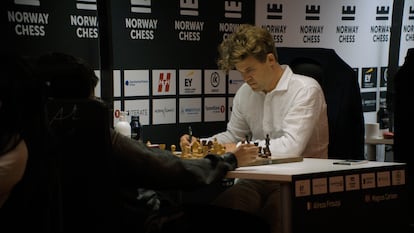

Hans Niemann, a 22-year-old American, has enormous talent for chess; but his volatile and arrogant temperament rubs almost everyone up the wrong way. Magnus Carlsen, a 35-year-old Norwegian, is one of the best chess players in history; generally even-tempered, but sometimes he explodes and borders on arrogance himself. Niemann beat Carlsen at the Sinquefield Cup in St. Louis in September 2022. The Scandinavian accused his rival of cheating, without any proof, and Niemann sued him for $100 million; they reached an out-of-court settlement. The documentary Untold: Chess Mates recounts the huge scandal — even Elon Musk got involved — without a single word of apology from Carlsen.
Ciutadella (Menorca), April 2023. Four months before the out-of-court settlement, which was already being negotiated (it’s not known how much Carlsen paid in exchange for the withdrawal of the lawsuit), Niemann behaved like an extravagant nouveau riche: he arrived at the Menorca Open Chess tournament in a limousine, demanded a free suite at the hotel (which they refused), and went out onto the terrace at 10 a.m. to smoke a Cuban cigar during the games. These scenes could have been a very fitting ending to Chess Mates, because they illustrate the great relief and satisfaction Niemann felt after being the victim of a worldwide smear campaign that could have ruined his sporting career and his life.
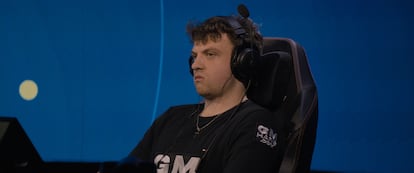
Although the documentary barely touches on it, there is ample evidence to suggest that Niemann’s childhood and adolescence were turbulent, which helps explain why he is a difficult person to deal with. During the Sinquefield Cup, just days after Carlsen accused him and withdrew from the tournament, Niemann, then 19, confessed on camera that he had cheated in online games when he was a minor; but he also maintained that he never cheated in face-to-face games, including, of course, his very surprising victory over Carlsen.
Chess Mates clearly confirms the sequence of events and causes that have always made the most sense. Carlsen’s business group, Play Magnus, was negotiating its merger with the largest online chess platform, the U.S.-based Chess.com — a deal that ultimately went through, with Play Magnus receiving an $80‑million payout (Chess.com now claims to have 250 million users). In that context, Carlsen received privileged information that Niemann had cheated in online tournaments.
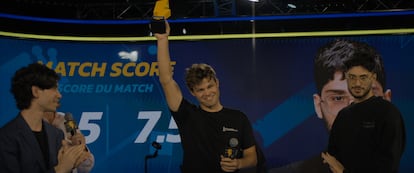
Carlsen — the undisputed number one chess player today (although he relinquished the world title in 2022) — admits that he played the infamous game in St. Louis heavily influenced by the thought that he was facing a cheat. Niemann, for his part, admits that he was very lucky because the Norwegian chose an opening that he had analyzed that very morning at the hotel. No elite grandmaster has ever claimed that Niemann cheated that day; they all agree that the Norwegian underperformed, and also that the U.S. player was incredibly talented.
But the scandal grew, not only because the accuser, lacking evidence, was none other than Carlsen (in the midst of negotiations over the merger), but above all because of a ludicrous claim that the documentary’s director, Thomas Tancred, revels in. It is the theory —fueled by Musk — that Niemann had used anal beads to receive Morse code messages with the best moves for each position in the game, dictated by a computer. There is no rational or technical argument to support the idea that such a scatological method is more effective than a micro-earpiece.
In any case, cheating in a live game is much more difficult than online, due to the metal detector inspections used by arbiters at all serious tournaments, along with other preventive and surveillance measures designed to deter or catch cheaters.
At the time, EL PAÍS published two series of daily columns analyzing Niemann’s most brilliant live games (and later dozens more games and reports). The reasons for suspicion lay not so much in his spectacular moves, but in the stark contrast with his other low-quality games, sometimes even in the same tournaments. In other words, Niemann’s results were highly inconsistent, with a sawtooth pattern. But that pattern fit well with the testimonies of the coaches he had during his adolescence — and with his own erratic behavior.
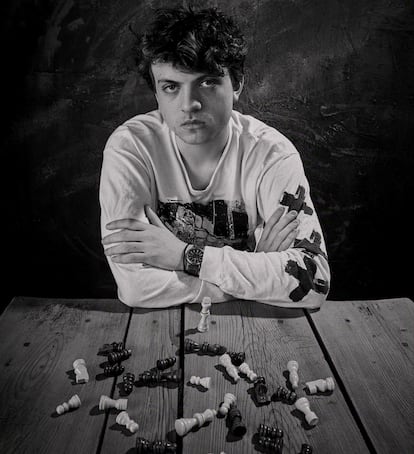
A month after the scandal broke, a revelation emerged that devastated Carlsen, as he himself acknowledges in the documentary: Chess.com announced that, after thoroughly analyzing the controversial St. Louis game and other in-person games played by Niemann with their sophisticated algorithms (“They’re the best in the world at catching cheaters,” they claim), they found no conclusive evidence of cheating (although they also reiterated that online cheating had been widespread).
“My main argument fell apart,” Carlsen admits in the documentary. Thanks to this, Niemann was able to pull himself out of the hole he’d been pushed into and filed a $100 million lawsuit against Carlsen (as well as against Chess.com and others; in total, he was seeking around $400 million), which ended in a backroom deal a few months after his antics in Menorca.
In November 2022, with the scandal still at its height, two months after the much-publicised contest, this journalist, hiding behind a column, watched Niemann for over an hour as he competed in the World Team Championship in Jerusalem, representing the U.S. He moved constantly, making all sorts of gestures, as if he were incapable of standing still for a single minute. Further proof that his talent is as great (he is currently 20th in the world rankings, but last October he was 15th) as the instability of his character, which led him to cheat as a teenager. And it was this knowledge of his past behavior that led Carlsen to play poorly against him.
These conclusions align neatly with the documentary, where everything indicates that Carlsen isn’t hiding any relevant facts, except for the amount of money he most likely paid Niemann. But Chess Mates was the perfect opportunity for the world number one to apologize for making accusations without evidence, and reaffirm the charisma he is famous for. He doesn’t, and this may tarnish his reputation forever.
Sign up for our weekly newsletter to get more English-language news coverage from EL PAÍS USA Edition









































