
The secrets of the multimillion‑dollar sale of the Gunzburg collection, the design auction that could make history
The 125 lots that will go under the hammer next April 22 in New York show that furniture pieces by Ruhlmann and other great names of the decorative arts are now competing on equal footing with paintings and sculptures by Picasso, Paul Klee, and Richard Serra
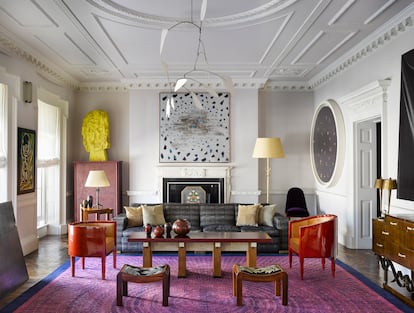
When Terry and Jean de Gunzburg crossed the threshold of their Upper East Side apartment for the first time, it wasn’t the silhouette of the skyscrapers framed by the windows that caught their eye. It was the floor. An antique parquet inspired by the one at Versailles, which looked as if it had been transported piece by piece from a hôtel particulier in the Faubourg Saint‑Germain, and which became the starting point for French interior designer Jacques Grange — architect of the Parisian high society’s dreams — to bring to life the home its owners had had envisioned.
“New York on the outside, Paris on the inside,” is how Terry de Gunzburg, founder of the cosmetics company By Terry, and her husband, the aristocrat and molecular biologist Jean de Gunzburg, recently described it.
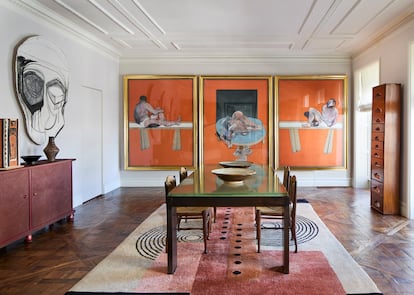
On that exquisite wooden grid, Grange’s first decision was to unfurl a rug by Émile-Jacques Ruhlmann, the great master of Art Deco. It was the foundational piece of a collection that now, more than 20 years later, is at the center of an auction that promises to make history: composed of that rug and roughly 125 additional lots, the sale of the Gunzburg collection is expected to become the most valuable single‑owner design auction in Sotheby’s history, confirming that furniture by Ruhlmann and other major figures of the decorative arts now competes on equal footing with paintings and sculptures by Picasso, Paul Klee, and Richard Serra.
“The art on these walls is not from lipsticks,” Terry de Gunzburg told the Financial Times regarding the artworks included in the auction.
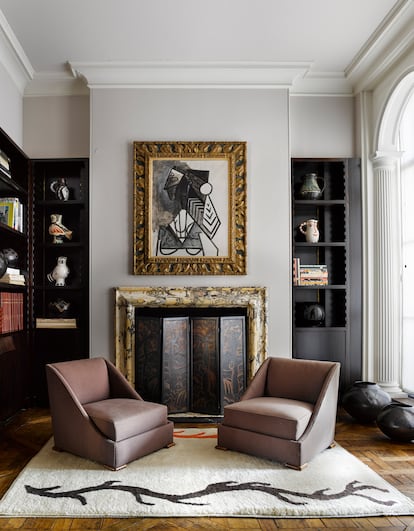
The businesswoman was trying to distance the acquisition of these treasures from the fortune she built with By Terry, and to remind people that, after all, her husband comes from a European aristocratic family with a long tradition of collecting. Even so, her career in the beauty world is essential to understanding the spirit of this collection.
It’s not just that years ago she decided to acquire a Rothko painting (the hypnotic Untitled/Black on Purple, estimated at around $15 million in the art sale held separately from the design sale) simply because the painting’s color palette matched her brand’s packaging.
Before founding her own cosmetics empire in 1998, Terry de Gunzburg worked with Yves Saint Laurent as the creative director of its beauty line (the iconic YSL Beauty Touche Éclat highlighter was her idea), and she was able to breathe in the designer’s extreme sensitivity at 55 rue de Babylone, his Paris residence, where she witnessed how Saint Laurent and his partner, Pierre Bergé, built a universe in which home decoration was not understood as a mere catalogue of trends, but as a composition of volumes and textures that demanded the same rigor as a haute couture dress.
There, the businesswoman observed how her bosses’ refinement materialized in pieces like the one they commissioned in 1974 from Claude Lalanne: a suite of 15 monumental mirrors for the music room that the French sculptor took a decade to complete, and which Florent Jeanniard, head of the design department at Sotheby’s, now describes as the most spectacular lot in the auction to be held in New York on April 22.
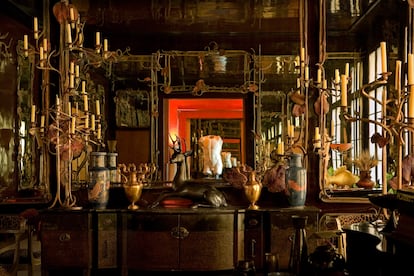
Decorated with bronze tree branches and leaves, the Gunzburgs acquired them for just under €2 million ($2.3 million) during the historic sale of the Saint Laurent-Bergé collection in 2009, although, as they have explained, they never found the right spot to hang them in any of their homes.
Sotheby’s has estimated the set with a starting price of between $10 and $15 million, a figure that seems almost conservative in light of the growing appetite for the fantastical works of the Lalannes. Last year, a single mirror by Claude Lalanne reached £3.5 million ($4.6 million) at the sale of the collection of British patron Pauline Karpidas, while shortly afterward a bar cabinet shaped like a hippopotamus by the artist’s husband and collaborator, François-Xavier Lalanne, surpassed $31 million, becoming the most expensive 20th‑century design piece ever auctioned.
“The design market is experiencing a period of record-breaking sales. There is strong global demand for these exceptional pieces in the face of a very limited supply, which naturally drives prices up,” explains Florent Jeanniard via email. “That these sales reach levels comparable to contemporary art remains the exception rather than the rule… but who knows what the future may hold.”
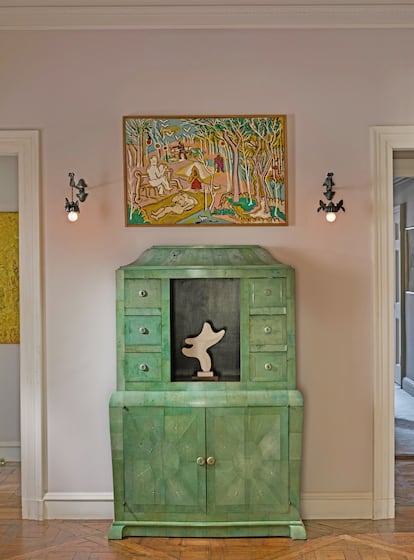
Art Deco furniture was another of the whims that Saint Laurent and Bergé helped bring back into fashion when they began collecting it, and it helps explain the anticipation surrounding this auction. In addition to the aforementioned rug and other designs by Ruhlmann, the Gunzburg collection includes other highly notable and sought‑after figures from that period, such as Jean Dunand, the creator of several vases and a pair of armchairs valued at between $150,000 and $200,000; André Groult, whose 1926 armoire could exceed $800,000; and Jean Royère, of whom, among other pieces, two sideboards in ash, walnut, and ebony are being sold with estimates of up to $1 million.
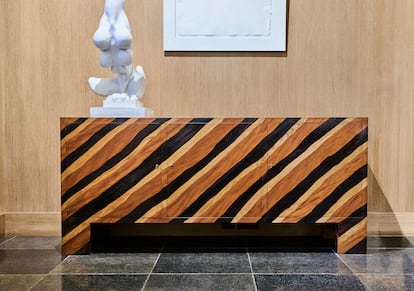
The catalogue also features Eugène Printz, another of the kings of Art Deco: one of his sideboards has been offered with an estimate of up to $500,000, although Christie’s valued another of his pieces at the same figure in 2019 and it ultimately shattered all records by surpassing $5 million.
Although most of these lots come from the couple’s New York apartment, the auction also brings together objects from other homes, such as the one they have in London. In all of them, different periods and visual languages are combined, a vibrant mix that updates the classic refinement of Yves Saint Laurent and Pierre Bergé and places it in a more contemporary dimension in which Ruhlmann’s rug continues to function as the cornerstone. Spread out in the Gunzburgs’ living room, its radiant design of pink and purple bands not only creates a perfect visual dialogue with a pair of purple armchairs by Jean‑Michel Frank, but also serves as the foundation for an ensemble in which one of Damien Hirst’s butterfly paintings hangs alongside a blue vase by Alberto Giacometti that once belonged to Karl Lagerfeld, and an abstract yellow sculpture by Georg Baselitz.
“Jean and Terry de Gunzburg acquired these pieces with uncommon level of taste and curiosity. The notion of risk never held them back, and thanks to that, they were able to recognize the power and uniqueness of the works long before the market celebrated them,” says Florent Jeanniard. “They always bought what they loved, with a sincerity that didn’t seek immediate approval or recognition, and history has ultimately proven them right.”
To preserve the feeling of a lived‑in collection, Jacques Grange himself has overseen the exhibition of the lots that Sotheby’s will hold ahead of the sale at its premises in New York’s Breuer Building: the final opportunity to see it assembled before the auction hammer falls and disperses, piece by piece, that little Paris the Gunzburgs built over their old parquet floors.
Sign up for our weekly newsletter to get more English-language news coverage from EL PAÍS USA Edition









































