
The art market embraces risk again at Art Basel Miami Beach
After a crisis that forced galleries to withdraw from the Americas’ most important fair, ABMB has reinvented itself and surpassed 2024 sales

The 23rd edition of Art Basel Miami Beach (ABMB), the most prestigious contemporary art fair in the Americas and the third most important in the world, opens Friday through Sunday at a time of great uncertainty. While last week’s auctions in New York injected some vitality into the market, generating $2.2 billion in sales, this year has been very tough for galleries.
In the months leading up to ABMB’s opening, the art market was marked by a worrying uncertainty that led several elite galleries to withdraw from the fair in October (including Miguel Abreu Gallery, Chantal Crousel Gallery, Alison Jacques Gallery, Peter Kilchmann Gallery, Edward Tyler Nahem Gallery, Luisa Strina Gallery, and Lia Rumma Gallery). The sector’s benchmark report, The Art Basel and UBS Survey of Global Collecting 2025, highlighted the crisis: global sales fell 12% compared to 2024. The collapse was particularly pronounced at the high end, where sales of works over $10 million dropped 39%, with inflation and market volatility directly affecting U.S. collectors’ investments.
ABMB, therefore, started from a vulnerable position, since speculation and risk have long characterized this fair (it was at the fair in 2019 that Maurizio Cattelan’s controversial The Comedian banana sold for $120,000). This year, collectors seemed unwilling to take on that risk. On Wednesday, the day of the VIP opening, gallery owners displayed cautious optimism; fewer pre-sales had been made compared to previous years, but there was strong interest from collectors.
The precedent in New York, where Gustav Klimt’s Portrait of Elisabeth Lederer fetched $236.36 million at Sotheby’s — setting a record as the second-highest price ever paid at auction — suggested a positive turn. And indeed it has: the second day of sales closed with the fair’s highest transaction. Lévy Gorvy Dayan sold Muhammad Ali, one of Warhol’s star works, for $18 million. This single deal means that at ABMB the price of the most expensive work sold at the fair is nearly triple that of 2024, when the highest figure reached was just $4.75 million for a work by David Hammons.
On the first day of sales, David Zwirner gallery made more than $18.5 million, selling the day’s most expensive work, Gerhard Richter’s Abstract Painting, for $5.5 million; and the influential gallery Hauser & Wirth reported selling 40% of its works. “The pace seems relaxed, but business is steady and dynamic,” said Marc Payot, the president of Hauser & Wirth, via email at the end of the day.
White Cube gallery also performed strongly. Its centerpiece, a four-meter-long painting by Andreas Gursky titled Harry Styles (2025), sold for $1.4 million, along with works by De Kooning ($2.85 million), Damien Hirst ($2.5 million), Tracey Emin ($1.6 million), and Richard Hunt ($1 million). The sales point to two interests: historically significant works (Richter, Bourgeois, Alice Neel, Picasso) and highly publicized contemporary pieces like Gursky’s, which, according to the gallery, conceptualizes the “essential commonality” of contemporary life.
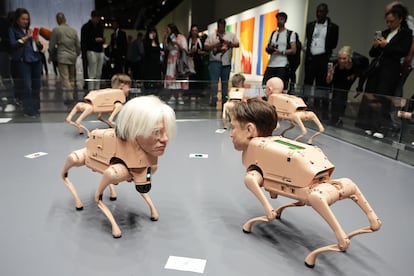
There was also growing interest in the digital realm. Following the concerns raised by the NFT bubble, and despite leading the market’s most disruptive trends, digital art was the day’s big surprise, generating significant attention and substantial sales. Beeple made a notable return with his mechanized installation, Regular Animals, selling all 10 pieces he brought to the show
Compared to last year’s edition, 2025 surpasses 2024 not only in the price of the most expensive work sold, but also in the volume of million-dollar sales. Additionally, the presence of representatives from the ICA Miami, Museum of Modern Art (MoMA), Los Angeles County Museum of Art (LACMA), El Museo del Barrio, and Toledo Museum of Art has restored legitimacy and confidence to the market, not just liquidity.
New energy
Bridget Finn, director of Art Basel Miami Beach, has confronted the market’s vulnerability by refreshing the fair with new additions. While 32 galleries debuted in 2024, 48 are presenting for the first time in 2025, marking a notable renewal among the 283 exhibitors from 43 countries.
This change is intended to bring new energy to the scene and focus on discoveries. Among the newcomers is El Apartamento, the first Cuban gallery to participate in an Art Basel fair — a geopolitical milestone that breaks Miami’s blockade of the island. This edition also includes six local galleries, a historic record, including Nina Johnson, which for many years participated in NADA Miami, one of the most prominent satellite fairs.
Art Basel has also launched Zero 10, a platform dedicated to digital art, curated by Eli Scheinman, creative director of Proof (a company specializing in NFT collections) and Yuga Labs (the creators behind Bored Ape Yacht Club, BAYC). The platform takes its name from Kazimir Malevich’s 1915 exhibition 0,10, which marked the beginning of Suprematism, because it shares the same disruptive spirit and the desire to break new ground starting from zero.
Another major highlight is the introduction of the Art Basel Awards. According to Art Basel, the future of contemporary art depends not only on artists, but also on the ecosystem that supports them. This May, 36 winners were announced across nine categories: three for artists (iconic, established, and emerging) and six for professionals and other collaborators (multidisciplinary creators, sponsors, institutions, curators, allies, media, and storytellers). On Thursday night, at a gala, the winners of the 12 gold medals — each awarded $50,000 — were announced.
Collectors
“There’s a generational shift among art buyers,” explained Noah Horowitz, CEO of Art Basel. “They’re younger, they come from other backgrounds, there are more women. And in many cases, they’re self-made.” To welcome this new wave of Premium Pass holders, Art Basel Miami Beach has opened a new VIP lounge this year, the East Salon, which offers a special program akin to a masterclass in collecting.
Everything is changing at a dizzying pace, and Art Basel has decided not to be swept along but to rebuild its own ecosystem — awards, digital platforms, new exclusive areas — instead of being carried by external forces. In February 2026, it will also launch its fifth fair, Art Basel Qatar.
Sign up for our weekly newsletter to get more English-language news coverage from EL PAÍS USA Edition









































