
Paris returns to the epicenter of artistic luxury: ‘It is once again the art capital it was in the early 20th century’
The Cartier Foundation and Art Basel Paris illustrate the growing influence of private initiative in the French capital’s cultural scene. The trend is at once revitalizing the industry and threatening the role of the public sector
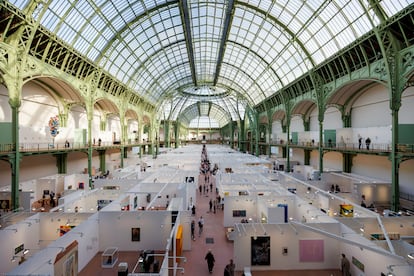

Something is stirring in the cultural sector of Paris, which is experiencing a resurgence as an art capital thanks to a new prominence of private enterprise. Over the past few months, the city’s cultural ecosystem has entered a new phase, undoubtedly more vibrant than in recent decades. But it is also more oriented towards art as a form of luxury, increasingly distant from the public model that once dominated the French capital.
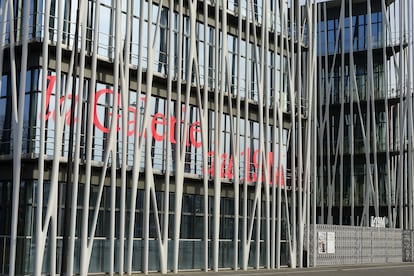
Several milestones in recent months demonstrate this. First, the multimillion-euro results of Art Basel Paris, a branch of the famous fair held every June in Switzerland that sold €90 million worth of artworks in just the first four hours. Then came the inauguration of the new Cartier Foundation headquarters opposite the Louvre, in a former antiques center transformed by Jean Nouvel. Around these two new centers, a more spectacular and international city of the arts is taking shape. But, according to critics, it is also more vulnerable to the transformation of culture into a mere financial asset.
Some doors open, but others close. For example, the Centre Pompidou, which has just closed to begin renovations that will last until 2030. The old FIAC art fair, which brought together French galleries at the Grand Palais since the 1970s, has been replaced by the Swiss giant Art Basel, which already organizes professional events in Basel, Miami, Hong Kong and Qatar, in addition to Paris. The glass-fronted headquarters of the Cartier Foundation in Montparnasse, where artists’ studios were concentrated at the beginning of the 20th century, is now history. The institution has moved to the center of Paris, to a larger museum-scale building, capable of displaying a wider portion of its collection of more than 5,000 works, and equipped with an innovative system of mobile platforms that allows the space to be reconfigured for each exhibition.
Its location aims to attract high-spending tourists who rarely venture far from the city center. The new building is adjacent to the Louvre, which is still recovering from the heist of the century — another sign, for some, of the decline of public museums, victims of mass tourism and relative financial instability compared to their new neighbors.
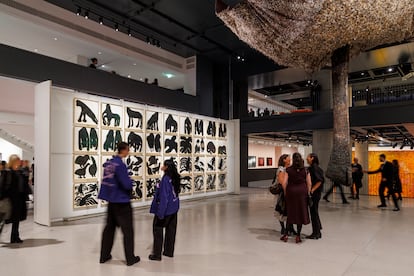
The landscape is undergoing a profound transformation. The new building joins a cultural map where a central position has been held since 2014 by the Louis Vuitton Foundation, the flagship of the business tycoon Bernard Arnault, whose fortune exceeds €200 billion. Housed in a building designed by the late Frank Gehry, it has hosted exhibitions that have made history, such as the one dedicated to the Russian collector and patron of the avant-garde Sergei Shchukin, and which was the most visited exhibition in recent years in all of Paris. In 2021, the city’s cultural landscape added the Bourse de Commerce, showcase of the Kering empire, which owns brands like Saint Laurent and Gucci. The building, remodeled by the Japanese architect Tadao Ando, houses the collection of 10,000 works belonging to its owner, François Pinault, in museum-quality exhibitions such as the current one dedicated to minimalism, which would once have been hosted by the Centre Pompidou.
Alongside the more modest 19M, a cultural center owned by Chanel and dedicated to luxury craftsmanship and emerging artistic talent, the pieces are beginning to fall into place in a different way. Paris is leaving behind the model of cultural democratization designed during the years of François Mitterrand, who championed large public institutions and culture as a state service accessible to all, a model that set a trend in Europe and the world. Now, a different logic is taking hold: a new circuit of showcase museums that dazzle with their artistic ambition and financial power, but which are also more restrictive on a sociological level. There is evident enthusiasm in Paris, but also a certain vertigo about what is being left behind, perhaps irreversibly.
In mid-October, Art Basel Paris opened its new edition with another exclusive event for a select group of collectors. Prices reached pre-pandemic levels: two canvases by Gerhard Richter, currently on display at Vuitton in one of the largest exhibitions ever dedicated to the German painter, sold for €25 million and €23 million, respectively, while two Picasso paintings fetched €50 million each. A comparison with London, until now the undisputed capital of the art market on the continent, made it clear that something is changing: the Frieze fair, held a week earlier, saw more modest prices, between €1 million and €3 million. “Art Basel didn’t create this moment, but it has been able to accompany and amplify it,” stated Clément Delépine, director of Art Basel Paris, a position he will leave to take charge of another private foundation, Lafayette Anticipations, owned by the department store of the same name. “The city has regained its status as a cultural capital, which it already had in the early 20th century and which it lost to London and New York.”
France remains the world’s fourth-largest art market after the United States, China and the United Kingdom, but it has doubled its share in the last 20 years and has tax incentives, such as a reduced VAT rate and legislation favorable to patronage, that help it retain masterpieces within its borders. Paris has also capitalized on the Brexit situation to gain ground on London. Since the UK’s departure from the EU, several international galleries have opened or strengthened their presence in the city, establishing it as their new headquarters. These include Hauser & Wirth, David Zwirner, Esther Schipper, White Cube, Jessica Silverman, and Jack Shainman, while the French capital has attracted an increasing number of top-tier collectors and dealers.
Véronique Jaeger, president of the Jeanne Bucher Jaeger gallery, one of the historic galleries on the Left Bank of the Seine that supported avant-garde artists and recently celebrated its centennial, welcomes the current acceleration but issues a warning. “I hope that the arrival of major international brands will contribute to the dynamism of the capital without detracting from the charm of a city that has always been defined more by its spirit than by its market,” she notes.
In reality, not all perspectives are euphoric. The critic and essayist Pierre Bal-Blanc, a member of the Documenta 14 curatorial team, echoes this sentiment. What is presented as a renaissance is, he argues, a transformation of the relationship between art and capital. “It illustrates how the business world and the art market have arrogated to themselves the power to shape a relationship with culture subordinated to the production of surplus value,” he says. “The vertigo one might feel stems from a confusion between vitality and speculation. The proliferation of foundations, the privatization of patronage, the transformation of the Centre Pompidou or the Cartier Foundation are not signs of good health, but rather symptoms of capital appropriating a common heritage,” says Bal-Blanc, who fears that art will end up “reduced to its decorative function.”
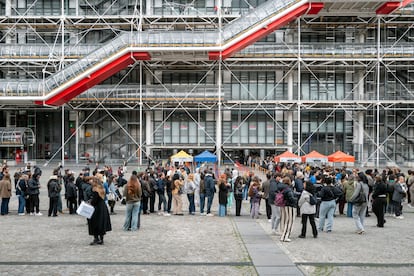
At the Centre Pompidou, curator Alicia Knock organized Paris Noir, the last major exhibition before its temporary closure. The show recalled the cosmopolitan character that the French capital has always possessed, a place where the African diaspora found intellectual refuge. A proponent of public institutions, Knock emphasizes the role that state museums must maintain in the coming years. “In this new landscape, they must continue to be a place for conversation: a space where collective narratives and critical perspectives are constructed.” The challenge, she suggests, is not to compete in spectacularity with private foundations, but to contribute what has always defined them: to offer food for thought and an openness to everyone.
Even so, not everything privately owned can be labeled as mere speculation. Alongside a centrifugal force gravitating towards historic Paris, another force is pushing outwards and occupying territories in the suburbs, sometimes abandoned by the state. The periphery is filling up with centers born from private initiative, transforming former factories and industrial facilities into spaces for creation and exhibition: the Fondation Fiminco in Romainville, the Poush center in Aubervilliers, or the new artistic hub of Île Seguin, a major cultural project by the Emerige real estate group designed by the Catalan firm RCR Arquitectes in Boulogne-Billancourt, on the outskirts of Paris.
“A truly dense, diverse and vibrant ecosystem is emerging year-round, where we are seeing improved dialogue between public institutions and private actors,” confirms Jean-Michel Crovesi, director of another such center, Hangar Y, located in a renovated former aircraft hangar in Meudon, 10 kilometers from the center of Paris. With its pros and cons, this shift is not only reshaping the Parisian cultural landscape, but also points to a changing era that could serve as a model for other parts of Europe.
Sign up for our weekly newsletter to get more English-language news coverage from EL PAÍS USA Edition









































