
Woody Allen: ‘As long as there is freedom of speech, there will be humor’
The filmmaker makes his debut as novelist at 89 years of age with ‘What’s With Baum?’
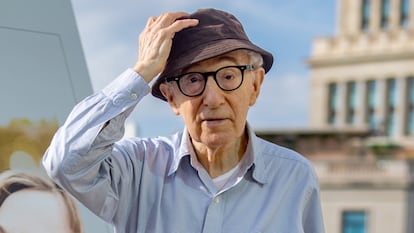

The book What’s With Baum? — Woody Allen’s debut as novelist at 89 years of age — breathes the same air as his movies; that of the streets of Manhattan, visits to museums, bookstores and the Hotel Carlyle bar, Cole Porter songs, romantic entanglements, and a neurotic Jewish protagonist. There is no lack of nods to episodes from the celebrated filmmaker’s own biography, in which immense popularity and renown has given way in the last decade to allegations and rejection by a large part of the public, particularly in the United States.
In his novel, the third wife of Asher Baum, the fifty-something writer protagonist, comes from a notable Los Angeles family. She manages to convince him to live in Connecticut, a place that he, a proud New York City urbanite, hates. The beautiful Connie also has a ruling passion for her spoiled, know-it-all son, with whom the novelist finds himself competing.
As if that weren’t enough, Baum is hit with an accusation of assault by a journalist at the height of the #MeToo movement, and, with potential protests from the staff at the publishing house where he releases his work, he seems to be left without an editor. The novel echoes Allen’s situation with Mia Farrow, two of her children (Fletcher Previn and Ronan Farrow), and also the controversial withdrawal of his memoir Apropos of Nothing by the Hachette group following staff protests.
But in What’s With Baum?, the comic tone prevails. Allen, who has directed 50 films and authored countless monologues and comedy sketches since his teenage years, seems more interested in making jokes than in settling scores. He responded to this interview via videoconference, accompanied by his assistant, who was in the room with him but out of the camera’s view.
Question. How did you decide to write a novel? Did you ever think about doing the story in another format?
Answer. Yes, I thought about it as a film or a play, but that turned out to be uncomfortable because I had to find the money, take meetings, find an actor and then go somewhere and direct it. If I wrote a novel, it wasn’t going to be expensive, and I’ve always liked writing prose, it’s something I’ve done my whole life. I decided to do it like this, and have fun.
Q. The protagonist asks if anyone is open to listening to him with “consideration and empathy.” Do you share that doubt? Recently, your participation in a Russian film festival generated controversy.
A. That really doesn’t matter to me. I didn’t travel there, I participated via video call in a debate after seeing a movie. It’s very important that people of good will, artists and the public, communicate and talk. We don’t bomb each other or shoot each other, we talk about art, there was no intention to…
Q. To validate an invasion, or support the regime of the country that promoted the festival?
A. I was there to talk about movies, and it didn’t have anything to do with supporting a government. I made it clear that I think that Putin is completely responsible for the war. But that is my political point of view, the festival was film people talking about films. And that is important. Scientists and artists have to keep talking, rather than be divisive.
Q. In your novel, Baum remembers the discussions he had with an old friend in which they laid bare their “conflicting points of view” on all kinds of issues, including the Middle East. Is it hard to have those kinds of conversations nowadays?
A. At a dinner or taking a walk with close friends, a person has discussions about a multitude of things, and a lot of it is trivial, gossip and jokes. And I don’t know enough to speak publicly, I’m not an expert and I would turn into yet another show business person, ignorant of what is truly happening, who weighs in. With my friends, I can talk about anything because it stays in my living room and there is no consequence for proclaiming our stupid opinion in our exchange of misinformation. But doing that publicly is a waste of everybody else’s time.
Q. The plot of the novel echoes some things you have experienced yourself, such as the employees of the publishing house protesting. Did putting that into fiction help you to process it?
A. What guides me when I write is trying to do something entertaining and fun. If something happens to me and I find it funny, I include it, like the part about the fish and the frogs and the flies that I put in my memoir. When I made movies, people thought that I was the character, but I never was. The roles that I played were incredibly exaggerated, for comic effect.
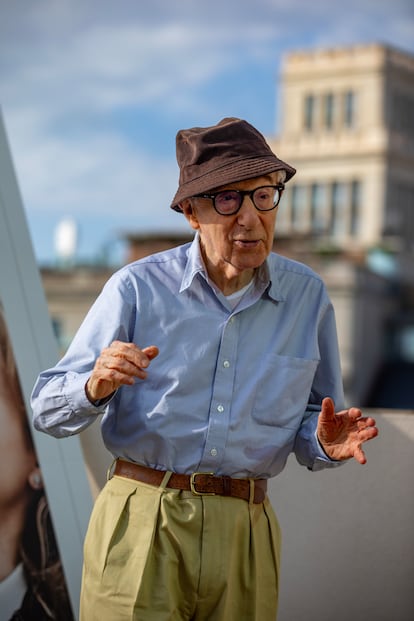
Q. In what ways do you see yourself in Baum, and in what ways does he differ from you?
A. I share his recurring complaint about how terrible life is, how scary it is, and how overwhelming the universe is compared to how small we are. Also, wanting to make something great but not having the talent to do it, and loving the city more than the country. But I don’t have his brother, nor his life, I’ve been a filmmaker.
Q. You’ve been in the comedy business for 50 years, and focused on making people laugh. Does humor change with time? Are things that used to be funny no longer funny?
A. What changes is only the cosmetics. Chaplin and Buster Keaton came after the industrial revolution, and they made people laugh with physical things because the world was obsessed with railroads, factories, that was the cosmetic of the time. Years later came the Freudian revolution, people discovered psychology and comedians began to make jokes about that. The outward form changes, but the comedy itself does not.
Q. Currently in the United States, there is tremendous pressure on the comedians, late night shows and their hosts. What do you think about that?
A. The thing is, I was born a Democrat, so whenever there is a Republican administration, I’m suspicious and complain. It’s the same this time. We are going through a period in which freedom of speech and women’s rights and abortion are being called into question, and all the things that the Republicans in power are doing, I’m opposed to. With a little bit of luck, in the next elections, voters will kick them out and the Democrats will come and I’ll complain about them, but in another way, not about civil rights in this country or the rejection of science.
Q. It’s been said that Trump’s election has marked the end of satire and humor.
A. It doesn’t matter how bad things get, people will always make jokes. Even in Nazi Germany, they were whispering them. If comedians are free, there will always be humor about the country, politicians, sex, marriage. If they can’t speak because it’s against the law, then there will be a serious problem. As long as there is freedom of speech, there will be humor, the important thing is for that right to be protected.
Q. In your work, you have frequently joked about antisemitism and parodied the sense of endless persecution. But in recent times, that conversation has taken on a more serious tone. What are your thoughts on that?
A. There will always be antisemitism because, as the Einstein quote goes, we are the “pitiful remnants.” There will always be prejudice against Jews, women, Black people, minorities, we already know that. When it comes to the Middle East, it’s a conflict zone and has been a problem for decades. Very intelligent people, very good writers and smart politicians have tried to resolve it, and they haven’t been able to. It’s very complicated. I read something that a very intelligent person wrote in the newspaper, and the next day, there’s something else from a different person, who is also very intelligent. There is a war of words. It’s hard to talk about this, although clearly, I want it to be resolved peacefully and quickly, with the least amount of damage possible, but look at what is happening. I don’t have anything very intelligent to contribute.
Q. You enjoyed enormous success and recognition and were known for your deep pessimism. In recent years, you have faced strong criticism and disapproval from part of the public. Did that pessimism prepare you, or has what has happened finally turned you into an optimist?
A. I work, I don’t dwell on it. I made my first movie in 1967 and have never gone back to watch it, or any other. I don’t read reviews, or interviews. All that is far removed from my life. I finish a project and I have a little bit of fun, I play music, I go to sporting events and I set out to work on the next one. When they ask me how I have had the time to make so many movies, write for The New Yorker and create monologues and plays, well it’s simply by not losing time thinking about myself or about what other people write about me. I’m not interested in that. And not to compare myself, but when Dostoevsky wrote a book, I’m sure that he didn’t read what they said about him and think, “next time I have to make it funnier.” You don’t learn anything doing that. It’s important to work and keep going without getting distracted, thinking about how terrible life is and how people make it worse than it has to be. If you’re a misanthrope, and I am one, people can’t disappoint you.
Q. Despite that misanthropy, you don’t seem to be isolated. In your novel you make jokes, for example, about the #MeToo movement that stalks the protagonist.
A. I joke about anything that comes to mind. I read the news and I have a superficial understanding, not a profound one, about all of it, what is happening. I have made 50 movies and not one has been about politics, but rather things that have happened to me, stories about men and women, existential thoughts.
Q. What are you working on now?
A. I just finished a play. There’s a production in Budapest that has been running for almost a year, another being rehearsed in Germany, and another in St. Petersburg, and there’s another play that we might bring to the United States. I’d also like to write another book.
Q. No more movies?
A. Only if someone comes to me with the money. I always have problems with financing, because they want to know what the movie is about and what star is going to act in it, and I don’t want to argue about any of that with anyone.
Sign up for our weekly newsletter to get more English-language news coverage from EL PAÍS USA Edition









































