
‘Four friends who broke the rules’: Why ‘The Golden Girls’ has become a queer symbol 40 years later
The series, in which a hilarious quartet of women shared a home and the challenges of middle age, brought to the table debates unthinkable for a family show, from AIDS to sex and loneliness
In the final image of the first season of Looking, HBO’s series about modern gay life in San Francisco, the protagonist climbs into bed beside the lover he isn’t sure he should leave and, while he makes up his mind, reaches for his laptop and presses play. What we hear next are the rapid-fire jokes of a random episode of The Golden Girls. The young man smiles, like someone returning from a stormy journey far from home, and as the screen fades to black, it’s accompanied by the theme song of the now-classic sitcom.
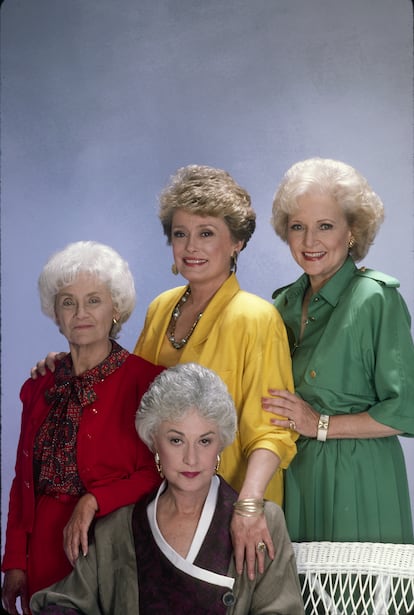
This metatelevision homage is one of the countless flashes that continue to reflect the sitcom which proved that older women could be glamorous, sharp-tongued, and very funny. Having just celebrated the 40th anniversary of its premiere (the first episode aired in the United States in September 1985), journalist Pedro Ángel Sánchez has written a book on the golden ratio embodied by Dorothy, Blanche, Rose, and Sophia — the four elements of one of the most solid and celebrated pillars of global LGBTQ+ culture.
In Las chicas de oro: la serie que nos enseñó que las amigas son la familia elegida (The Golden Girls: The Series That Taught Us That Friends Are the Family We Choose), published by Dos Bigotes, Sánchez dissects what he considers “a great ode to friendship,” as well as “a series that continues to appeal to new generations.”
The addition of the episodes to Disney+’s catalog in January 2022 has renewed affection for a show that the gay community has always held close. “The model of coexistence it presents has been gaining ground over time,” the author reflects. “These are mature women, initially destined for a husband and children, who break away from those norms while enjoying all aspects of their lives.”
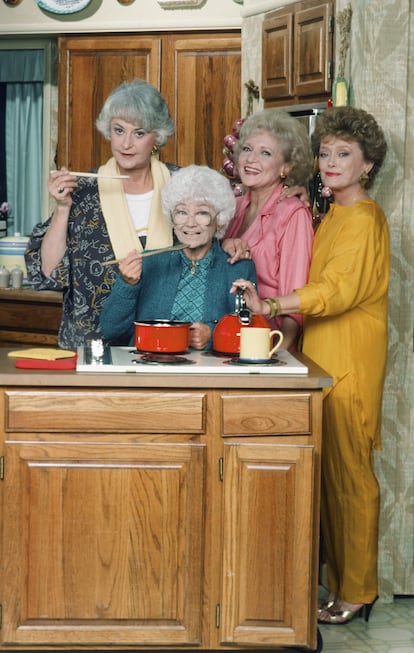
It’s not hard to imagine why a community excluded from traditional frameworks would choose The Golden Girls as a reference point. For screenwriter Paloma Rando, one of the keys is that the women sharing a house in Miami show that “whether or not you’ve fulfilled social norms, it’s an ideal to be able to spend your retirement years alongside people you love.”
Journalist and television expert Borja Terán expands on this idea: “Care is given in relationships that fall outside the standard models—couplehood, marriage, and blood ties. Here, the ones who take care of each other are friends.” For the expert, “good television is the kind that breaks through the viewer’s prejudices, the kind that makes reality more complex.”
The first chosen family on TV?
Of the many prejudices the series confronts, the main one is undoubtedly the fear of aging — something that touches the LGBTQ+ community in a particularly acute way. That’s where the golden girls shed the most light.
“Having lived in loneliness — even if surrounded by people — because you couldn’t share your intimacy or your problems, is something very common in the community,” Rando continues. “And on top of that, especially the gay side suffers from rampant ageism: it worships youth and dismisses what isn’t young. So to reach an age where you might otherwise feel isolated, and instead live with people who understand you — even if you argue — is an absolute triumph.”
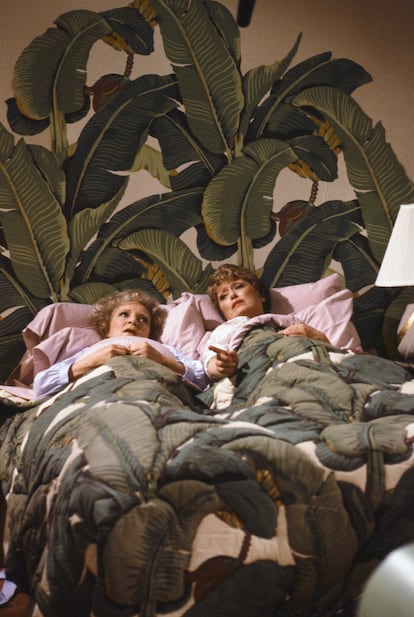
Because getting older has its positive aspects, as the four protagonists demonstrated. “Aging — especially as a woman, and even more as a single woman — deprives you of many things,” explains filmmaker Julián Génisson. “But it also has something powerful: what others think of you loses all importance. You can be whoever you want.” Author of the recent treatise on laughter Deshacer el ridículo (Undoing Ridicule), Génisson adds that for those “who don’t fit into the traditional model of coexistence, the lifestyle of The Golden Girls has something utopian about it. Since you have to grow older, it’s better to be among friends.”
Season after season, the four women have countless lovers, flings, steady boyfriends, and more or less successful weddings — in the first episode, Blanche is left at the altar; Sophia nearly marries in season four; Dorothy finally marries at the end of the series — but they never give up their primary bonds, the ones they share with each other. This is another of the charms identified by screenwriter Juan Flahn regarding the show’s appeal to gay audiences: “We wanted to see the adventures of these liberated women who didn’t have to justify themselves to anyone. That was the fun part — there were no men to answer to. They were completely independent, and that was a great pleasure.”
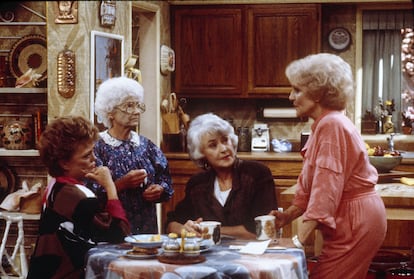
While The Golden Girls was not the first show to depict what has come to be called a chosen family, it certainly set the standard. “Sex and the City is a clear heir,” asserts Juan Flahn. “They weren’t that old, but neither were they young girls, and the way they shared their worries — even their intimate sexual problems — was already present in The Golden Girls.”
Another television product clearly influenced by the series has its origin in the show itself. Pedro Ángel Sánchez explains that “Marc Cherry, creator of Desperate Housewives, was a writer for The Golden Girls. He was the one who coined the golden rule of four: series with four female characters based on the relationships between them.” Like all rules, it has exceptions. “Some projects of this type haven’t worked,” adds the journalist.
Humor
The Golden Girls, created by screenwriter Susan Harris, incorporated painful and complex themes into the formula of its highly effective comedy mechanism. According to Paloma Rando, “the levers the series uses to generate comedy are the same as always in film and television: entanglements, physical gags, recurring jokes…” she explains. “That’s why it never gets tiring, even if you watch it over and over, because in structure and technique it’s classic, but innovative in its themes.” For the screenwriter, “other series that try to reinvent the wheel expire quickly; those that innovate in subject matter rather than form endure better.”
Over its seven seasons and 180 episodes, issues such as euthanasia, homelessness, mental illness, and immigration took center stage in some storylines. “It’s a series that has taught us empathy,” Sánchez recalls, “and sexual diversity has been very present from the beginning.” The visit of a lesbian friend, support for a trans councilman, or Dorothy’s brother’s enjoyment of cross-dressing are some examples of this visibility, although the most remembered moment in this regard is the storyline addressing the AIDS crisis.
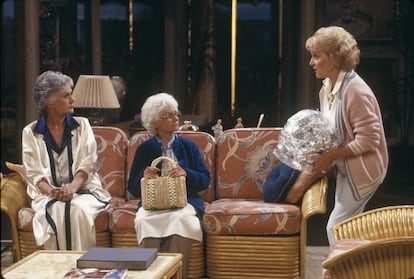
In 72 Hours, an episode from the fifth season first aired in 1990 — the year the United States recorded more than 18,000 deaths from this pandemic — the naive Rose, played by Betty White, must wait three days to receive the result of an HIV test following a possible infection during surgery. In a moment of weakness, she lashes out at Blanche, the boldest of her housemates, saying that if anything, it should happen to her, since she has slept with “hundreds of men.” Rue McClanahan’s character responds that AIDS “is not a punishment for sins” and can affect anyone.
According to Sánchez, the author of the book on the series, the fact that some episodes like this — still used as an educational resource by organizations supporting people living with HIV — “weren’t afraid to tackle thorny issues in a family-friendly show is commendable. And moreover, while doing so, the series remained just as funny.”
Could this be one of the reasons it has aged so well? For Julián Génisson, “the humor of The Golden Girls was never stale. In fact, many of the issues it addresses are absolutely relevant today, like the nightmare of housing or the need to reinvent yourself in the job market, at any age.”
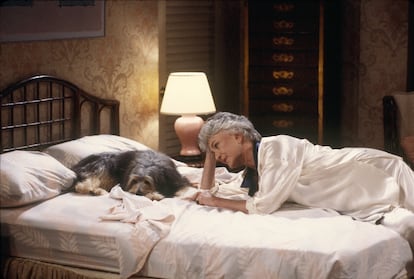
Another aspect highlighted by Génisson is “that the series never ridicules the women: they are the ones laughing at each other.” And this is despite the fact that they aren’t afraid to call each other names, which also connects with gay culture. “Telling the truth and turning insults into jokes is something we do,” reflects Pedro Ángel Sánchez. “They might call Blanche a ‘show-off’ or Rose a ‘prude’ without problem.” This type of humor is so embedded in the community’s DNA that the drag parody of The Golden Girls in San Francisco (Golden Girls Live) has been a city classic for decades.
The golden legacy
The impact of the comedy, which ended in 1992 due to Bea Arthur’s departure — there was even a spin-off without Dorothy, The Golden Palace, which didn’t make it past the first season — was felt both on and off television. First and foremost, it boosted the self-esteem of mature women represented on TV.
“We shouldn’t forget that part of the transgression is aesthetic,” recalls Pedro Ángel Sánchez. “They always looked divine, stunning, wearing incredible clothes. And the fact that these were older women was novel. Rue McClanahan even confessed that playing Blanche allowed her to love herself more.”
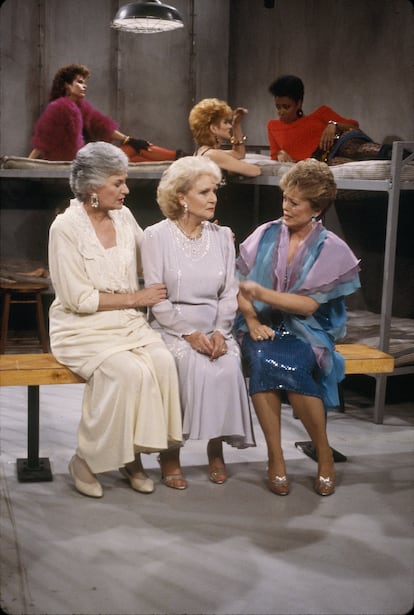
That added touch of glamour has kept The Golden Girls in perfect form. “Right now, you see the fashions, the shoulder pads, the colors, the décor… It’s a wonderful time machine,” says Juan Flahn. “I would even say it has grown more appealing over the decades, because now it’s a capsule that takes us to a kinder world.” A world that, during its original run, audiences could only dream of, as Sánchez recalls: the series was a hit in years when “many of our grandmothers still didn’t go out for hot chocolate with their friends, because it might have been frowned upon.”
Ultimately, dressing up lives that had always been shown to us as undesirable with fantasy and jokes (another point in common between the women without traditional families and the LGBTQ+ community) is this television show’s great achievement. “The series is largely based on everyday dreams: a fling, going to a certain party, making a good impression on someone, enjoying a beautiful moment,” explains Borja Terán, “and that’s what drives us day to day — to feel cared for and to have hopes.” The journalist wishes “to grow old within the care network of The Golden Girls. That capacity to adapt and move forward is what television should show us.”
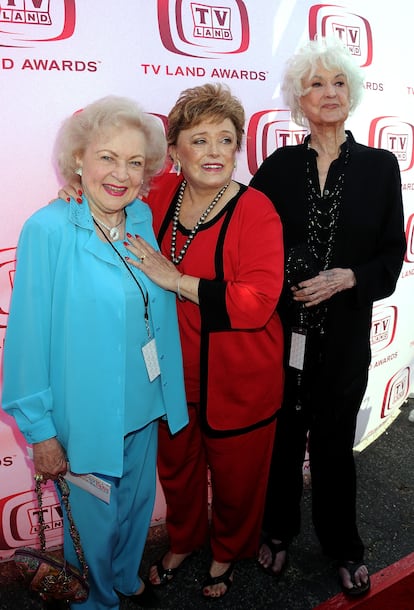
Perhaps there’s no need to theorize so much: “They were very camp — the characters and the actresses who played them,” sums up Pedro Ángel Sánchez, who in the volume dedicated to the series explains that “all of them were very supportive of the community on a personal level.” The actresses came largely from the theater world and “moved in very gay circles, which at the time were so affected by the AIDS crisis.” In some LGBTQ+ bars in the United States, it is still remembered how, week after week, the music would pause on the dance floors during the 23 minutes of each new episode.
Beyond the laughs, Estelle Getty (Sophia) became “a true activist” on HIV issues, while Bea Arthur (who had been a major Broadway figure before becoming a Golden Girl) “left $300,000 in her will to a shelter for LGBTQ+ youth. It was her world,” the author concludes. A world that continues to honor and celebrate four women whose friendship remains both an inspiration and an aspiration.
Sign up for our weekly newsletter to get more English-language news coverage from EL PAÍS USA Edition









































