
The Russian Tea Room in New York: A cinematic story for a cinematic setting
The current owners of the legendary Manhattan restaurant manage the 99-year-old establishment with respect and care, protecting it from property speculation
Few places in the Big Apple are as legendary as the Russian Tea Room. How much of what’s said about it is true, and how much is just myth? Was Madonna really fired after two weeks working in the coat check? It doesn’t sound far-fetched. Did Leonard Bernstein write the opening bars of his famous Fancy Free on a napkin there? Probably. Did Zero Mostel himself serve food and drinks wearing an apron in an act of extravagance? That’s what people say. Did the ghost of Anastasia, daughter of Tsar Nicholas II, appear from time to time during renovations? That sounds more unlikely. But that there’s a huge rotating polar bear-shaped aquarium and a tree decorated with Fabergé eggs on the second floor, and a several-meter-high model of the Kremlin on the third, we can confirm as true.
“We won’t tell you which Chagall artworks are authentic and which aren’t,” explains Isabella Biberaj, the venue’s chief operating officer and daughter of the owner, laughing. She grows more serious when talking about the presence of ghosts, which she assures do roam the building’s five floors. “Our intention as owners is to make sure all their past lives continue to have a place,” she says, speaking somewhere between metaphorically and literally.
The Russian Tea Room is located in a building barely six meters wide on Manhattan’s 57th Street, and eventually became the unofficial snack bar of Carnegie Hall. In 2026, it will celebrate its 100th anniversary. Or rather, several anniversaries, because its history has been a constant reinvention: changes of ownership, concept, and menu; closures and reopenings; lavish renovations.
Today, its activity is split between tourists and regulars on the ground floor and private parties in its multiple rooms. Just this year, it hosted a Tony Awards celebration in June and a Fashion Week event in February. The New York Times, not surprisingly, described it as “the city’s longest-lasting symbol of glamour, the intersection of money and art that defines the heart of New York.”
Its current owners, who bought it in 2006, run it as a family business and treat the space almost like a museum. The older it gets, the more charm this time machine exudes, transporting visitors to eras long gone — or perhaps to a time that never existed at all. At least, never coexisted in time and space: a blend of romantic style with original Art Deco sconces, chandeliers, more than 20 samovars, leather sofas, white tablecloths, and silver trays. It’s the dream of Tsarist Russia filtered through a historicist American lens.
One of the main architects of that identity was Sidney Kaye, who began attracting Broadway audiences after the New York Philharmonic moved from Carnegie Hall to Lincoln Center in the 1960s. He had bought the venue in 1955, and one year he was so pleased with the Christmas decorations that he decided never to take them down.
“Christmas is always just around the corner. Besides, it looks more Russian this way,” he declared. He died in 1967, and his widow, Faith Stewart-Gordon, defined the essence of the place like no other: “Let the restaurant remain as people remember it, not as it was.”
This actress, whose Broadway career never took off, ran the business for another three decades, ushering in its most popular and celebrity-filled era. She wrote three books on the subject: two cookbooks and one memoir. In the latter, titled The Russian Tea Room: A Love Story, published in 1999, she reflected: “I am growing old and frivolous. I miss the seriosity of my youth.” She never expected that in her later years she would have Salvador Dalí dining at her table and Elizabeth Taylor “debuting” the large diamond of her engagement ring to Richard Burton there. Julio Iglesias was also a regular.
The venue had its golden era in film during the 1980s and was immortalized in movies such as When Harry Met Sally, Manhattan, and, most notably, Tootsie, where Dustin Hoffman first appeared before Sidney Pollack dressed as a woman.
“The new generations have also renewed their vows with the Russian Tea Room, and while some customers request the Tootsie table, others ask for Blair’s table from Gossip Girl,” Biberaj notes. “In any case, after COVID and with the resurgence of nostalgia, a very favorable era has arrived for the venue. Young people want to experience the old New York. We haven’t had to do anything to adapt to that trend,” he explains.
But let’s rewind to 1926. Although it’s not entirely clear, the first recorded owner was Polish chocolatier Jacob Zysman, but the person who truly gave the place its identity was, once again, a woman: the Russian-born dancer Albertina Rasch. Born in Vienna, she put on the map a business that had initially started as a tea and chocolate salon across the street, but as soon as Prohibition ended, she expanded the menu to include vodka.
Rasch combined a remarkable artistic career — performing alongside Sarah Bernhardt and being among the first to blend classical ballet with jazz — with her hospitality work. She was also the wife of Dimitri Tiomkin, who would compose the soundtracks for High Noon and It’s a Wonderful Life. With such a hostess, Russian dancers found a sanctuary in the restaurant: a place where their language was spoken, their customs maintained, and their food served.
Although Rasch stayed only until 1933 and the original Russian identity gradually faded, the tradition endured. It was said that in the 1940s, George Balanchine would appear with a dancer on each arm, and three decades later, Rudolf Nureyev would declare it his favorite spot in the U.S.
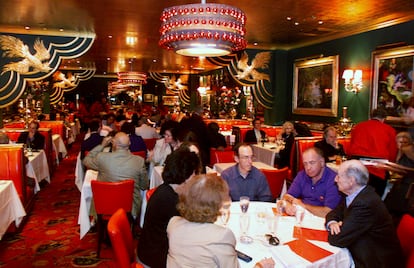
The restaurant’s current appearance, however, is the legacy of the major renovation undertaken by Warner LeRoy, owner of the Central Park restaurant Tavern On The Green, when he purchased it from Stewart-Gordon for $6.5 million in 1995. It closed in 1996 to be renovated, but the work dragged on, the budget ballooned to $35 million, and it wasn’t able to open until 1999. LeRoy conducted archival research, translated thousands of recipes from Russian into English to create an imperial menu that spanned Scandinavian to Mongolian traditions, and opened to tremendous fanfare. But he didn’t enjoy his new toy for long: he died in 2001, burdened by debt and harsh restaurant reviews, amid the city’s crisis following the September 11 attacks.
The family that now runs the Russian Tea Room had been regulars and decided to rescue it. “I learn something new about this place every day, and it’s a privilege to dive into its archives,” says Biberaj. They have vowed to keep the restaurant not only profitable and busy, but also safe from one of its greatest enemies: real estate speculators. The restaurant holds the air rights over its five floors and rubs shoulders (or ankles) with the skyscrapers that surround it and define the city’s new skyline. But Biberaj says no offer could lure them: “The Russian Tea Room is not for sale. It will remain open for many, many years to come.”
Sign up for our weekly newsletter to get more English-language news coverage from EL PAÍS USA Edition









































