
Trajan, the Roman emperor who fought the Dacians and Parthians, superpowers like today’s Russia and China
Historian David Soria dedicates a monumental biography, with special emphasis on military matters, to the first Caesar of Hispanic origin
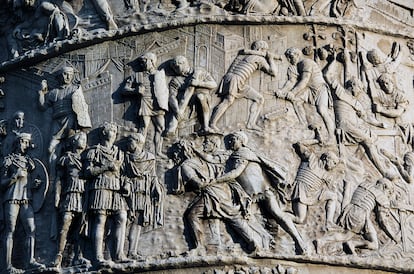

A misty dawn breaks over the legion’s camp. The powerful Roman army begins to simmer, restless, “like a volcano about to erupt.” The first advance guards deploy. Thousands of soldiers equip themselves and take turns forming up with rigorous discipline, ready to enter combat against the dangerous enemy waiting on the other side of the front. A commander, accompanied by high-ranking officers, inspects the disposition of the troops. Everyone greets him as he passes with a respect bordering on veneration. The charismatic leader is not General Maximus Decimus Meridius, the protagonist of Gladiator, but a real figure, the martial emperor Marcus Ulpius Trajan. And we’re not in the forests of Germania in 178 AD on campaign against the Marcomanni, but by the Danube in 101 AD, about to begin Trajan’s First Dacian War, the first of two brutal conflicts that would end with the annihilation of the Dacian state, a geopolitical threat to Rome, as they would say today. And the scene isn’t described in a Hollywood film but in a book, a monumental biography of Trajan stretching over more than 700 pages written by David Soria, a doctor in ancient history at the University of Murcia.
It’s not usual, of course, for an academic biography, no matter how informative it seeks to be, to start off the way Trajan, el mejor emperador (Trajan, the Best Emperor, 2025, with a luxurious prologue by José Soto Chica) does, with the obvious influence of the most striking scene of the Roman army in action that cinema has ever given us. But Soria’s aim is clear from the outset: to draw us in, in an erudite yet passionate way, to follow the sensational historical and life story of the first Roman emperor of Hispanic origin (Trajan was born in Italica, near present-day Seville, in 53 AD), who led the empire to its maximum territorial reach and whom his contemporaries christened Optimus Princeps, the “Best Emperor.”
With Soria and Trajan — and the legions — we journey on a breathtaking historical adventure from the blood-stained Sarmizegetusa, the Dacian capital, to the sacked city of Ctesiphon, the Parthian capital, the twin nerve centers of two of the great political entities of the time and rivals of Rome — the Dacian Kingdom and the Parthian Empire — and two cities that Trajan conquered; from the forests of the Carpathians, where the deadly curved swords of the Dacians await, to the deserts of Arabia and the dusty expanses of Mesopotamia, where the cataphracts gleam and the great camel drums of the Arsacids resound, to finally arrive at the waters of the Persian Gulf (Trajan personally went further than any Roman magistrate or general had ever gone, or would ever go).
The biography, with a special focus on military matters and surprising considerations about the use of unusual special troops by the Roman army (Soria identifies Germanic ecstatic warriors, “berserkir and úlfhednar,” side by side with Trajan’s personal guard), offers a very favorable portrait of the emperor.
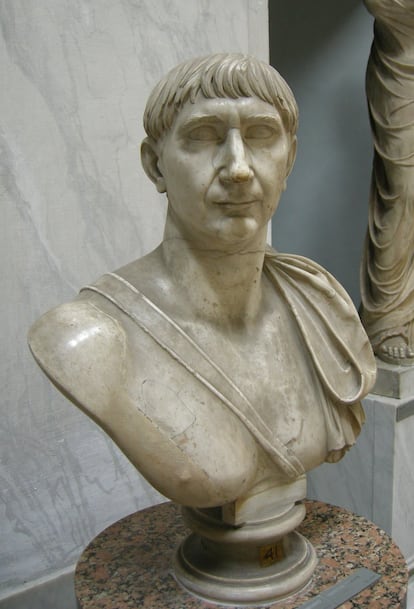
Would we like Trajan if we met him? (As long as we weren’t Dacians or Parthians, or any of the peoples against whom he led his campaigns.) “I think so. He was a man, according to sources, who was very approachable, down-to-earth, easy-going, and not at all elitist, very accessible. He liked to consider himself just another citizen and avoided pomp and ceremony. When he arrived in Rome in 99 AD, after being proclaimed emperor the year before, he left his personal escort behind, opting to enter not in a chariot or sedan chair but on foot, and he didn’t wait for the senators to emerge to greet him, but went to find them and addressed them one by one without formalities. He didn’t want to be courted. Energetic but not harsh, he was sometimes too direct, almost brusque, the result of an excess of frankness. He recognized talent, accepted advice, and took criticism well. We would have liked him, yes,” says the historian.
Soria believes that we would like Trajan more than his successor, Hadrian, another of the so-called “five good emperors” along with Nerva, Antoninus Pius, and Marcus Aurelius, and the protagonist of Marguerite Yourcenar’s famous novel Memoirs of Hadrian. “We would have liked Hadrian a little less. He was more devious, more duplicitous, and had a need to excel in everything, which doesn’t mean he wasn’t also a great politician, but he found it harder to empathize.” We know Hadrian’s great love, his favorite Antinous. What do we know about Trajan’s private life? “He was a very good friend to his friends and protected them. When one of them, Lucius Licinius Sura, from Barcino, present-day Barcelona, was accused of plotting against him, he went to his house, left his escort at the door, put himself in the hands of his doctor, and let himself be shaved by his barber.” Erotically, “he was bisexual, with an attraction to young boys, just like Hadrian.” He had no children and adopted his successor, his second cousin.
When asked why he was interested in Trajan, Soria replies that he was drawn to him because he was relatively unknown to the general public, despite Santiago Posteguillo and his trilogy. “He is certainly not as well-known as Julius Caesar, Augustus, or Nero, and people know less about his era than about the Punic Wars, for example. On the other hand, he was Hispanic, of course, and his military campaigns are a goldmine.”
The historian also points out the interest in the transition from the Flavian dynasty (Vespasian, Titus, and Domitian) to the Ulpio-Aelian, or Antonine, dynasty (96-192 AD, ending with the assassination of Commodus, the son of Marcus Aurelius). He explains how Nerva and Trajan were actually part of the entourage of the last Flavian emperor, the reviled Domitian, who was condemned to damnatio memoriae after his assassination in a conspiracy of the palace staff. Soria believes that Domitian (who started the Parthian War that Trajan would finish) was not a bad emperor at all, and that the change to the next dynasty, with Nerva as the bridgehead, was actually a continuation of politics and names. Negatively, he says, it was a way of justifying a change that was actually a continuation of both personal (the same establishment) and ideological aspects. In fact, it’s surprising that Trajan didn’t carry out any of the purges that new emperors usually did. “He was part of the regime of Domitian and Nerva; the same elites of the empire placed him on the throne amid complete consensus, the same circles of power; there was no resistance.”
To what extent was it relevant that Trajan was Hispanic? “He came from Baetica, one of the most Romanized and prosperous provinces of the empire, with an elite greatly enriched by the trade of oil, garum, and also bricks. They were entering the Senate and playing their cards very well. Trajan’s father rose significantly under Vespasian and placed the family on the starting line for the great Hispanic uprising. When there was a power vacuum, connections allowed Trajan to contend with the empire. I get the feeling that being Hispanic wasn’t at all surprising to the elite. He must have been seen as a novelty, the first provincial emperor, but they don’t seem to lend it much importance. Hispanics were already ubiquitous in other strata of the empire, such as in the military leadership, and were highly regarded. Perhaps something was noticeable in Trajan’s pronunciation; it seems that Seneca, from Corduba (Córdoba), was criticized for his accent. Hadrian also spoke sonorous Latin, but in his case more due to his habitual preference for Greek than for being Hispanic; he was also from Italica like Trajan.”
Was Trajan’s reign the finest hour of the Roman Empire? “Until then, yes. Then there was another peak, in the 4th century with Constantine, and then the Valentinian dynasty. But certainly the 2nd century is one of the peaks of the Roman Empire. I don’t like to choose, and there are other moments of splendor.” Yes, but the book is titled Trajan, the Best Emperor. “That’s what the Senate calls him, and the publisher thought it better to use that than the Latin Optimus Princeps. From then on, the Senate also began to greet new emperors with the formula 'sis felicitor Augusto, melior Traiano’: may you be happier than Augustus and better than Trajan."
Be that as it may, his wars against the Dacians and Parthians alone reveal him to be a formidable emperor. “I like the comparison that it’s as if the United States were fighting against Russia and China. The Dacian kingdom and the Parthian empire were two superpowers. Not at all tribal armies. The Parthian army was almost a medieval feudal army, with a core of professional troops and an elite with extensive military training, like the knights of the Middle Ages, as well as specialized troops. They had learned from the Hellenistic powers. The Parthians’ successors, the Sassanids, would further improve that army. The Dacians [see, as a good complement to the biography of Trajan, Dacia: The Roman Conquest by Radu Oltean, 2017] also had a core of professional fighters, and theirs was an army of citizen soldiers, like the Spartans or the Athenians. They were highly motivated and very tough fighters, with weapons and tactics not very different from those of the Romans. They didn’t launch disorderly charges like the Germans and even performed the testudo, the tortoise. Although there was a huge difference in scale between the Dacian kingdom and the Parthian and Roman empires. The Dacian kingdom was a major threat to Rome, and Rome assessed it very well. It was no longer a question of turning it into a vassal kingdom, but of destroying it completely. Trajan was completely successful in this."
The Parthians were more difficult. “With them, Trajan found it very difficult to achieve his objectives. He needed to open a second front in the Parthian rearguard through alliances with the Kushan empire or with China, with which he had contacts. But he didn’t achieve these and also had to face a Jewish war in his own rearguard — stoked by Parthian military intelligence — that burned as far away as Egypt. In the end, he had to accept that he couldn’t win definitively and opted for a long peace.” His campaign was on the verge of success; he even conquered the Parthian capital, Ctesiphon. It’s a bit reminiscent of Napoleon’s Moscow campaign. “Yes, to take the enemy’s capital and still have them continue fighting. But Trajan didn’t have a disastrous retreat like Napoleon. His retreat was a tactical success.”
Trajan took the golden throne of the Parthian kings to Rome, along with a daughter of the monarch, the shahanshah, king of kings, Osroes I. Is there scope for an Indiana Jones and the Golden Throne? “I’d love it! That would be amazing. It was among the spolia optima, the trophies of the state. It probably disappeared with the sacking [of Rome] by Alaric, if it hadn’t been lost or reused before then.”
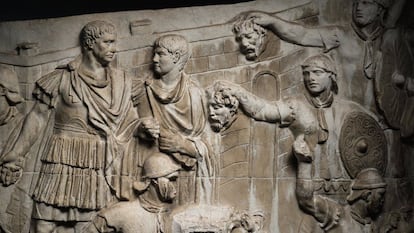
In any case, Trajan’s army prevailed in its battles. “He inherited a well-oiled war machine, undoubtedly at a point of excellence, optimal for the challenges it had to face.” Was it the best Roman army of all time? “The best to fight those enemies; if Trajan’s legions had had to face the Goths, they would have had serious problems. There is no such thing as a pinnacle of the Roman army; it always continued to evolve, adapting to new enemies. That was probably one of its secrets, along with discipline, planning, and communication, the ability to adapt.” And implacability. “In war, Rome was a brutal and terrifying power, employing terror as a weapon of deterrence. It often carried out prophylactic massacres, exterminating entire tribes, such as the Bructeri. The head of Decebalus, the Dacian king (who took his own life), ended up thrown down the Gemonian Steps, the classic haunt for Rome’s enemies. Rome’s prestige always goes hand in hand with terror.”
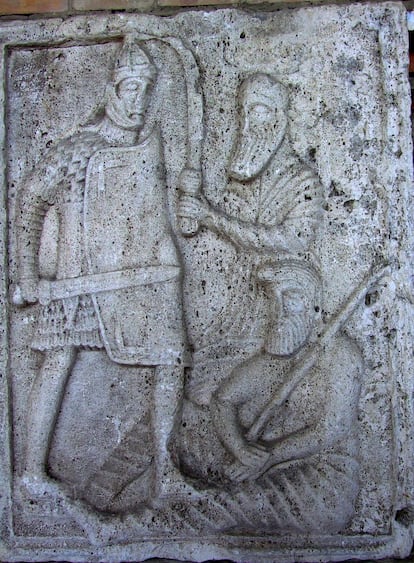
The best-known representation of Trajan’s army is Trajan’s Column in Rome (where his ashes were buried after his death in Cilicia upon his return from the Parthian campaign). “It is a great propaganda piece for the campaign against the Dacians, aimed at the capital’s public. The war is greatly softened when compared to another, much cruder representation, that of the Tropaeum Traiani, in Adamclisi, Romania. The troops have been reproduced so that they can be easily identified from a distance. It represents Trajan’s triumph as a great conqueror, and the success of his regime.”
Sign up for our weekly newsletter to get more English-language news coverage from EL PAÍS USA Edition









































