
Stricter Trump-era vetting leaves police departments without ‘Dreamer’ officers
Lengthy wait times are leaving many DACA beneficiaries in limbo and without work permits, including law enforcement officers
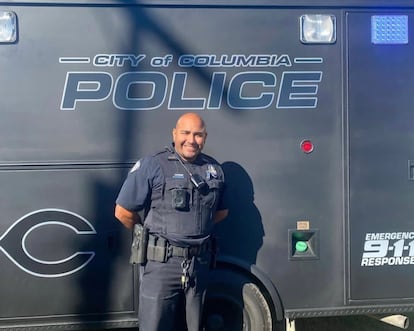

They warned him at the police academy: sooner or later he would show up at a crime scene that would haunt him for the rest of his life. Édgar Vázquez Silva never imagined that traumatic moment would come during his first week as an officer in Mississippi. “I had never seen a dead person before,” he recalls of that blood-soaked room that stole his peace of mind.
That happened in 2021. Now the fear that keeps this officer awake is a different one: losing the badge he worked so hard to earn. His career would be at risk if there is a delay renewing his DACA work authorization, tied to the immigration relief program created in 2012 by the administration of Barack Obama to shield from deportation undocumented people who arrived in the country as children.
Vázquez Silva’s anxiety is not unfounded. At least three California officers have had to surrender their badges and guns and were placed on unpaid administrative leave because they could not renew their DACA card in time. That procedure, increasingly complex and slow, must be repeated every two years by roughly 500,000 beneficiaries.
Amid the assault the program has faced under the administration of Donald Trump, processing times have risen and, for some, filing for renewal months in advance has not been enough. The average wait time rose from 15 days in 2025 to 70 days this year, an increase of more than 360%, according to data from U.S. Citizenship and Immigration Services (USCIS).
Groups that defend immigrants say this is part of a strategy to “destroy” the relief and expel from the country people who lack other immigration protections. “It’s sad to see Dreamers lose their jobs because of these delays,” says Officer Vázquez Silva, 36, who was born in Tamaulipas, Mexico. “I think: if it’s affecting many, it could affect me too.”
There are no public figures showing how many DACA card holders have lost their work permits. USCIS attributes the delays to the current federal government imposing “more rigorous vetting and scrutiny” of foreigners seeking immigration benefits, and stresses that DACA does not confer any form of legal status in this country. “Any undocumented noncitizen who is a DACA beneficiary may be subject to arrest and removal for a variety of reasons,” it says in a statement.
The economic contributions of dreamers to essential sectors of the country, from health care and education to police forces, seem to carry little weight in the Trump administration’s decisions. More than 90% of beneficiaries over age 25 participate in the workforce and generate annual earnings close to $27.9 billion. They also contribute more than $2 billion a year in state and local taxes, according to the Institute on Taxation and Economic Policy.
“I’m worried”
At a time when the Los Angeles Police Department (LAPD) continues to shrink after nearly 1,300 officers left since 2020, the department now faces the possibility of losing dozens of DACA-beneficiary officers and civilian employees. Two officers, surnamed Pacheco and Carrillo, were placed on unpaid administrative leave after their work permits expired. Both had filed for renewal several months in advance.
The suspension also left them without access to unemployment benefits. “They can’t pay me for my vacation, my sick days, or other hours I’ve accrued working for them,” Pacheco told Univision. Carrillo has now gone four months without income. “I’m worried. I have bills to pay, like everyone else,” he told the same outlet.
A California law that took effect on January 1, 2023, opened the doors of law enforcement agencies to Dreamers by removing the requirement that officers be U.S. citizens. Instead, they now only need legal authorization to work in the country.
The problem of DACA Dreamer officers leaving comes at one of the most delicate moments for the LAPD. Considered the worst staffing crisis in three decades, the force has shrunk from more than 10,000 officers a few years ago and there is now fear the number could fall to around 8,600 uniformed officers this summer.
In a statement, the LAPD confirmed the situations of Pacheco and Carrillo but said it has little wiggle room while pending renewals are unresolved. “The Department must comply with state and federal employment eligibility requirements and is awaiting action by the federal government regarding pending EAD (Employment Authorization Document) renewals,” it said.
A similar situation is unfolding in Santa Ana, a predominantly Hispanic city about 30 miles south of Los Angeles. Its police department has already lost at least one officer because of DACA renewal delays and fears others will face the same fate in the coming weeks.
At a Senate hearing held on May 12, Santa Ana Police Chief Robert Rodríguez warned that delays in those procedures are worsening recruitment and retention problems police agencies face nationwide. He also highlighted the contributions of Dreamer officers to American society.
“They have passed exhaustive background checks, psychological evaluations and months of training at the academy and in the field. They wear a badge, respond to violent emergencies, help victims, guide young people and work shoulder to shoulder with other officers in high-risk situations. Many are bilingual and maintain deep ties to the communities they serve,” Rodríguez said. “And yet they live with uncertainty.”
Democratic Representative Lou Correa has urged the federal government to resolve these delays as soon as possible and in late April sent a letter to the Homeland Security secretary to intercede on behalf of a Santa Ana Dreamer officer and an Irvine Police intervention officer in Orange County. To date, they are still awaiting approval of their work permits.
“Both women chose careers in institutions that depend on trust, integrity and good conduct, and they have demonstrated precisely that through their service,” Correa’s letter reads. “Losing two dedicated law enforcement professionals because of a processing delay will affect the departments where they work and the communities that rely on them,” it adds.
An officer without a gun
Vázquez Silva has no memories of Mexico. He was only three years old when his mother crossed with him without papers into Texas. His stepfather’s construction work moved the family from state to state until they finally settled in Mississippi. When he was 12, his mother told him something that changed how he saw himself. “Son, you are undocumented,” she said. He understood what those words meant years later, in high school, as he began planning his life. “And now what am I going to do?” he remembers asking his mother.
After finishing school, he worked as a gardener, bricklayer and gas station attendant. His horizon changed in 2012 with the introduction of the DACA program, and a casual encounter sealed his future. A police officer he knew invited him for a ride around the city in a patrol car. When the ride was over, Vázquez Silva was certain: “This is what I want to be.”
In 2021 he graduated from the part-time officers’ academy and began patrolling the streets of Columbia. Three years later he was selected for the full-time academy. But midway through training he received devastating news: he had been disqualified because he was not a permanent resident or citizen. “You can finish the academy, but we can’t give you the badge,” they told him.
From that moment he was not allowed to carry a firearm and his career was put on hold. For a time he was responsible for guarding a public school in Columbia, although he was forbidden from using the shotgun in his patrol car. “I never felt right because I didn’t have a gun. They could kill me.”
In 2023 he found a new opportunity in the Stone County sheriff’s office, where he transports inmates to their court hearings. He does so despite the risk of being unarmed. It is a part-time job he supplements with another position as a security supervisor at a power plant.
Vázquez Silva renewed his DACA card in 2025 and kept his job. However, the clock is still ticking. In a few months he will once again have to face the process that today has other Dreamers on the verge of losing their jobs. “They see us as if we weren’t important,” he says with frustration. “We are Americans, we love this country; we should be given a chance.”
Sign up for our weekly newsletter to get more English-language news coverage from EL PAÍS USA Edition









































