Bruna Ferreira, the former sister-in-law of the White House press secretary detained by ICE: ‘I never wanted to be an international news story’
The Brazilian woman, who was engaged to Karoline Leavitt’s brother and had a child with him, says in an interview with EL PAÍS that she has been living a ‘nightmare’ since immigration officials arrested her in November
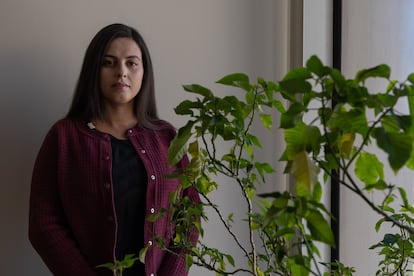

More than six months have passed, and Bruna Ferreira still does not understand why she was arrested. Nor does she understand why the Donald Trump administration labeled her a “criminal illegal alien” after her detention. What she does know for certain is that she has lived through a true “nightmare” ever since. She thanks God again and again that she only spent 26 days in a detention center before being released rather than deported, as thousands of migrants have been under the U.S. president’s mass deportation campaign. But her release did not bring an end to her ordeal. Getting her life back on track has proved difficult due to the massive media coverage her case received. After all, she is the mother of the White House press secretary’s nephew.
“I never wanted to be an international news story,” Ferreira said. The 34-year-old Brazilian met with EL PAÍS last Wednesday at her attorney’s office in Boston. For nearly two hours, she maintained steady eye contact, and her voice faltered only once. Speaking in flawless English, interrupted by only a few words in Portuguese — a reflection of the fact that she has spent virtually her entire life in the United States — she recounted how she arrived in this country as a child, her long struggle to regularize her immigration status, and her previous romantic relationship with the brother of Karoline Leavitt, President Trump’s press secretary.
One question naturally hung over the entire interview: did Michael Leavitt have anything to do with her arrest? Ferreira and Leavitt engaged in a bitter custody battle — now resulting in shared custody — over their 12-year-old son after their relationship ended a decade ago. It is the same question other detainees at the Immigration and Customs Enforcement (ICE) detention center in Louisiana, where she was held, asked her when they saw her case mentioned in the news on one of the facility’s televisions. It is also the question her son has asked her on several occasions.
“I just tell him that it’s not really his place to choose between a mother and father. Let things happen the way that they’re going to happen and we’ll get there, but I don’t want to make false accusations,” she says. However, both she and her lawyer agree that her arrest “appears to have been targeted.”
‘Are you Bruna?’
It happened on November 12, 2025. Ferreira is a woman of faith and spirituality: she remembers the date clearly because she and her son text each other every day at 11:11 a.m. to make a wish. The day before her arrest had been the 11th day of the 11th month. “It’s almost like we wished for something to change,” she says ruefully. I didn’t know it was gonna be this kind of change, but it came into fruition.”
It was a Wednesday. Ferreira woke up at 4:30 a.m. to take her son to school. The journey from her home in Revere, north of Boston, to his school in New Hampshire is more than 30 miles, which means early mornings are a necessity. After dropping him off, she returned home for a while, knowing she would have to make the same trip again that afternoon to pick him up. “I don’t think I even had the opportunity to change clothes,” she recalls. “I had some chicken noodle soup and headed out the door.”
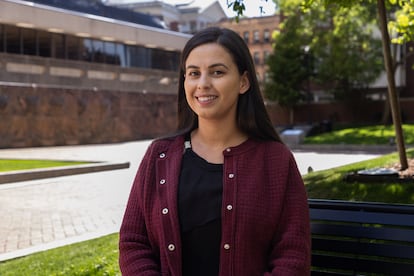
As she drove out of the parking lot of her apartment building on her way to pick up her son, her vehicle was surrounded by several unmarked cars. About half a dozen federal agents emerged and, within seconds, ordered her out of the vehicle, handcuffed her, and took her into custody, according to video footage of the arrest that was later leaked to the press.
“I recall one of the agents asking me my name, and I didn’t tell him what my name was because how would you be able to pull me over if you don’t have a warrant for my arrest? This vehicle isn’t insured under my name. If you ran the plate, it’s not my name? So obviously they knew who they were pulling over,” she recalled. Then, one of the agents suddenly blurted out, “Are you Bruna?” The video of her arrest that was released to the press does not include audio, but Ferreira says that at that moment she realized this wasn’t just a routine traffic stop.
The officers took her to the local police station while Ferreira begged to be allowed to make a call to make sure someone would pick up her son. Unable to reach her ex-fiancé, Michael Leavitt, Ferreira asked them to call the White House press secretary directly: “When they found out that I was related to Karoline Leavitt, one of the officers slammed the door and was like, ‘Fuck, what are we going to do? We have to get her out of here.’”
From there, ICE transferred her from facility to facility “like cattle,” as she describes it, moving her through Vermont, Philadelphia, Texas, and finally Louisiana. Attorney Todd Pomerleau took on her case, and it was through his efforts that, around Thanksgiving Day, Ferreira’s story and her connection to the Leavitt family became known in the national press. Before long, she had captured the attention of the entire country.
‘Criminal illegal alien’
The Trump administration immediately went on the offensive. While Karoline Leavitt — one of the most outspoken defenders of Trump’s deportation campaign — remained publicly silent, the Department of Homeland Security labeled Ferreira a “criminal illegal alien.” The department stated that the Brazilian national had been arrested for assault and that she had entered the United States “on a B-2 tourist visa, which required her to leave the country by June 6, 1999.” The White House, meanwhile, asserted that Ferreira had not spoken to the press secretary in years and that she had never lived with her son.
“All false,” Ferreira says. “Factually false and legally false,” her lawyer adds.
Ferreira arrived in the United States in 1998 when she was six years old. She was brought by her grandmother, with whom she had been living in Brazil, to reunite with her parents, who were already in the country. According to her account, her grandmother returned to Brazil and was supposed to come back for her a few months later, when Ferreira’s visa expired. But the woman died, and Ferreira remained in the United States with her parents.
Under U.S. immigration law, a person does not begin accruing unlawful presence in the country until turning 18. Once they do, they have 180 days (approximately six months) to adjust their status before triggering a three-year reentry bar if they leave the United States for any reason. If they remain without authorization for one year or more after turning 18 and then depart the country, they face a 10-year reentry ban.
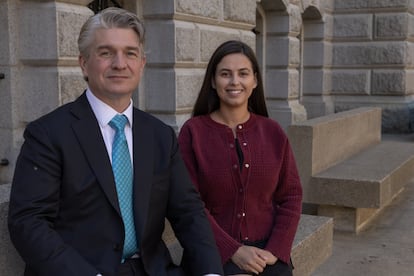
As attorney Todd Pomerleau explains, after Ferreira’s visa expired when she was six years old, she could not be penalized for remaining in the United States without authorization until she reached adulthood. When she turned 18 in 2011, Ferreira married her high school boyfriend, a U.S. citizen, and began the process of applying for lawful permanent residency — a green card.
However, the marriage eventually fell apart, and the application was never completed or adjudicated.
In 2012, she met Michael Leavitt and the two began a relationship. That same year, Ferreira also applied for DACA (Deferred Action for Childhood Arrivals), the legal program created by the Obama administration for undocumented immigrants who arrived in the United States as children, shielding them from deportation. She was granted the protection and, with it, authorization to work legally in the country.
For years, according to her attorney, her immigration case remained dormant while her application for permanent residency languished. Pomerleau maintains that Ferreira has never been unlawfully present in the United States because she has spent this entire period awaiting a decision on the residency petition she filed when she was 18.
But after Donald Trump returned to power in 2025 with a pledge to carry out the largest deportation operation in U.S. history, the government reopened her immigration file. “And shortly afterward, she was arrested,” Pomerleau says.
Addressing the Department of Homeland Security’s claims that Ferreira has a criminal record, Pomerleau argues that those allegations are also inaccurate. According to the attorney, the incident in question occurred in 2008, when Ferreira was 16 years old. She was summoned to juvenile court following an altercation with another girl outside a restaurant. The two teenagers had argued over eight dollars in change, but the dispute never turned violent, Pomerleau said. He further maintains that the court summons was not a criminal matter, that the case was ultimately dismissed, and that the proceedings should have remained confidential, as is standard for cases handled in juvenile court.
“She was never arrested, so how could she be a criminal illegal alien? It’s considered a crime if you’re an adult. She wasn’t an adult; that’s the whole point. You’re not supposed to be stigmatized for the rest of your life when you’re 14 or 15 years old and you go to a juvenile proceeding,” her lawyer points out.
Armed with these arguments, Ferreira’s legal team succeeded in persuading an immigration judge to grant her release on bond on December 8. The judge set the bond at the minimum amount permitted — $1,500 — and, after 26 days in detention, Ferreira was finally able to leave the Louisiana facility.
The Department of Homeland Security reiterated in a statement sent to EL PAÍS that Ferreira was arrested “because she is an illegal alien.” “A Biden-appointed judge allowed her to be eligible for bond. She paid her bond and was released while she continues in removal proceedings. She will have periodic mandatory check-ins with ICE law enforcement to ensure she is abiding by the terms of her release,” it added.
Ferreira still recalls, with a heavy heart, the women she met in detention — women who had spent months or even years trying to secure their release, who spoke no English and were unable to advocate for themselves in the way she was able to do. “It’s so wild to witness it firsthand because allegedly what my sister-in-law is conveying is that they’re locking up the big, the bad, and the ugly: rapists, murderers, and gangbangers. But I saw it firsthand that that is the furthest thing from the truth.”
‘He knew my immigration status was my Achilles’s heel’
Ferreira is now awaiting further progress in her immigration case before the courts, while also dealing with the consequences of her arrest. The Brazilian woman says her home-cleaning business has suffered losses, as some clients no longer want her inside their houses. She has also been targeted on social media, where she has been labeled everything from an absent and negligent mother to an opportunist and a liar. Her only mission, she says, is to protect her son from it all.
Ferreira had no contact with her son during the nearly month she spent in immigration custody. She alleges that the boy’s father never returned her calls seeking to speak with the child. After being released, she was reunited with her son and has continued seeing him since then: “I brought him to his first hot yoga class. I just went to the school concert. He had a solo. I was just sitting back crying. It was a very great moment for him. We have been able to spend time together. It’s not as much time as I would like, but he does have his own little life out of school with baseball and sports and extracurricular activities.”
Regarding the rest of the Leavitt family, she says, “I’ve been trying to avoid Mike (her son’s father) and his parents.”
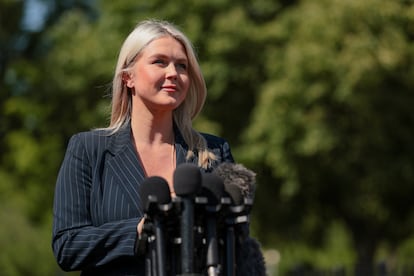
Ferreira and Michael Leavitt were together until April 2015. Before the relationship unraveled, Ferreira describes her interactions with the Leavitt family during those years as “cordial.” They were young at the time: the couple in love was in their early twenties, while Karoline was still a teenager. Their child was born in March 2014, and nearly a year later, Ferreira and Leavitt ended their engagement.
She says she decided to leave because the relationship had deteriorated following several “domestic altercations.” “It wasn’t good for a child,” she says, referring to the impact the relationship had on her son. According to Ferreira, Leavitt at one point threatened to have her deported, aware that her immigration status was her “Achilles’ heel.”
This newspaper attempted to contact Michael Leavitt but received no response; however, in comments to The Washington Post in December, he said he had nothing to do with Ferreira’s arrest.
The couple’s breakup was followed by a custody dispute over their son that lasted for years and was ultimately resolved through an out-of-court shared custody agreement, under which young Michael primarily lives with his father. During the court proceedings, The Washington Post reported in December, Ferreira and Leavitt accused each other of abuse and neglect. Both have denied the allegations.
Ferreira says she has explained her entire immigration situation to her son in case, “God forbid,” she is ever deported. Her mother recently obtained permanent residency, and her two siblings, both born in the United States, are citizens. But she remains in limbo. Following her arrest, Ferreira alleges, the Leavitt family told her sister that she should “self-deport” and attempt to return legally.
“A trap,” her lawyer says. He knows, as Ferreira does, that under the Trump administration’s anti-immigration crackdown, she would likely never be able to return.