
Spanish man returns home after more than six months in ICE detention: ‘Your life slowly fades away’
Miguel Barreno, stopped by Trump’s immigration agents in Chicago and sent to several centers, arrives in Madrid with a safe-conduct and denounces the ordeal he was subjected to
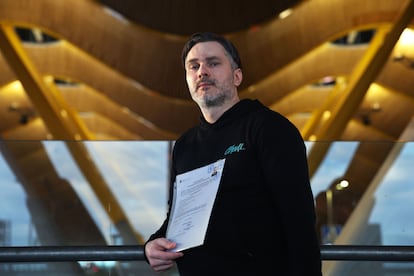

Around 6:30 a.m. on October 28, Miguel Barreno López, a citizen of Spain, was driving to the Indian food factory where he worked near Carol Stream, a suburb of Chicago. He was with three other people, all Nicaraguans. Suddenly, a vehicle pulled up alongside them and forced them to stop. Barreno immediately sensed what was happening. “These aren’t police officers,” he thought to himself. They were agents of ICE (Immigration and Customs Enforcement), the police-like units to which the administration of President Donald Trump has given free rein to pursue and detain undocumented immigrants. Thus began “a nightmare” from which he only began to see the end after reporting his situation in a phone call to EL PAÍS.
More than six months have passed since his arrest. On Sunday, May 3, Barreno landed in Madrid. As he crossed the Atlantic, sitting in seat 29-D of American Airlines flight 126, without any suitcases or even a backpack, and with a safe-conduct tucked away in a folder, he reviewed the Kafkaesque ordeal in which he had been trapped and glimpsed a new life in Spain. Barreno spent Christmas in a detention center in the state of Indiana and turned 39 in another correctional facility in Kentucky, surrounded by common criminals. Seated at a table in a fast-food restaurant in Terminal 4 of Adolfo Suárez Madrid-Barajas Airport, Barreno’s story pours out of him in a rush of dates, images, and emotions.
Barreno lived with his partner, Leticia Centeno, in an apartment in Chicago. For years, he had earned $800 a week (about €684). “I had my car there, I was up to date with the payments and the insurance. We were hard workers, we paid the rent at the end of the month, we went out on weekends, we ate out, we went shopping. The usual stuff, but all that was before, when we weren’t being persecuted,” he recounts. They met in Madrid, where he grew up, about a decade ago. She is from Nicaragua, and when she decided to return to her home country first, and then migrate to the United States, Barreno chose to follow her. He bought a ticket to Chicago, entered as a tourist, and stayed. It was November 2017, and he was starting his life from scratch. His Spanish passport and ID card expired, but he got a driver’s license, and with that, he was able to live without major problems in a place considered a “sanctuary city”, like New York or Los Angeles, because of its welcoming policies towards migrants.
It was precisely through his driver’s license that ICE agents obtained his immigration history. Barreno vividly remembers those moments, starting with the banging on the window. “Bang, bang, bang. I kept quiet because I thought, ‘I have my rights, and they haven’t read them to me.’” However, the methods of this federal agency, expeditious at best, allow neither for arguments nor silence. And what came next shows that in reality, for ICE, he had no rights.
They asked him if his tourist visa had expired, and he answered yes. He was then taken, along with the other passengers, to the nearest detention center. “Once there, an officer interrogated me and gave me a court date of November 17th. Then they took us to a room with dozens of people in a confined space. They had to turn on a fan because many people were suffocating. And around four in the morning, they transferred us, handcuffed and shackled. Just like in the movies.”
The next stop was the Brazil Detention Center in Indiana. There he waited until the November 17 hearing, which was held via video call from the facility. “I appeared without a lawyer. The judge told me I had no options for requesting asylum and that I don’t have any children born in the United States. I had nothing there, really. I also had no criminal record, so the only way to end this, she told me, was voluntary departure. At no point did she mention deportation,” he says.
Towards an exit
Barreno clung to that idea, although he was ultimately deported and is barred from returning to the United States for at least 10 years. After appearing before the judge, he awaited the administrative conclusion of his case, which, according to him, remained in limbo between local authorities, ICE, and the Spanish Consulate in Chicago, although Spanish diplomatic sources in the United States maintain that they had offered him safe passage back in November. In any case, after spending Christmas at the Indiana detention center, an official informed Barreno in early January that he was going to be released. “It was the 7th or 8th; I thought I was leaving, but it wasn’t sorted out yet. They told me I was being transferred to another jail, in Kenton County, Kentucky.” There he spent almost four months living with common criminals and 15 other foreigners awaiting deportation. The center, used for temporary detentions, didn’t have any cells, but rather partitioned modules. “If something had happened to me in that prison, if I had been hit, or anything at all, what would I have done? How would I have defended myself? I had a really bad time in there, a truly terrible time. Being deprived of freedom is the worst thing that can happen to you. It’s like everything shuts down. You lose contact with others, your heart fades away, your life fades away, you sink to the bottom.”
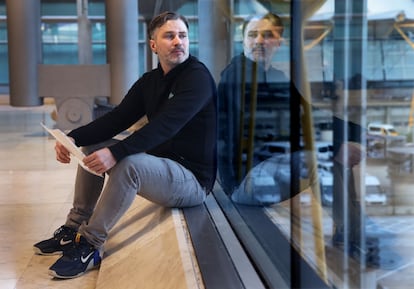
It was at the end of March when the Spanish Consulate in Chicago located him again at that center, from where he could make a 15-minute call each day. “They told me that all that was needed was a document [to prove his identity]. My passport had expired, although luckily I still had my national ID card in my wallet, even though it had also expired. So they made a copy,” he recalls. “After that, they called me again, and this time it was for real, this time they were going to take me to Chicago. There at the Consulate, the consul and his wife received me very kindly. They gave me the safe-conduct and shook my hand.”
Barreno, however, had to wait another week in custody, as ICE had purchased his ticket for May 2nd. They escorted him to the airport, right to the boarding gate. He arrived in Madrid wearing the same clothes he had on the day of his arrest: sneakers, a black hooded sweatshirt, and gray jeans. In an envelope, he carried a handful of belongings: a leather keychain with the Nicaraguan coat of arms embossed on it, his cell phone, a smartwatch, his safe-conduct document, and the deportation orders.
—How are you feeling?
—Do you know what it means to me to talk to you, to talk to anyone and have everyone understand me? That’s it.
Sign up for our weekly newsletter to get more English-language news coverage from EL PAÍS USA Edition









































