
US plans to review up to five years of the social media history of foreign travelers
The Trump administration’s proposal would apply to visitors from countries included in the Visa Waiver Program
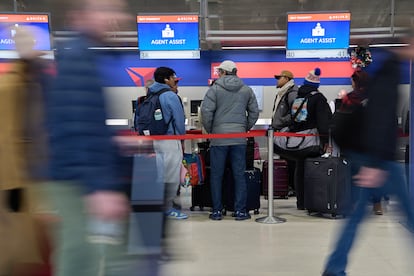

Foreign travelers wishing to enter the United States may be required to disclose up to five years of their social media history before arriving in the country under a proposal submitted by Customs and Border Protection (CBP) and the Department of Homeland Security (DHS). The data would be “mandatory” for visitors, regardless of whether they come from countries that require a visa, according to a notice published Tuesday in the Federal Register.
This change in border control would significantly expand the information collected from visitors arriving in the country without a visa under the Visa Waiver Program. Currently, citizens of about 40 countries, including much of Europe, Australia, Japan, South Korea, and Israel, can enter the United States for up to 90 days without a visa by completing an Electronic System for Travel Authorization (ESTA). The process requires basic biographical data, contact information, and a $40 fee, and the authorization is typically valid for two years.
Under the new proposal, social media would become a “mandatory data element” of the ESTA application. Applicants would have to provide details of their social media activity over the past five years, although the proposal does not specify which platforms or types of information would be requested. In addition, travelers could be asked to submit any phone numbers used in the last five years, email addresses from the last 10 years, and more detailed information about their family members, including names, dates of birth, addresses, and contact details.
The measure also includes plans to collect additional technical and biometric data from travelers. This could include IP addresses, metadata from uploaded photos, and biometric identifiers such as facial images, fingerprints, DNA, and iris data. CBP has also suggested requiring applicants to submit a selfie as part of the ESTA process. Although facial and fingerprint data are already collected upon arrival at U.S. borders, the proposal would move this part of the process to the pre-travel stage.
Another proposed change is to move ESTA applications exclusively to a government mobile app, which would eliminate the option of applying through a website. CBP estimates that more than 14 million people per year would use the ESTA mobile app if the changes are implemented.
The proposal has been published in the Federal Register and is open to public comment for 60 days. Authorities say the measures are part of a broader effort to strengthen border security and address threats to national security and public safety, citing an executive order signed by President Donald Trump shortly after he began his second term.
The Trump administration has taken a tougher stance on immigration and travel over the past year. Authorities have expanded social media screening for student visas and H-1B visas for highly skilled workers, requiring applicants to make their accounts public. Since 2019, all immigrant and non-immigrant visa applicants must disclose their social media accounts, a policy first introduced during Trump’s previous presidency.
The proposal comes after the Republican administration last week halted all immigration proceedings for people from 19 countries currently subject to a travel ban, in response to the attack on the National Guard in late November in Washington, D.C., by an Afghan citizen, which killed one officer and seriously injured another.
Supporters of the measure argue that increased scrutiny is necessary to identify individuals who may pose a security risk, including those who promote violence or terrorism. However, the proposal has also drawn criticism from digital rights advocates and immigration lawyers, who warn that it could deter visitors and raise civil liberties concerns. Some argue that mandatory disclosure of social media history may lead travelers to self-censor their online comments or avoid traveling to the United States altogether, in addition to potentially damaging the country’s global reputation.
There are also concerns about practical consequences, such as longer processing times for ESTA approvals. Immigration specialists warn that expanding data collection could slow approvals and create uncertainty for travelers planning short visits.
Furthermore, the proposal comes shortly before the United States hosts major international events such as the 2026 FIFA World Cup and the 2028 Olympic Games in Los Angeles, which could have an impact on the number of foreign visitors attending. The World Travel and Tourism Council has stated that the United States is the only one of the 184 economies analyzed that is expected to experience a decline in international visitor spending in 2025.
Sign up for our weekly newsletter to get more English-language news coverage from EL PAÍS USA Edition









































