
Trump asks attorney general to investigate Epstein’s ties to Bill Clinton and JP Morgan in an attempt to shift focus
The US president also cited former Harvard president Larry Summers and LinkedIn founder Reid Hoffman
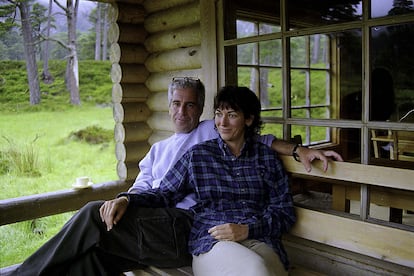

It was further proof, visible to the world, of the U.S. president’s disdain for the democratic ideal of the separation of powers. And it was, once again, delivered on his social media platform, Truth, with a message posted Friday, in which Donald Trump said he would ask Attorney General Pam Bondi and the Department of Justice, “together with our great patriots at the FBI,” to investigate the relationship between Jeffrey Epstein and “[former President] Bill Clinton, Larry Summers [former president of Harvard and a member of Clinton’s administration], [LinkedIn co-founder] Reid Hoffman, JP Morgan, Chase, and many other people and institutions, to determine what was going on with them, and him.”
Trump justified the order — which breaks the rules of American institutional decorum, given that the figure of the attorney general is supposed to be independent of the White House — by claiming that the Democrats have resurrected the Epstein case, or “the Epstein Hoax,” according to the president, to “deflect from their disastrous shutdown, and all of their other failures.”
The maneuver seems to be aimed at another goal: to try to divert attention from the scandal caused by his refusal to release the files held by Bondi on the case of the pedophile, who died in 2019 in a maximum-security cell in Manhattan (he took his own life, according to the coroner, even though conspiracy theorists believe he was killed so that he would not expose his secrets).
It’s unclear whether Bondi will accept Trump’s assignment, or how the investigation might materialize if she does. It’s also unclear whether — as so often happens with Trump — his grandiose announcement will ultimately amount to nothing. Much less clear is whether it will achieve its diversionary objective: the release this week of more than 20,000 documents obtained by Congress from the family of the pedophile financier has resurrected a ghost that has haunted the president for years: that of his long friendship with Epstein and the suspicion that Trump’s determination not to release these materials — despite his own promises to do so — is hiding something.
The Republican denies any knowledge about the crimes of his former friend, with whom he maintained relations for 15 years until their falling out in 2004. Trump claims that they parted ways when he kicked Epstein out of his Mar-a-Lago club because of his “really weird” behavior toward some employees. In messages released this week, the convicted sex offender denied that this was the case. There is also an email in which Epstein appears to place Trump at a Thanksgiving party the two attended in 2017, during the Republican’s first presidential term, although there is no certainty that this actually happened.
There is also no evidence that Trump was aware of Epstein’s misdeeds, let alone that he participated in them, although in the batch of emails released in recent days, one states that he “spent hours at my house” with one of the victims and that “of course he knew about the girls,” referring to the minors whom the financier abused with impunity for years, with the complicity and participation of his procurer, Ghislaine Maxwell, who is serving 20 years in a low-security prison.
In his message Friday, Trump points to Clinton, one of the influential figures most frequently linked to Epstein (again, without evidence that he committed any crimes) and to the list of rich and famous people that the millionaire supposedly kept, which has also been the source of numerous conspiracy theories.
It has been proven that the former Democratic president met Epstein through his daughter, Chelsea, and Maxwell, and that he flew on his private planes “at least 26 times” between 2002 and 2003, according to flight logs and as part of his work for the Clinton Foundation. This was also before the first trial against the convicted sex offender.
Trump also cited JP Morgan, which was Epstein’s main bank for 15 years, a period during which the financier made money transfers that triggered alarms among the institution’s anti-money laundering watchdogs, who never took action against one of their preferred clients. The relationship extended beyond the first trial. An investigation by The New York Times concluded in September that the largest bank in the United States facilitated the crimes of the sex offender, who moved vast sums of money to maintain his child trafficking network.
In his book The Spider: Journey Inside the Criminal Web of Jeffrey Epstein and Ghislaine Maxwell, investigative journalist Barry Levine writes that in 2002, two witnesses twice placed Clinton on the private island where the financier committed many of his abuses, although there is no documentary evidence of this and no victim has accused Clinton of any crime. The former president has categorically denied traveling to the island or having a close relationship with Epstein, and has maintained that he knew nothing about his crimes.
Larry Summers has been one of the most prominent figures in this week’s latest declassification of documents (in two batches: the first, of three emails, was released by the Democrats; the second, of more than 20,000, was released by the Republicans). It was already known that Summers had had a relationship with the financier (a relationship he later publicly regretted), but not that he had continued to maintain such frequent contact with him between 2017 and 2019, years after Epstein’s first conviction for a prostitution-related crime, and even after the Miami Herald revived the case against him with a series of investigative reports.
In those exchanges, they talk extensively about Summers’ relationship with a woman in London about whom Epstein gives him advice. They also discuss Trump. From those dozens of emails exchanged between the two, it’s also impossible to conclude that Summers knew anything about Epstein’s crimes.
As for Hoffman, the LinkedIn co-founder was in talks with the financier when he asked him for money for the Massachusetts Institute of Technology (MIT). In that context, he traveled to the island once for a fundraising event.
Sign up for our weekly newsletter to get more English-language news coverage from EL PAÍS USA Edition









































