
Trump administration debunks Epstein conspiracy theory: He died by suicide and no ‘client list’ exists
The Department of Justice and the FBI released two videos capturing the night of the businessman’s death in a New York jail cell while he awaited trial
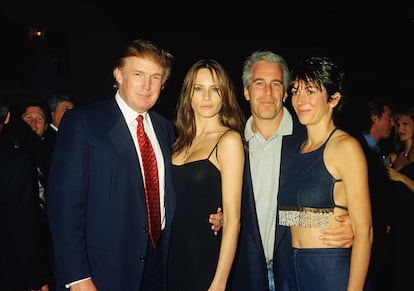

One of the MAGA movement’s favorite conspiracy theories has been debunked — from the inside, or rather, from the top. A two-page document bearing the letterheads of the FBI and the Department of Justice, first reported by Axios, concludes that there is no “client list” — the alleged black book in which convicted pedophile Jeffrey Epstein supposedly recorded the names of powerful people involved in his underage sex trafficking network. The report by the Trump administration also confirms that Epstein died by suicide.
Epstein was found dead in August 2019 in his cell at a high-security prison in Manhattan, where he was awaiting trial. Major lapses in his supervision led to widespread skepticism about the official account of suicide.
To support this conclusion, the Department of Justice released two surveillance videos — in both raw and "enhanced" versions — showing that no one entered Epstein’s cell on the night he died. Both videos, nearly 11 hours long, feature a fixed overhead camera angle focused on the cell door, which remains closed and untouched.
Prison staff failures
Epstein died on August 10, 2019, one month after being arrested in New Jersey. He was in the custody of the Federal Bureau of Prisons, held at the now-closed Metropolitan Correctional Center in Manhattan — once nicknamed New York’s Guantánamo. In 2023, a Department of Justice investigation found “numerous and serious failures” by prison staff. These lapses left Epstein unsupervised and alone in his cell with an excessive amount of bedding from the night before until the morning of August 10, when he was found hanged with a bedsheet during the first morning check.
As for the infamous Epstein files, the official document released by Axios says the FBI conducted “digital searches of its databases, hard drives, and network drives, as well as physical searches of squad areas, locked cabinets, desks, closets, and other areas where responsive material may have been stored,” and that this “systematic review revealed no incriminating ‘client list.’” It also states that there was no credible evidence “that Epstein blackmailed prominent individuals” or that “could predicate an investigation against uncharged third parties.”
This revelation comes just over a month after Elon Musk and Donald Trump had a very public falling-out — shortly after Musk left his special government role as head of the Department of Government Efficiency (DOGE). Amid the feud, Musk wrote on X (formerly Twitter): “@realDonaldTrump is in the Epstein files. That is the real reason they have not been made public,” He added: “Have a nice day, DJT!” Musk, a known purveyor of conspiracy theories, offered no evidence for the claim and later deleted the post.
MAGA disappointment
America’s conspiratorial far-right has long fueled rumors about Epstein’s supposed client list and the authorities’ alleged refusal to release it. Trump’s return to the White House had raised hopes in those circles that the truth might finally come out. Attorney General Pam Bondi had promised transparency and even invited a group of far-right influencers to Washington to share what turned out to be disappointing news. The declassified documents — most of them already public — left prominent MAGA figures underwhelmed and angry.
That disappointment only deepened the conspiracy theories. Ironically, Kash Patel and Dan Bongino — two of the theory’s loudest promoters — now serve as FBI director and deputy director, respectively, and are the very people insisting there was never anything to hide.
Epstein was first arrested in Palm Beach, Florida, in 2005, accused of paying a 14-year-old girl for sex. Dozens of other underage victims later came forward with similar accusations. In 2008, he reached a plea deal, pleading guilty to a single charge involving one victim. He served 13 months in a work-release program.
After his conviction, some prominent friends — including former president Bill Clinton and Donald Trump — publicly distanced themselves from Epstein. Yet he remained in elite social circles for another decade, often under the guise of philanthropy. A series of investigative reports by the Miami Herald reignited public interest in the case, prompting federal prosecutors in New York to charge Epstein with sex trafficking in 2019.
His associate, British socialite Ghislaine Maxwell — daughter of media mogul Robert Maxwell — was convicted of child sex trafficking and sentenced to 20 years in prison in June 2022.
Sign up for our weekly newsletter to get more English-language news coverage from EL PAÍS USA Edition









































