
United States kills 14 crew members of four suspected drug boats in the Pacific
Defense Secretary Pete Hegseth said the victims of three extrajudicial operations belonged to ‘designated terrorist organizations’
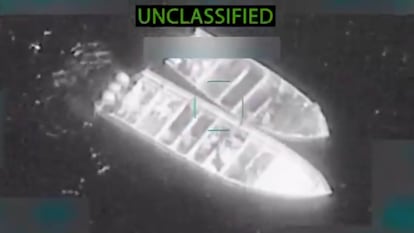

Defense Secretary Pete Hegseth announced Tuesday on his social media account X that the U.S. military had launched three extrajudicial attacks on four vessels sailing in the Pacific on Monday. Fourteen people were killed in the operation, and there was one survivor. Hegseth claimed, without providing evidence, that the vessels were transporting drugs and that their crew members, killed in the operation, belonged to “designated terrorist organizations.” He did not specify which organizations.
Including these four vessels, the U.S. military has destroyed 14 boats since early September in a White House-declared war — without Congressional approval — against Venezuelan, and more recently Colombian, drug traffickers. The operations have so far left 57 civilians dead, with only three survivors reported.
Hegseth said that eight “narco-terrorists” were on the first two vessels attacked “at the direction of President Trump.” The second attack killed four more people. In the third attack, two crew members died and one survived, and is now in the custody of the Mexican Navy. All of these extrajudicial operations, Hegseth added, “were in international waters with no U.S. forces harmed.”
Yesterday, at the direction of President Trump, the Department of War carried out three lethal kinetic strikes on four vessels operated by Designated Terrorist Organizations (DTO) trafficking narcotics in the Eastern Pacific.
— Secretary of War Pete Hegseth (@SecWar) October 28, 2025
The four vessels were known by our intelligence… pic.twitter.com/UhoFlZ3jPG
As usual, the message from Hegseth — who seems to have taken over Trump’s role in announcing these extrajudicial operations on social media — included a video labeled “declassified.” The clip showed three different targets. Two of them were fast-moving boats crossing the ocean. In the opening sequence, two vessels are stationary side by side before a projectile strikes, causing both to explode.
Mexico’s role
Regarding the survivor, Hegseth said that the U.S. Southern Command (USSOUTHCOM)“immediately initiated Search and Rescue (SAR) standard protocols” and that “Mexican SAR authorities accepted the case and assumed responsibility for coordinating the rescue.”
That detail suggests that at least that attack occurred off the coast of Mexico. However, sources in the Mexican government said shortly after Hegseth’s tweet that the U.S. military operation took place in international waters.
By saying the four boats belonged to “designated terrorist organizations,” Hegseth offered clues — though no proof — about their possible origin. In February, the State Department added the Venezuelan gang Tren de Aragua and six Mexican cartels to its list: Sinaloa, Jalisco Nueva Generación, Northwest, Gulf, La Nueva Familia Michoacana, and the Carteles Unidos.
Four years earlier, under U.S. President Joe Biden, two major umbrella groups of the various dissident factions of the now-defunct FARC guerrilla — known as the Estado Mayor Central and the Segunda Marquetalia — were added to the list. In addition, since the list was created in 1997, the National Liberation Army (ELN), a guerrilla group formed in the mid-20th century, has been included. The ELN now has such a significant presence in Venezuela — due to strong ties with the Nicolás Maduro government — that many analysts consider it a binational guerrilla. Hegseth had previously said that an earlier U.S. attack targeted a vessel linked to the ELN.
This is not the first time one of these operations has left survivors. A couple of weeks ago, two men — an Ecuadorian and a Colombian traveling in a shallow submersible — survived after U.S. military missiles struck their boat. They were repatriated, and the Ecuadorian was released by authorities.
That incident sparked a clash between Trump and Colombian President Gustavo Petro, who has in recent weeks condemned attacks that originally targeted Venezuela — specifically the Maduro regime. The U.S. president recently called Petro a “drug trafficking leader.”
No one in Washington is trying to hide it anymore: behind the veneer of this drug war, the U.S. government is aiming to topple Venezuelan President Nicolás Maduro — whom Washington accuses of running a narco‑state — and force political change in the country. There is a $50 million reward for information leading to Maduro’s arrest.
A couple of days later, after Trump threatened to cut all aid to Colombia and impose tariffs on Bogotá that have yet to be implemented, the first attack in the Pacific — rather than the Caribbean — took place off the Colombian coast. It was followed hours later by another strike in the same area.
Before news of Monday’s three attacks, the previous strike had occurred last Thursday in international waters of the Caribbean, a return to the original pattern in Trump’s offensive against traffickers. The administration has justified the campaign as a war declared against drug trafficking organizations the State Department has listed as terrorist groups.
“We will hunt and kill them”
Hegseth ended his message on Tuesday with a warning: “The Department has spent over TWO DECADES defending other homelands. Now, we’re defending our own. These narco-terrorists have killed more Americans than Al-Qaeda, and they will be treated the same. We will track them, we will network them, and then, we will hunt and kill them.”
This rhetoric has led to an unprecedented military buildup. About 10 U.S. warships, including a nuclear submarine, and 10,000 troops have been deployed to the U.S. Southern Command’s area of influence. Last Friday, Trump ordered the deployment of the largest and most advanced aircraft carrier in his fleet, the USS Gerald Ford, to the Caribbean. The warship, with a crew of more than 5,000 sailors, was in Europe and had just passed through the Strait of Gibraltar at the time of its mobilization. It is expected to arrive in the region early next week.
A vote is also pending in the U.S. Senate on a proposal that, if approved, would force Trump — who has repeatedly said the United States is ready to move to a ground offensive in Venezuela — to abandon his military campaign and scale back the naval deployment.
Sign up for our weekly newsletter to get more English-language news coverage from EL PAÍS USA Edition









































