
Trump cools on supplying Ukraine with Tomahawk missiles sought by Zelenskiy
‘What we want is the war to be over,’ the US president said as he received his Ukrainian counterpart at the White House. ‘I think that things are coming along pretty well... we want to see if we can get this done’
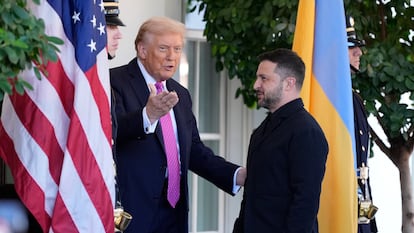

During a meeting at the White House with Ukrainian President Volodymyr Zelenskiy, U.S. President Donald Trump expressed his desire to end the war in Ukraine without having to supply long-range Tomahawk missiles, a controversial request as it would give Ukraine the option of striking targets at greater distances, such as on Russian territory. “We need Tomahawks for the United States of America, too,” Trump said. “We have a lot of them, but we need them. I mean, we can’t deplete our country.”
Although Trump’s words seem to rule out the option, the Repubican did not dismiss it completely and said the will leaders will discuss the possibility during their closed-door conversation. The Ukrainian president has proposed a cooperation agreement to provide Washington with Ukrainian drones in exchange for U.S. Tomahawks with which to attack Russian targets. Trump has expressed openness to the possibility: “I would be interested,” he confirmed in statements to the press before his closed-door meeting with Zelenskiy. But immediately afterwards, he clarified: “What we want is the war to be over.”
The Republican, who has taken credit for the ceasefire and hostage exchange agreement in Gaza, said he wants to build on the momentum in the Middle East to reach an agreement between Ukraine and Russia. “I think that things are coming along pretty well... we want to see if we can get this done,” Trump said at the start of the bilateral meeting in the White House Cabinet Room. “I think we can end this war with your help,” the Ukrainian leader said.
“First of all, I think we need to sit and speak [with Putin]. The second point, we need a ceasefire. We want peace, Putin doesn’t want [peace]. That’s why we need pressure on him” Zelenskiy said. “For Ukraine, this is a great opportunity, and hopefully we can take advantage of it.”
In a sign of the good rapport that now exists between the two leaders — a big difference from their first meeting in the Oval Office in February, when Trump publicly rebuked Zelenskiy — the Republican praised his guest’s dark suit. “Very stylish, I like it,” he joked, after his awkward reference to the military-style attire Zelenskiy wore during their first meeting at the White House last February.
Neither of them made any comments to the press when they greeted each other upon Zelenskiy’s arrival at the West Wing of the presidential residence. After their meeting, the Ukrainian president is scheduled to hold a press conference at Blair House, the official residence for presidential guests.
The meeting comes after Trump spoke by phone on Thursday with Russian President Vladimir Putin, with whom he has agreed to meet in Budapest. It will be their second face-to-face meeting, following their summit in Anchorage, Alaska, on August 15. According to the U.S. president, it will take place “in a couple of weeks.” The Kremlin has been much more cautious and has warned that it may be delayed beyond that timeframe, as there are still many details to be resolved.
Asked why they are meeting in the Hungarian capital, Trump said, “Because it has a leader we like, Viktor Orban. [Putin] likes him. I like him. It’s a safe country and it’s done a very good job.”
Tomahawks
Ukraine is seeking authorization for the deployment of Tomahawk missiles, which, according to Kyiv, could be key to attacking Russian territory: with a range of up to 2,500 kilometers, they could hit oil facilities or weapons factories far from the border. They would be much more effective than the missiles currently being used, such as the British Storm Shadow, with a maximum range of 250 kilometers. And although the Tomahawks alone would not definitively turn the tide in the war, they would serve as a signal to the Kremlin that Washington is once again firmly on the Ukrainian side. Trump has indicated that he would consider doing so if Russia does not return to the negotiating table.
This Wednesday, in remarks during an event in the Oval Office, the U.S. president advanced: “We will discuss war,” referring to the conversation scheduled with Zelenskiy. The Ukrainians “want to go on the offensive. I will make a decision on that, but they would want to go on the offensive,” he added. The idea has unleashed Russian fury. The delivery of Tomahawk missiles to Kyiv would mark “a new phase in the escalation, which would even affect relations between Russia and the United States,” Putin warned.
In addition to the Tomahawks, Trump and Zelenskiy could discuss other types of weapons. Last month, the Ukrainian leader proposed a “mega-deal” that would see his country receive nearly $90 billion in U.S. weapons. A delegation from Kyiv, led by presidential adviser Andrii Yermak, has been in Washington since the beginning of the week to meet with executives of some of the major U.S. defense corporations, such as Raytheon and Lockheed Martin.
180-degree turn
Trump’s shift in attitude toward this conflict has been noticeable in recent months, and especially striking when compared to the beginning of his second term, when he completely aligned himself with Moscow and publicly insulted Zelenskiy in the Oval Office.
Now, he has gone from suspending arms shipments to Kyiv to having his Secretary of Defense urge NATO partners in Brussels to increase their contributions to the mechanism for purchasing U.S. equipment for Ukraine, the system that has replaced the equipment donations sent during Joe Biden’s presidency; from maintaining that Zelenskiy would have to resign himself to the loss of territory in any peace agreement, to declaring the possibility that the invaded country could recover all the occupied land; and to expressing his openness to some contribution to the security guarantees that Ukraine demands for the post-war period.
This 180-degree turn in Trump’s positions, unthinkable when he reproached Ukraine for “not holding the cards” to prevail in the war, has been influenced by several factors. Among them, European pressure, reflected in the support, sometimes even physical, of the bloc’s leaders for Zelenskiy. Also, the willingness of NATO allies to increase their military spending to 5% of GDP — part of those funds are invested in the mechanism for the purchase of U.S. weapons destined for Ukraine. The last face-to-face meeting with the president of the invaded country, on the sidelines of the United Nations General Assembly at the end of September, was notably cordial.
But above all, Trump has changed his mind out of frustration with Putin. The American leader, who months ago considered Russia’s victory in the conflict inevitable due to its much larger size, population, and resources, has seen the invading forces’ summer offensive fail. He has also criticized Moscow’s serious economic problems. And he has seen the Russian president repeatedly avoid committing to a ceasefire, despite expressing his desire for peace.
Nothing has worked with Putin: neither public flattery, nor the glitter and pomp at the summit at the Elmendorf-Richardson military base outside Anchorage, Alaska, on August 15. Nor has his favorite tactic, which has worked so far in Gaza: announcing that a breakthrough had been achieved and putting pressure on the parties to such an extent that they had no choice but to see how they might implement it. Trump announced in August — following the Anchorage summit and the one held at the White House with Zelenskiy and European leaders — a three-way meeting between the Ukrainian president, the Russian president and himself. It never materialized. However, there was a breakthrough on an unexpected front when First Lady Melania Trump announced last week that she had established a channel of communication with Putin to discuss the abducted Ukrainian children taken to Russia.
Now the key to how the negotiations will progress — if they progress at all — will be in the meetings with the leaders. A test of their resolve will be the pressure they exert on Moscow: whether they actually opt to authorize Tomahawk weapons for Ukraine or some other type of pressure measure. Or whether, instead, the threat of authorizing the use of these weapons goes the way of the promises of secondary tariffs and sanctions against Russia: mere words, with no real intention of carrying them out.
Sign up for our weekly newsletter to get more English-language news coverage from EL PAÍS USA Edition









































