
Ukraine is torn between hope and disbelief after Trump’s change of tack
Kyiv avoids triumphant statements despite the US president’s apparent support for the country’s recovery of all territory invaded by Russia
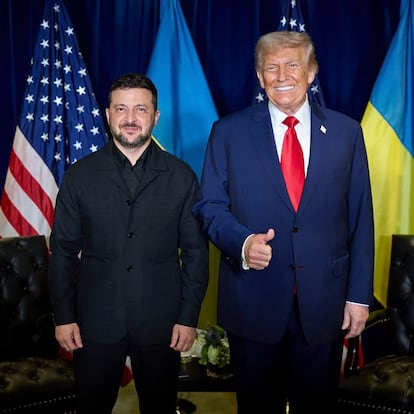

Taking any statement made by U.S. President Donald Trump literally entails risks. The head of the world’s leading power frequently changes course without any apparent explanation. This was the case on Tuesday, when he suddenly reversed his position on the conflict in Ukraine, and made his strongest defense of the latter country since he began his second term in the White House last January. The statements caused surprise among officials in the Kyiv government, which has been the victim of high-profile verbal attacks by the Republican leader in the past. Yet some degree of optimism and caution are emerging, according to Ukrainian analysts consulted by EL PAÍS. Speaking from the front, a Ukrainian military official sees the recovery of the territory lost to Russia as a long way off.
Trump’s U-turn took place this Tuesday, in parallel with the UN General Assembly being held in New York, where the U.S. president met with Ukrainian President Volodymyr Zelenskiy. “I think Ukraine, with the support of the European Union, is in a position to fight and WIN all of Ukraine back in its original form,” he wrote on his social network, Truth Social, after the meeting. At the same time, he criticized the Kremlin’s administration, finances, and military, which acknowledges the rift between Washington and the Kremlin. This comes after Trump repeatedly aligned himself with the position of Russian President Vladimir Putin, whose troops already control around a fifth of Ukraine and continue pushing to gain more. Trump had never gone so far with his statements, but according to the experts consulted, he could change course again when Kyiv least expects it. For now, Zelenskiy is savoring Washington’s support at a global showcase like the UN General Assembly, but has avoided appearing jubilant.
“For President Zelenskiy, this is a great victory. We could argue all we want about Trump’s earnestsness, but this is the most pro-Ukraine and pro-Zelenskiy tweet he’s ever posted,” Oleg Rybachuk, head of the Center of United Actions—a public think tank independent of the government—and former Ukrainian Deputy Prime Minister for European Integration, said in a telephone conversation. “Most Ukrainian experts are skeptical or cautious,” because “we know there’s often a huge gap between what [Trump] says and what actually happens,” Rybachuk adds. In any case, he recalls, it’s a far cry from the reception at the White House last February, where Zelenskiy was greeted with extreme hostility.
“Tactically, it is a significant victory for Ukraine that President Trump has shifted, for now, from blaming Ukraine for the war with Russia to highlighting Ukraine’s potential for war,” Marianna Fakhurdinova, an analyst at the Transatlantic Dialogue Center (TDC) and a member of the Center for European Policy Analysis (CEPA) in the United States, argues in a written response. Fakhurdinova agrees with Rybachuk, emphasizing: “Trump is known for his inconsistent messaging and views. Therefore, this statement should be interpreted with cautious optimism and should not immediately be seen as a strategic shift in the U.S. stance.” Thus, she believes that, to give consistency to this new stance, it should be endorsed by other U.S. officials, such as Washington’s top diplomat, Marco Rubio, and, at the same time, be accompanied by a supply of arms to Kyiv, as well as new sanctions against Moscow.
In any case, Oleg Rybachuk believes it is necessary to closely monitor the development of Trump’s relations with China—Moscow’s ally and Washington’s counterweight—the European Union, and NATO, bearing in mind, he adds, that the president needs these last two institutions as allies against the Asian giant. At the same time, Kyiv depends on “strong and reliable U.S. support” through high technology, intelligence, missiles, and modern weapons. For Marianna Fakhurdinova, “the EU should not be carried away by these positive messages from Trump” and “should start taking seriously the need to invest in its own defense and integrate Ukraine [into the EU club].”
The degree of realism in Trump’s announcement must be measured in terms such as “the substantial intensification of economic sanctions against Russian oil and gas export and production capacity, through joint efforts by the United States and Europe” and the increase in “military aid to Ukraine” so as to “exert sufficient pressure on the Putin regime to weaken its military position in Ukraine,” argues Taras Zhovtenko, a security expert and analyst at the Ilko Kucheriv Democratic Initiatives Foundation, a Ukrainian think tank. This is the way, he believes, to “deal a critical blow” to the Kremlin’s “aggressive plans, not only against Ukraine, but also against NATO’s eastern flank, which is obviously Moscow’s next target.”
Meanwhile, beyond Trump’s message in Truth, “his strategic approach toward Russia and Vladimir Putin has not changed” and “he remains interested in the potential mutual business projects promised by the Russian side and will avoid any direct action against the Russian economy, the Putin regime, or Putin personally, to the extent possible.” Another issue, Zhovtenko believes, is “the maneuvers the U.S. may carry out through third parties, such as selling arms to NATO to Ukraine, or pressuring Europe to impose sanctions on countries like China or India, major buyers of Russian energy.”
After launching its troops into the neighboring country in 2014 and furthering its advance with a major invasion in 2022, Russia now controls around 20% of Ukraine’s 600,000 square kilometers: the entire Crimean peninsula, much of the eastern regions of Luhansk and Donetsk, and parts of the southern regions of Zaporizhia and Kherson. Moscow organized illegal referendums in 2022, unrecognized internationally, announcing that this territory would become part of Russia. Likewise, although to a lesser extent, Kremlin troops maintain positions in the Kharkiv (northeast) and Dnipro (east) regions.
Russian military might means that, despite the aid Kyiv receives from abroad, the local army is barely able to contain the invader’s advance. The number of Kremlin troops assigned to fight on the front lines, around 700,000 according to Kyiv’s military intelligence, is almost double the number of Ukrainian soldiers.
On the ground, the weariness accumulated by the bloody conflict leads Ukrainians to recognize that recovering the occupied territory is almost a utopia. This pessimism is also reflected on the front lines. Odin, a soldier from the 43rd Brigade deployed in a combat zone in Donetsk, believes, after hearing Trump’s message, that “if they had wanted to recover those territories, they would have done so a long time ago,” he says in written responses. “From the front lines, I don’t see any chance of it happening yet,” he concludes.
Sign up for our weekly newsletter to get more English-language news coverage from EL PAÍS USA Edition









































