
‘Operation White House’: How European leaders backed Zelenskiy against Trump
The carefully choreographed European talks sought to curb the US cronyism with Putin seen in Alaska and increase pressure on Moscow to agree to negotiations with Kyiv
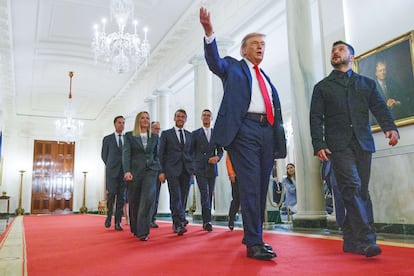

Donald Trump likes to be told how well he does everything. So it’s no surprise that, at the start of Monday’s summit on Ukraine, he boasted that he was the president who had hosted the most leaders at once in the White House. So many Europeans had come to talk with him about the war in Ukraine that they had to meet outside the Oval Office. The U.S. president’s satisfaction with this record was an early indication that the European strategy of flocking to accompany Ukrainian President Volodymyr Zelenskiy on his second and very sensitive visit to the White House in less than six months could go as well as could be expected in the face of a president as unpredictable as Trump. Although the results were not guaranteed.
“The conversation was a conversation among friends, among close allies, who respect each other, who like each other, who know each other very well,” NATO Secretary General Mark Rutte, one of the participants, told Fox News — one of the networks most closely aligned with Trump — after more than six hours of talks.
The Dutchman is one of Trump’s strongest defenders in a Europe that continues to view a president who has repeatedly demonstrated his disdain for the Old Continent with great suspicion. Despite being the target of criticism and ridicule for his shameful praise of the Republican tycoon, particularly during the NATO summit in June, where the increase in military spending to 5% of GDP was approved, Rutte has not wavered in his strategy.
On Monday, like the other guests, he also lavished praise on the U.S. president’s management, calling him a “pragmatic peacemaker” (Trump is vying for the Nobel Peace Prize), without whom breaking the “deadlock” in negotiations to find a peaceful solution to Russia’s war in Ukraine would not have been possible.
“It is deeply disturbing that matters of war and peace, democracy and autocracy, depend on stroking and flattering the fragile ego of the self-absorbed Trump,” lamented Kenneth Roth, former executive director of Human Rights Watch, in a Guardian article.
But that was precisely the strategy. After the first few months of Trump’s new term, in which the EU has repeatedly clashed with Washington’s demands, European leaders and their allies seem to have learned that the best way to deal with Trump is, above all, to prepare well. Especially when faced with a president who turns every appearance into a television show, as happened on Monday before a nervous European crowd who arrived without knowing how and when the cameras would focus on them, always to Trump’s greater glory. And second, it’s also convenient to sweeten with praise the messages they really want to resonate with the American.
Trump’s meeting with Putin in Alaska on Friday had set off alarm bells in European capitals. Not only did he fail to secure a single concession from Vladimir Putin — who was received with full honors, including a red carpet — but the Russian president buried Western isolation in Anchorage and managed to get Trump to stop threatening him with sanctions while returning to broadly adopting the Kremlin’s narrative, including the idea that a ceasefire isn’t necessary to begin peace negotiations and that Ukraine must cede vast territories to Russia.
The EU and its allies, especially London, were clear: they had to counter this situation as quickly as possible and convince Trump that Putin is not the reliable partner for doing business (or making deals) that he believes him to be.
If there is one thing Europeans have learned, it is that Trump tends to take the advice of the last person to whisper in his ear. So when Trump invited Zelenskiy to the White House, several European leaders immediately accepted Kyiv’s proposal that he accompany them. The Ukrainian president — and the European leaders too — were fearful that the U.S. administration would set him up for a fall again, as it did in February, when he was practically kicked out of the White House after receiving a monumental scolding from Trump and his vice president, J.D. Vance, who this time remained discreetly in the background.
The list of those present — the leaders of Germany, France, Italy, Finland, and the United Kingdom, as well as Rutte and European Commission President Ursula von der Leyen — was no coincidence. Beyond their political weight, they all share a key characteristic: they are, as Matthias Matthijs of the Council on Foreign Relations calls them, “Trump whisperers,” leaders who have dealt with the Republican on several occasions and know how to handle and woo him: from Rutte’s unabashed flattery or Finnish President Alexander Stubb’s golf rounds, to the manifest complicity of Italian Prime Minister Giorgia Meloni, who had a good relationship with Trump even before rising to power and whom the American once again described on Monday as “a great leader” and “a source of inspiration.”
Preparations were intense over the weekend — Zelenskiy traveled to London and Brussels before taking off for Washington — and lasted until the final minute before the meeting at the White House on Monday. The Europeans and a suited Zelenskiy (instead of the military fatigues that had so displeased Trump in February) agreed on a carefully choreographed approach: initial flattery, followed by key points for Kyiv and Europe ahead of the negotiations.
The insistence on a serious but not necessarily strategic issue was surprising: the Ukrainian children kidnapped by Russia. This topic was emphasized not only because of the dramatic nature of the situation, but because it is an emotional issue that seeks to unmask Putin’s predatory nature, which he has visibly managed to hide from Trump. Hence, Zelenskiy also underlined this issue, giving the president a letter from his wife addressed to the first lady, Melania Trump, who in turn had written to Putin telling him that “it is time” to protect “the innocence of children.” The moment also served to create a much-sought-after moment of complicity between the two leaders.
“The Europeans prepared their interventions in advance so as not to be repetitive and to hit the right notes with Trump,” summed up former French ambassador to Washington, Gérard Araud, on X. For Russia expert Kirill Shamiev of the European Council of Foreign Relations, the format chosen by the Europeans was “a good idea, and the right one.”
Beyond the messages sent, the trip was “an attempt to find out what Trump really thinks about the peace process and Russia,” Shamiev analyzes via email, but it remains to be seen what will come of it all. In fact, Washington has already taken it upon itself to lower European and Ukrainian expectations regarding Trump’s assurances about his participation in security guarantees. In this sense, he warns, “the trip only addressed the consequences of Europe’s strategic irrelevance, not the problem itself. Europe should become a military power.”
The reaction from Moscow — which is once again dragging its feet at the prospect of a face-to-face meeting between Putin and Zelenskiy — and Foreign Minister Sergei Lavrov’s statements accusing the Europeans of trying to “clumsily” influence Trump, seem to show that something was well-played in Washington. Although there is still no guarantee that the outcome will be successful.
With reporting from Macarena Vidal Liy in Washington, Lorena Pacho in Rome and Almudena de Cabo in Berlin.
Sign up for our weekly newsletter to get more English-language news coverage from EL PAÍS USA Edition









































