
The department of the war of words
The far right is beginning to dispense with euphemisms when they want to rally their own people to instill fear in others
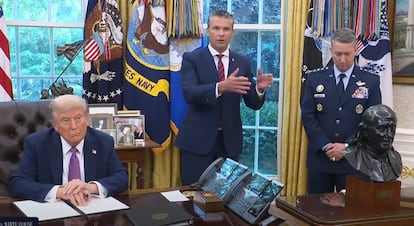

Donald Trump has no complexes. Someone capable of claiming he wouldn’t lose votes if he committed a murder on Fifth Avenue wasn’t going to be deterred by a euphemistic question. That’s why, on September 5, he announced his intention to rename his “Department of Defense” the “Department of War.”
Well, the “Department of Defense” hadn’t been particularly peaceful either. Under that name (which in 1949 replaced the “National Military Establishment”), the United States had already launched several invasions. Among the most recent were the invasion of Grenada, in the Antilles (1983), the invasion of Panama (1989, in which U.S. soldiers killed photographer Juantxu Rodríguez, who was working for EL PAÍS), the first Gulf War (1990-1991, to liberate Kuwait from the Iraqi invasion), the occupation of Iraq (2003-2011, in which its military murdered Spanish cameraman José Couso, who was working for Telecinco)... Even, albeit with different nuances, the Vietnam War (1955-1975). And the invasion of Afghanistan, led by U.S. troops and their allies (2001-2021).
Many U.S. wars have not been defensive but offensive actions, because its territory had not suffered a previous military aggression from which it had to protect itself (although there would be room to argue otherwise in the case of Afghanistan, given the previous attacks on the World Trade Center and the Pentagon).
Thus, throughout its history, the Department of Defense has largely functioned as a department of offense. Changing its name now will not alter the essence of its dangers. However, it may well increase them.
The powerful word “war” (from the Germanic werra) has been part of Spanish since its inception; It was introduced, adapted, and adopted into various languages (war in English, guerre in French), most likely due to the European expansion of the Goths, and in Romance languages it took on the meaning of the Latin bellum, a word that sounds less bellicose, paradoxically. Spain had a “Ministry of War” at various stages of its history, including during the Second Republic (1931-1939), but established the “Ministry of Defense” in 1977.
Political vocabulary and journalistic language influenced by it have been avoiding the term “war” everywhere in recent decades when the sender of the message intended to downplay the seriousness of what was happening: “Military action,” “conflict,” “forceful solution,” “attack,” “confrontation,” and other words that have been analyzed by Professor Elena Gómez in her work Linguistic characterization of euphemistic substitutes related to the field of “war” (University of León, 2006).
After all that, why would a U.S. president now dispense with the euphemism “Defense” — already established in dozens of ministries across five continents — and return to what was a dysphemism, that is, the opposite of a pleasant word? Why does Trump like a word that is often banned by those who wage war?
He does so, and he likes it, because a euphemism tends to sugarcoat, mitigate, downplay, or hide something. And Trump is not looking for that, but rather the opposite: to instill fear. That is, to recapture the panic that those Gothic warriors wreaked during their invasions. He does not want the euphony of a reassuring term, but rather the dissonance of a frightening expression. Because he is not interested in being respected, but in being feared. Will other authoritarian politicians who challenge democracy follow his example? Perhaps. If so, such a trend would correspond to the threatening escalation of these times in which dictatorial regimes and ruthless rulers are once again on the rise. And that is also terrifying, because words of violence often precede violence.
Are we then witnessing the beginning of the end of the era of euphemisms in far-right language? Yes, in some cases: for example, when their spokespeople need to make bold statements against supposed enemies, who are usually invented. But far-right movements, as unapologetic as Trump, are not going to give up manipulating words when it suits their purposes. In Spain, Vox has spread the acronym MENA (unaccompanied foreign minors), which avoids the mental image of an abandoned child, in order to dehumanize the immigrants whose expulsion it proposes; and it spreads the phrase “domestic violence” to defuse the concept of male chauvinism; it proclaims “traditional values,” with which it disguises its attempt to impose a single identity that dismantles our multicultural society.
The far right will use euphemisms as long as they need to dress some ideas in sheep’s clothing; but, and this is perhaps a novelty, they are beginning to resort to dysphemisms (“chainsaw,” “expulsion,” “war,” “toughen up,” “life sentence”) when they believe their voters no longer fear those words, when they want to rally their own people to instill fear in others. This seems to be what Trump is now aiming to do, sadly, promoting the “Department of War,” despite the fact that his country is perhaps the only one in the real world that could have created a Department of Peace.
Sign up for our weekly newsletter to get more English-language news coverage from EL PAÍS USA Edition









































