
A new day of protests against Trump is expected to fill US streets on Thursday under the slogan ‘Good Trouble Lives On’
Hundreds of demonstrations have been called across the states in honor of the late Congressman John Lewis, a leader of the civil rights movement who always advocated causing ‘good trouble’
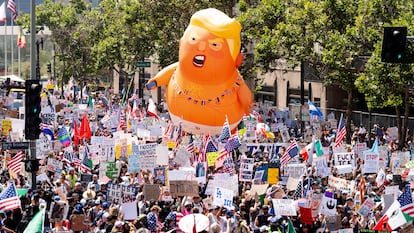

Protests against various policies of the Donald Trump administration continue. “Good Trouble Lives On” is the name of a day of protests that seeks to draw tens of thousands of people to march against cuts at the federal level, mass deportations and the attack on voting rights. It will take place this Thursday, July 17, in cities across the United States.
“Good Trouble Lives On”
The name of the protests is inspired by Congressman John Lewis, who was a civil rights activist —one of the “Big Six” leaders of the movement. He organized the 1963 March on Washington and led the marches in Selma, Alabama, in 1965, where he was attacked by police. He later served 17 terms in the House of Representatives, as a delegate from Atlanta, Georgia. One of his most remembered phrases is, “Get in good trouble, necessary trouble, and help redeem the soul of America.” Lewis passed away on July 17, 2020.
According to organizers, “‘good trouble’ is the action of coming together to take peaceful, nonviolent action to challenge injustice and create meaningful change.” “Civil rights leaders of the past have shown us the power of collective action. That’s why on July 17, five years since the passing of Congressman John Lewis, communities around the country will take to the streets, courthouses and community spaces to broadcast their fight for justice, voting rights and dignity for all.”
On the movement’s website, organizers also claim that President Donald Trump seeks to divide Americans, and that they will demonstrate “the power of coming together.”
Where will the demonstrations take place?
An interactive map that can be viewed on the official “Good Trouble” website shows hundreds of locations where people will congregate to protest. Among them are some major cities such as California and New York, but there will be demonstrations in all states and territories, including Puerto Rico.
The organizers note that the demonstrations will be carried out in a non-violent manner, and that they expect participants to seek to de-escalate any type of confrontation with anyone who disagrees with their values. Likewise, they ask protesters not to carry any weapons.
Fight for voting rights
This year also marks 60 years since the passage of the Voting Rights Act of 1965, a pillar of the civil rights movement. However, it no longer provides the protections it once guaranteed, especially after the Supreme Court’s ruling in Shelby County v. Holder (2013), which eliminated federal oversight over election changes in areas with a history of discrimination. Since then, laws that make it harder to vote have proliferated, disproportionately affecting people of color, low-income communities, and people with disabilities, against a backdrop of broader civil and democratic rights rollbacks.
The Good Trouble Lives On movement highlights several bills that seek to strengthen democracy in the United States and guarantee voting rights: The John Lewis Voting Rights Advancement Act, which would restore key protections of the Voting Rights Act of 1965 by requiring federal pre-approval of election changes in states with discriminatory records. The Freedom to Vote Act, which would establish national voting access standards, and make Election Day a federal holiday. And the Native American Voting Rights Act, which would remove barriers faced by those communities and ensure accessible polling places on tribal lands.
Sign up for our weekly newsletter to get more English-language news coverage from EL PAÍS USA Edition









































