
A judge circumvents Supreme Court ban and blocks Trump’s order against birthright citizenship
Judge Joseph Laplante admits a class-action lawsuit, allowing him to issue a temporary nationwide stay
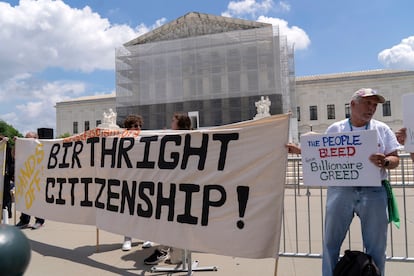

A judge in the Democratic state of New Hampshire has temporarily suspended the executive order with which U.S. President Donald Trump sought to end, on his first day back in office, the constitutional right to birthright citizenship for children of undocumented immigrants born in the United States.
The judge did so by admitting a class-action lawsuit from the American Civil Liberties Union (ACLU), which allowed him to circumvent the Supreme Court decision that gave Trump a significant victory in a related case almost three weeks ago. The ruling limited the power of federal judges, some 700 across the country, to oppose presidential executive orders, expanded Trump’s options to advance his authoritarian agenda, and raised questions about he separation of powers.
On June 27, just hours after the Supreme Court’s decision was announced, the ACLU rushed to take advantage of a loophole left by the ruling, which determined that injunctions against a presidential decision can only be applied to those who filed the lawsuit, and not, as has been the case until now, to the entire country.
The majority opinion in the Supreme Court ruling—which resulted in a six-to-three vote—was written by Amy Coney Barrett, one of the three justices appointed by Trump. The ruling left three options for obtaining nationwide stays: converting the lawsuits into class-action suits, as has now been the case in New Hampshire; limiting such measures to the state in which the executive decisions are being challenged; or for those affected to invoke the Administrative Procedure Act, which authorizes lower courts to overturn decisions of certain federal agencies if they deem them arbitrary.
Famous precedent
The class action lawsuit that came into play this Thursday has such famous (and cinematic) precedents as the 1998 case in which tobacco companies were ordered to pay all states a lifetime of damages, or the case of attorney Erin Brokovich, who defended consumer rights in a water supply contamination case in California.
Find a like-minded judge
The New Hampshire judge, Joseph Laplante, and he was appointed by a Republican president: George W. Bush. And that undermines part of Trump’s argument: that the plaintiffs are seeking Democratic judges (in a country where these are independent, albeit political, positions) in search of a certain sympathy for their cause. It’s another unmistakably American practice. It’s known as court shopping, and can be translated as “shopping for a judge,” specifically the one most suited to the plaintiffs’ aspirations. Then, whether that judge is in Republican territory—say, Lubbock, Texas—or Democratic territory—for example, Chicago, Illinois—their decision will have an impact in all 50 states.
The Supreme Court’s ruling gave a 30-day deadline for its entry into force, specifically to allow for a class-action lawsuit like the one just admitted. The high court has not ruled out accepting a case next year that could address the merits of the issue of birthright citizenship.
Birthright citizenship has been recognized by the Fourteenth Amendment since 1868. It was enacted three years after the end of the Civil War to guarantee equality for enslaved people and their descendants. Since 1898, following the historic ruling United States v. Wong Kim Ark, an Asian immigrant, it has granted citizenship to the children of undocumented immigrants simply for being born on U.S. soil. For Trump, ending this right would be a major victory in his crusade against immigration.
Sign up for our weekly newsletter to get more English-language news coverage from EL PAÍS USA Edition









































