
Social networks face their ‘tobacco moment’: Key points of a historic agreement that will shape the future of platforms
The pact between Meta and 52 US attorneys general reduces the hours minors can use social media and aims to serve as a guide for the rest of the industry


Four major tobacco companies signed an agreement in 1998 with the attorneys general of 52 U.S. states under which they would pay more than $200 billion over the following years to fund health treatments for smokers. They were accused of promoting and marketing products harmful to health, especially to minors. The agreement also included strict advertising limits, from restricting billboards to banning depictions of people smoking. It was a serious blow to their business and was seen as a victory for civil society against some of the world’s largest companies.
Three decades later, social networks are facing their “tobacco moment.” Meta, the parent company of Instagram and Facebook, has agreed to pay nearly $18 billion so that the attorneys general of 52 states and territories (although only 29 actually sued) will drop their suit against the company, which they accuse of designing and operating products (its platforms) knowing they have harmful effects on young people’s mental health.
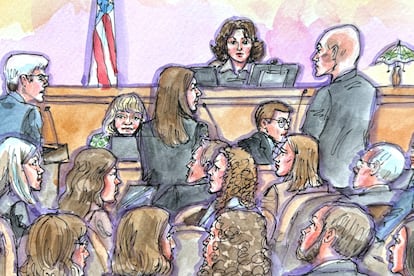
In addition to paying that amount, Meta has also agreed to make design changes to its apps aimed at limiting social media use among minors. They will not be allowed to be connected for more than two hours a day, there will be a nighttime disconnection, and there will be no notifications during school hours. Mark Zuckerberg’s company, which will avoid having to appear in federal court in Oakland thanks to this settlement, will also strengthen its age‑verification mechanisms to more accurately identify children under 13 (who may not use the platforms) and adolescents aged 13 to 17 (who will be subject to the stated restrictions).
The settlement announced this Tuesday is historic for several reasons. Here are its key points, possible consequences, and unresolved questions.
What the agreement means
The agreement implies an acknowledgement that the company was not sure it would win the case, which in turn raises doubts about the strength of its defense. Meta has denied throughout the process that there is scientific evidence its platforms cause addiction and has relied on a federal rule (the so‑called Section 230) that exempts companies from liability for content users post on their platforms.
If Meta has settled once to stop the trial and thus avoid a possible adverse verdict, it could do so again. “As happened with the tobacco companies, and as in the film The Man Who Would Be King, the first arrow that makes you bleed shows you are not a god, and Meta has a lot of similar lawsuits pending. Now it will face many more,” says Jorge García Herrero, a lawyer specializing in data protection.
That Meta chose to settle also suggests it suspects that the documentary evidence the plaintiffs have is strong. And it shows the company’s desire to avoid, at all costs, being declared liable for designing its platforms to be an addictive product, like tobacco, alcohol, or drugs.
Why that amount
The nearly $18 billion Meta will have to pay will not bankrupt a company that, in the second quarter alone, reported more than $60 billion in revenue. The figure is far from the roughly $200 billion the plaintiffs sought, and from the $1.4 trillion Meta itself estimated it could lose if privacy‑regulation claims prevail, another pillar of the litigation. But the agreed sum is a signal: Meta is willing to negotiate, and it will probably have to do so again in some of the other cases open against it.
Analysts say the significance of the settlement lies less in the money than in the design changes Meta will have to implement in its products.
How it affects the sector
And that matters because what Meta does will be closely watched by its competitors. Some of them, like TikTok, Snapchat, and YouTube (a subsidiary of Alphabet, Google’s parent company), also sit with Meta on the defendants’ bench in other class actions against social networks that remain unresolved, such as those filed by users’ families and several U.S. school districts.

The out‑of‑court settlement Meta reached actually reduces the penalty it would pay if TikTok and YouTube also decide to adopt the design changes agreed for Facebook and Instagram. “Standards are being set between Meta and the prosecutors that would affect the rest of the platforms. There is an attempt to externalize these obligations to third parties that are not Meta, and it seems prosecutors want to push for that,” says Rodrigo Cetina, professor of law and public policy at the Barcelona School of Management of the Universitat Pompeu Fabra and an expert on the legal challenges of digital technologies.
What users gain
The fine print of the agreement still needs to be specified, such as the implementation timetable, and it remains to be seen whether the ripple effect to other platforms will be effective. But if the deal is implemented, children will spend fewer hours a day glued to Instagram, and that alone will have a positive effect, for example, on their ability to concentrate on schoolwork.
The settlement also shows that, even if only because they have been warned, platforms have opened up to change — something that had not happened until now. And that invites cautious optimism.
What has been left out
The focus of the agreement has been on reducing hours of social media consumption, not on content. Children are not being banned from smoking; their habit is being limited to two cigarettes a day. The types of posts or comments that have caused mental‑health problems in minors will remain subject to the same restrictions they had before, although their impact will likely be smaller if overall use drops so significantly.
The agreement includes measures such as disabling autoplay for videos or allowing users to choose a non‑algorithmic feed (that is, showing posts only from accounts you follow rather than recommendations). But those measures are optional, not mandatory. And, as Francesco Fogu, Instagram’s head of product design, acknowledged in court Tuesday, measures that are not automatic have less impact on users than those that are.
How it affects Europe
The European Commission, which has its own administrative proceeding under way with Meta, declined to comment, reports Silvia Ayuso. As has happened before, experts say, it is likely to study the settlement and decide whether to import any of the measures. In any case, if Meta and other competitors end up implementing design changes, they are likely to roll them out globally rather than limit them to the U.S., precisely to avoid ending up in court again.
One issue that will have to be reconciled is strengthening age‑verification systems. “That includes systems based on biometric data, which are not well regarded by data protection agencies in Europe,” says Borja Adsuara, a lawyer specializing in digital law.
Sign up for our weekly newsletter to get more English-language news coverage from EL PAÍS USA Edition









































