
Yuk Hui, philosopher: ‘Tech companies want to exploit us and control us every second’
The Hong Kong thinker argues that today’s business model may not wipe out humanity, but it can impoverish our lives
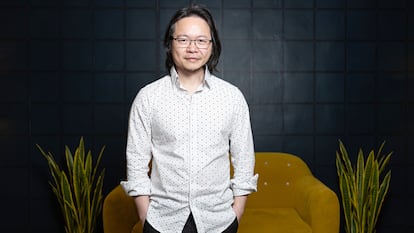

Hong Kong-born philosopher Yuk Hui was on track to become a computer engineer, but artificial intelligence led him to question consciousness, ethics, and our relationship with technology, ultimately prompting him to study philosophy in London.
In his book Machine and Sovereignty: For a Planetary Thinking, the professor at Erasmus University Rotterdam proposes technodiversity — an openness to traditions beyond the Western — as a response to an increasingly homogeneous world with ever-more-powerful corporations. In Post-Europe, Hui warns against nationalist and exclusionary ideologies, and in Kant Machine, he uses Kant’s ideas to explore the limits of AI.
We spoke with him during a visit to Madrid in late April, where he gave a talk at the Contemporánea Condeduque cultural center alongside journalist Marta Peirano. He doesn’t give his age, but when we ask whether he expected today’s rise of artificial intelligence back when he began studying philosophy, he jokes that he’s not that old: “There was already quite a bit of research on AI and neural networks.”
What has changed most, he says, is the business model behind the technology: “Most of these companies are, first and foremost, financial companies. Only after that are they tech companies.” This model, he argues, is less a threat to our jobs than a force reshaping entire economies and creating new kinds of work — like the rise of delivery‑app labor.
Question. This kind of work is worse for workers.
Answer. Not only that, but your life becomes tied to an algorithm. For example, the estimated delivery time within a three-kilometer [1.9-mile] radius decreases every year. The algorithm scores, manages the route, and penalizes. Many people thought that with these jobs, at least you’d have a flexible schedule. But that’s not true. I think the question of technology and work has less to do with unemployment and more to do with tech companies that want to exploit us and control us every second.
Q. So what can we do? Can we regulate technology?
A. Regulating or deregulating is a false dilemma because it means we’ve already accepted the starting point. We need to find a different path. And that path is technodiversity. We have to think, for example, about what technology could facilitate the work of local communities or about different social networks. I’m not saying that regulation isn’t important, but it’s not enough. We need to develop alternatives and guide innovation in other directions.
Q. In Post-Europe, you speak of a post-European Europe. What does that mean?
A. The term comes from the Czech philosopher Jan Patočka. It refers to the fact that, after the Second World War, Europe ceased to be a world power. But this doesn’t mean that Europe should rearm itself to regain its dominance. That would be preparing us for another catastrophe. We live in a post-European reality. Everyone, including those in Asia, is post-European because we have all been affected by European modernity. If we go to Tokyo or Seoul, we see more European than Asian elements, and we can’t renounce that. We need to think about what to do next, and the answer isn’t to retreat into the nation-state and expel immigrants, but to develop policies capable of addressing local problems that cannot be solved from a global perspective: unemployment, crime, community building…
Q. You also speak of facilitating the individuation of thought.
A. I start from the concept of individuation by the philosopher Gilbert Simondon. We are not finished individuals; we are always in process. For example, one day we read a book, and it transforms our life. Another day, we meet someone who becomes a friend, or we meet someone else and start a family. There are tensions that grow until the structure can no longer bear it and transforms. I wanted to explore this idea further by stating that tensions in thought are precisely the condition for thought to occur.
Q. How have you personally experienced these tensions? You’re from Hong Kong, but you’ve studied European, Chinese, and Japanese philosophy…
A. When I was growing up, Chinese philosophy seemed outdated, like it belonged to the past, to the empire. That puzzled me… I try to rethink the relationship between all these philosophies, and that means I also live in tension, because we all carry different cultural resources. I learned the Chinese classics, I went to study in the U.K., in France, in Germany… and those are my resources. They are within me; perhaps in some ways, they don’t speak to each other, but they coexist. I am their bearer. And, of course, they create tensions. I have to facilitate this individuation, which is my own individuation as a philosopher.
Q. Is this cultural mix a way of moving towards the planetary thinking you propose in Machine and Sovereignty?
A. When we talk about the planetary, we tend to think in terms of ever-larger scales: from the polis to the state, from there to large international spaces like the European Union, and then to the idea of a world government. But I don’t think that’s the solution; that’s just a continuation of modernity, the pretension of dominating everything. Planetary thinking boils down to a very complex question: how can we develop coexistence among humans and also with non-humans? This implies returning to the Earth and thinking about diversity in three areas: biodiversity, noodiversity — from the Greek nous, thought — and technodiversity. These three areas are not separate; they are interconnected. Humans cannot remain on the sidelines of biodiversity; we live in nature and are part of nature.
Q. What do you think about nostalgia in politics?
A. If by the politics of nostalgia we mean living in the glory of the past — for example, the glory of Spanish colonization or the glory of Western dominance — I think it’s a dangerous idea. If we think like that, we will repeat the catastrophes of history. We live in a different situation than in the past, and it’s very dangerous to return to those earlier times: we are now very close to the debates that preceded the Second World War.
Q. Is a Third World War possible?
A. Look at how many countries are preparing for war: if we don’t want it, why are we militarizing ourselves? In this, I’m closer to Kant and his idea of perpetual peace. Another world war would be a catastrophe. We are at a critical moment to think about the future of the planet, and we need to resist these ideologies that are regaining strength.
Sign up for our weekly newsletter to get more English-language news coverage from EL PAÍS USA Edition









































