
Peter Neumann, philosopher: ‘Without the idea of progress, only resignation remains’
In his work, the German thinker explores the usefulness of political projects that aspired to reinvent society, even though they inevitably ended in failure
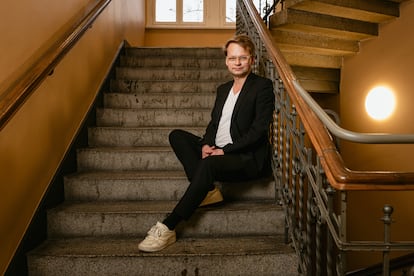

In his latest book, which, in English, would translate as The Long Century of Utopias (2025), German philosopher Peter Neumann, 38, explores the dreams and disappointments of the political projects that aspired to reinvent society in the 20th century; he also looks at their usefulness despite their inevitable failures. In his previous book, Jena 1800: The Republic of Free Spirits (2022), the Neubrandenburg-born writer focused on the philosophical ferment of 19th-century Germany, which was marked by a climate of intellectual optimism. However, in his latest work, the guiding thread is the sense of catastrophe that permeated the entire last century, but also the insistence on imagining solutions. This leads the author to traverse the temporal arc from Nietzsche to Susan Sontag, by way of Sigmund Freud, Walter Benjamin, Hannah Arendt and Salvador Dalí.
This young and brilliant thinker — who is also a cultural journalist for the newspaper Die Zeit — referred to this back-and-forth between disaster and hope, as well as its echoes in the present, during an interview with EL PAÍS. The conversation took place in mid-December, at a restaurant in his West Berlin neighborhood.
Question. In your most recent book, the 20th century opens with the eruption of Krakatoa, east of Java, in 1883. And it closes with the emergence of COVID-19 in Wuhan, China, in 2019. Why use such a framework, so far removed from conventional chronology?
Answer. These catastrophes served as a springboard for exploring the relationship between culture and nature. There’s an inspiration: Walter Benjamin, in exile in 1936, published an anthology titled German People, a compilation of letters written by his compatriots between 1783 and 1883, using another atypical chronology. From there, he recounts the rise and fall of liberal society as a harbinger of fascism, of what was happening in Germany from the early-1930s onward. After the pandemic, faced with the undeniable degradation of the world in recent years, I felt a similar need to revisit certain ideas that had been ignored or forgotten, but which we perhaps still need, so that we can look to the future.
Q. Why was the 20th century such fertile ground for utopian thought?
A. It was a century marked by terrible situations. And, at the same time, ideas grew larger, perhaps as a reaction. This is demonstrated, for example, by the proliferation of “isms.” Experiencing extreme situations pushed 20th-century thinkers to look toward the future and imagine alternatives to disaster. For example, in 1945, Auschwitz occurred as an absolute moral catastrophe, but so did the Universal Declaration of Human Rights. Even in the darkest moments, ideas that offer salvation have emerged. Perhaps we need something like that today as well.
Q. Do utopias arise from crises, or, on the contrary, do they end up leading to them?
A. Both. Until the year 1800, utopia was primarily spatial: the idea of a perfect place, as [conceived by] Plato or Thomas More. At the beginning of the 19th century, these spatial utopias became temporal: they stopped imagining places and began to imagine possible futures, often as a response to crises. But these ideas could also become crises themselves when their precepts failed. There is a constant flux between these two poles.
Q. In the book, you compare Hannah Arendt and Susan Sontag. What unites them?
A. They both remind us — each in her own time — that there’s a legacy of European thought in moments of crisis. [Think of] Arendt in 1945, after World War II, and Sontag in 2003, in the midst of the invasion of Iraq. And that legacy is important when it comes to thinking about what a liberal society should be, at a time when its values are being attacked. Trump is essentially saying that Europe isn’t on his radar: it is still there, but it no longer matters. And the same thing is happening in Europe, with the far-right parties. Arendt and Sontag remind us of that legacy, which stems from the French Revolution and a very European intellectual tradition. My intention is to bring it to the forefront: to remember it, defend it and revitalize it.
Q. Are you concerned about the speed with which, in recent years, that legacy has been dismantled?
A. Yes, there’s been a cultural shift. It comes from the rise of right-wing populism, but also from certain left-wing movements. There’s a very pertinent criticism of the Enlightenment: it was too white, male-dominated and Eurocentric. But the ideas [from that era] in the abstract are one thing; how they were applied at the time is another. I want to return to the pure ideas and ask myself how to preserve them, without denying the necessary criticisms. Precisely because they’re under pressure, I find it urgent to defend them: not as relics, but as something living and useful.
Q. If you were to write a book about 21st-century utopias, would it revolve primarily around technology, Silicon Valley and the new space race?
A. Yes, that’s quite possible. There’s a return to the technological utopia that we’ve known since the Industrial Revolution and the beginning of the 20th century. Think of Metropolis (1927), [the German science fiction film] by Fritz Lang. The difference is that, today, it takes on more libertarian, even right-wing, forms. Even so, left-wing utopias also exist. For example, there’s posthumanism: the idea of not placing human beings at the center of the world, but recognizing that other forms of life exist with equal dignity and that our relationship with them must be rethought.
Q. And what about the LGBTQ+ movement?
A. It’s also a utopian idea. It’s connected to queer approaches and a certain tradition of feminism. There is, so to speak, an ontology that understands identity as something fluid: it’s about questioning artificial boundaries. It begins with the right to one’s own body: “My body, my choice.” From there, the argument expands: many of these binaries must be forgotten or overcome.
Q. In the popular imagination, utopias are doomed to failure. You say, however, that even these failures leave a kind of guide for the future.
A. Utopias have to fail, because that’s part of what makes them utopias: that they cannot be fully realized. But even so, they leave a kind of blueprint for other thinkers and other societies of the future. Looking back, one can detect them in another historical period and resurrect them for the sake of progress. Utopias are useful even when they fail spectacularly.
Q. Do you still believe in progress, another much-maligned notion?
A. Yes, I think it’s essential. We can only understand ourselves as moral, free and reasonable beings if we acknowledge some kind of progress. I know it sounds old-fashioned, but I believe that, without progress, all that remains is resignation. Now, I don’t think it’s as simple as choosing between progress and regression. I prefer another image: the vortex, the whirlpool that pulls you down and from which you have to escape. In that vortex, progress and regression are intertwined. And yet, if we look at the last century, it would be absurd to say, despite the current situation, that there has been no progress: there is better health, more safety and more democratic rights. Without minimizing the costs — because there have been costs for the planet and for parts of its population — I prefer to live now than in 1925.
Sign up for our weekly newsletter to get more English-language news coverage from EL PAÍS USA Edition









































