
Gilles Lipovetsky: ‘If you want to live better and fall in love, take Prozac, don’t look to philosophy’
The French philosopher takes phenomena such as mass consumption, aesthetics, leisure and the kitsch to examine our world and insists that while his field can play a role in understanding it, taking antidepressants might be more effective in dealing with it than reading Socrates
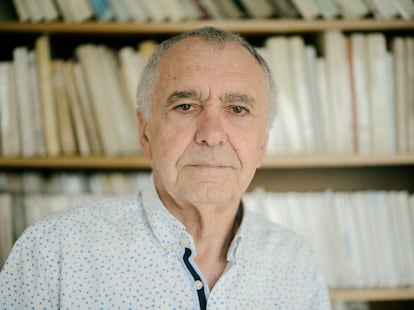

There was a time when the philosopher Gilles Lipovetsky would examine the contents of our homes, rummage through the kitchen drawers, listened to our records, put on our clothes and even examine what we threw away. Everything that had no apparent importance, or at least for the intellectual class of the time, was held up as a mirror. Through fashion, mass consumption, aesthetics and leisure, the philosopher and sociologist drew a precise, entertaining and vibrant portrait of our time. Or, rather, of what he calls hypermodernity, an era marked by aesthetics, consumption and excess. The result? A score of groundbreaking books such as The Age of Emptiness, The Empire of Fashion and Hypermodern Times. This time, however, it is our turn to enter his home.
Lipovetsky opens the door of his penthouse in Grenoble, where he lives surrounded by the Alps. “Look, there’s the Belledonne, the Chartreuse, the Oisans, the Vercors and the Trièves,” he explains, as we walk around the large terrace. On the shelves of the living room, he has stacks of DVDs and books and some apparently useless mementos. The thinker has always managed to turn phenomena that intellectuals despised into valuable devices with which to measure the contemporary.
Lipovetsky not only describes social transformations, he interprets them, assigns them a name and, in doing so, designs tools to dissect them. And he does so, almost always, in that poetic tone that runs through his books, and that elevates them to literature. His latest publication is Le nouvel âge du kitsch: Essai sur la civilisation du «trop» (The New Era of Kitsch: An Essay on the Civilization of Excess, not yet available in English), written together with the film critic Jean Serroy. It is a portrait of the journey taken by what is vulgar and showy to the center of our lives. Kitsch, from this new perspective, ceases to be a cultural defect and becomes a revealing portal to the way we live, consume and think about beauty.
The 80-year-old thinker is in good physical shape. The photographer even goes so far as to convince him to do a topless photo. “Look, I’m not Picasso,” he argues in a successful bid to have that particular shot omitted from the final selection. Today he writes, travels and lectures all over the world.
Question. What role does a philosopher play in today’s society? I get the impression that they are increasingly seen as business consultants or coaches.
Answer. The role they once had has gone. Philosophical thought does not possess the collective and social power that it had in previous centuries. Today artificial intelligence has much more impact than philosophy. But philosophy is still necessary, precisely because it is a different way of thinking from that of experts or consultants. In a world where everyone knows everything, where we are inundated with information, there is a muddle and that’s where philosophy can intervene. What I try to do in a transversal way is a global x-ray to put a degree of order into things.
Q. Do we still need those mind maps in such a fragmented world, where so many things happen at once?
A. Homo sapiens are not satisfied with eating, living and waging war. The spirit has an important role, and we cannot live without a certain number of pillars that talk to us about what we do, what we’re like and the world we live in. Before, these were religious systems; what were considered in the past to be the great ideologies. But today, things are much more chaotic. Philosophy allows us to understand the world we live in. But I don’t think that it’s therapeutic, that it’s better to read Socrates than take Prozac. If you want to live better, fall in love, take Prozac or do whatever you want, but don’t turn to philosophy.
Q. Do you use AI apps?
A. I’m an admirer of artificial intelligence. The results provided by ChatGPT are incredible.
Q. Do you talk to it?
A. Yes, of course. We have exchanges. And it’s very accurate. I am surprised by its reflections, also about me.
Q. Do you think it might think better than you?
A. No, it still makes mistakes. And I don’t believe in that idea of the obsolescence of man. People who use AI are also creative; this technology can be very inspiring. We are the ones who ask, and that is fundamental. It is an assistant, I don’t think it will deprive man of the pre-eminence of his thought. Take war. AI plays a very important role in some operations. But who has unleashed it in Ukraine? It is a deliberate decision by a dictator to invade a neighboring country. Decisions do not come from automatisms; they come from paranoia or human megalomania. We are a long way from that idea in which algorithms take power and eliminate man. I don’t see AI rivaling Plato’s Dialogues, or the Critique of Impure Reason — with what Kant termed genius.
Q. Yes, but with AI there will be just one genius in every 10,000. The others will have been eliminated.
A. That is debatable, it will depend on jobs: education, health. It is not desirable. AI can make novels, movies. Basic creativity. But great artistic or philosophical creativity is not on the agenda. The genius is in those who invent.
Q. You have been analyzing society for 40 years through the lens of consumption and taste. Won’t it be more difficult to draw interesting, original conclusions with the homogenization caused by the algorithm?
A. That’s true, but it’s not something new; it goes hand in hand with the consumer society. Thinkers such as Guy Debord already told us in the seventies that advertising created artificial needs, that it alienated. The algorithm is useful in recommending things, it gets it more or less right, that is true. Studies also show that the consumer does not obey in a servile way, that there is still agency.
Q. But the surprise, the ability to discover other worlds, is lost. If you listen to jazz, you won’t be recommended a punk album.
A. That is why training is essential, educating in that space, in the digital. It is the key to not letting the machine do what it wants. You know, you have to compare, use the information and mix it with your own. That is why we have to educate in that direction, to verify and explore other fields. But AI is a huge evolution that pushes back the limits of Homo sapiens and introduces us to extraordinary adventures. It’s the biggest transformation I’ve ever seen. There is nothing that has had this impact before, not even a great book. Also, do you want surprises?
Q. Yes, of course.

A. I don’t think things happen because consumption is handed over to the algorithm. What does consumption mean in human existence? Nothing. What difference does it make if you drink Coca-Cola or Pepsi? Or if you listen to Céline Dion or Jennifer Lopez?
Q. It alters part of our identity, no?
A. No, because identity is not consumption, it is only one aspect of our life. At least until AI tells me that I must divorce or change my religion. The predictive power of AI will increasingly guide consumption, but that doesn’t matter. If you watch a western tonight or a comedy, does that change your existence?
Q. It depends on the western.
A. Existence can be found in work, in creation, in our personal emotional lives, in political decisions. Will AI tell a woman if she should have an abortion? That’s the fundamental thing, not whether I go on holiday to Huelva or Barcelona. [René] Descartes says in Discourse on Method that the most basic degree of freedom is to choose between indifferent things. Your well-being does not depend on it. The important thing is to do things that you love in your work, to invent, to create, to live fully with your children — if you have them — to live according to your own political vision, to live in a society where people don’t hate each other too much. And algorithms won’t change that.
Q. Consumption, however, dominates sexual relationships, affective relationships, work... Think about dating apps, job search apps.
A. Sure, but before we were confined to our town looking for a partner and when we found one, we got married and had to put up with them for the rest of our lives. And besides, after the algorithm, comes the truth — the disappointments, the doubts, the human choices begin. Technology should not be demonized. But now the big trend is sobriety.
Q. What do you mean?
A. Not taking planes, consuming organic products, not buying clothes... Greta Thunberg. Great, why not? But even imagining the planet converted into that ethos of rigor and sobriety, we would not solve the problem of nine billion people who will have to be educated, transported, cured. I do not believe that humanity’s wellbeing is in the hands of a supposedly responsible, austere, sober consumer. These are crusades, rhetoric. Look, after the Covid-19 crisis, we all had staycations and rode bikes. But there have never been so many people flying as there are now.
Q. How do you define our time?
A. As two great poles. On the one hand, the dynamics of the techno-capitalist superpower: the conquest of space, AI, robotics, genetic modification. Sciences that pulverize the limits. And on the other, a generalized insecurity across the board. People are gripped by fear – fear of climate change, of the erosion of biodiversity, of war on European territory, of AI in the professional sphere, fear of intimate life, fear of food. There is total vulnerability, precisely at a time when there has never been so much power.
Q. In your latest book, you use kitsch as a symbol of this era of excess.
A. The word first appeared in 1860, used to refer to something small. An industrial reproduction of prestigious products. Furniture, small domestic objects. Something secondary criticized by artists, because it was a poor quality, a cheap copy. It was an overloaded reality to put on show. And it remained that way for a century. But now we have a neo-kitsch, a hyper-kitsch.
Q. An evolution?
A. The consumer society made the cheap conquer all spheres. It is no longer the copy that is at the center. Hyper-kitsch means the throw away culture. It involves a worthless product that today has invaded every aspect of our daily lives. It is no longer an aesthetic form, but a structural one, which organizes the contemporary world. There are shopping malls, Disneylands, cities copied from others, such as Dubai, the epitome of a kitsch city. The size, the excess, the monumental matter.
Q. And politics? Is Trump one of those kitsch snowballs placed on the shelf of global democracy?
A. He is the quintessence of kitsch, in every aspect. Trump Tower, gold, ostentatious luxury. Even his MAGA discourse is kitsch, because according to his definition, it is a beautifying mirror of the world, something that aestheticizes, that deceives. [Milan] Kundera said that kitsch was the denial of shit. All detestable aspects are excluded, a cheesy, ideal world. And that’s what Trump’s take on the United States is. But we see this in totalitarian regimes, in the regimes of autocrats. Or when Putin appears petting dogs, next to children, while massacring Ukraine’s civilian population. Kundera also said that the great ideologies are kitsch, because they place a veil over defects.
Q. Does kitsch hide the truth?
A. Yes, it deceives. But it does so through the religion of the supposedly beautiful, to show a false reality.
Q. You wrote a lot about authenticity in your previous book. What is the difference between authenticity and truth?
A. If a person is authentic, they are true to themselves. You are true because you act according to what you love, and not because religion, your parents, or anyone tells you to. Truth has a broader dimension; it is conforming to external facts. It has nothing to do with personal existence. It is an agreement of judgment regarding the facts.
Q. What place does truth have in a society where lies have become mainstream?
A. Keep to the scientific adventure. Although science is at the service of economic forces, it still serves to better understand the world. The media also has a very important role, and is threatened by social networks, now the main vehicle of information. I am in favor of banning social networks until the age of 15. And in schools, which should not fall prey to the fetishism of the digital and should nurture critical thinking.
Q. There is a very strong current that maintains that the truth is dead, that everyone has their own truth. Trump himself has a social network that claims be in possession of the truth — Truth Social.
A. I believe that truth is not dead. That is an old philosophical proposition. [Friedrich] Nietzsche said in the mid-19th century that there were no facts, only interpretations. But the facts do exist. We can discuss the number of demonstrators, but not the demonstration. And the media has a very important role to play in establishing the facts. That’s not to say they should not be interpreted, especially in a post-religious world like ours. The important thing, however, is that this interpretation does not lead to extreme polarization and that we stop talking to each other.
Sign up for our weekly newsletter to get more English-language news coverage from EL PAÍS USA Edition









































